What Craig Williams isn’t telling you about his signature energy bill

He keeps showing you the new paint. He never mentions what’s behind the drywall.
Picture the open house. Fresh paint. New countertops. The kitchen smells like cookies. 🍪 You’re already picturing your family living there.
But… the seller doesn’t mention that there’s black mold behind the basement drywall. He knows it’s there and painted right over it. As a buyer, how would that make you feel?
For months, Craig Williams has been giving us the open-house tour of his signature energy bill, House Bill 2372, which he calls the PA Ratepayer Protection Act. He says it will fix our energy price problems “immediately.” It won’t. And he’s never once told you what’s behind the walls.
🚨 Spoiler alert: Williams’ bill does not put your wallet first. It doesn’t advance American energy independence or your energy freedom, and it doesn’t let the free market do its job. It’s a giant favor to his corporate energy donors at your expense.
This bill, and dare I say it’s author, is a wolf in sheep’s clothing.
The fresh paint: data centers pay their own way
His bill requires data centers and hyperscalers to pay their own way for energy and infrastructure, rather than passing those costs on to the rest of us.
Great. We’re all on board so far. That’s the part he keeps showing you.
⚫ The mold: only some electrons count
Hiding behind that freshly painted drywall, his bill says data centers and hyperscalers can only use “baseload” energy “built in this Commonwealth” to meet that pay-your-own-way requirement. If an energy source doesn’t fit that narrow definition, those electrons don’t count toward compliance.
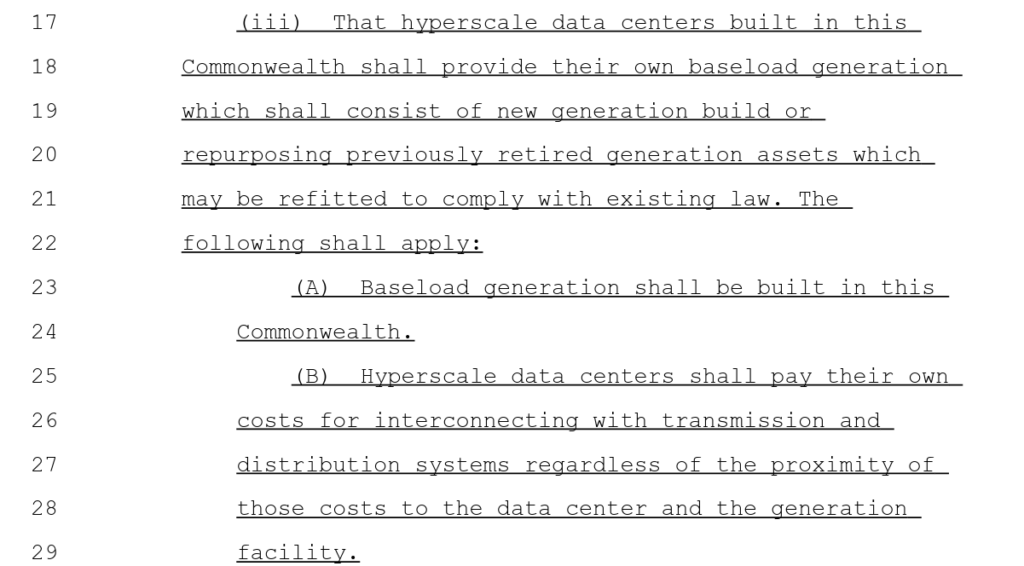
This is a very small bill, and these 13 👆🏻 lines do enormous damage. Those five words effectively rule out almost every realistic, near-term way to add electricity to the grid. What’s left is pretty much whatever benefits his corporate energy donors, regardless of the price or timeline.
Does his signature energy bill relate to your most important issues?
This seemingly small detail is a big problem. If you care about any of the issues below, then this bill affects a topic you care about. His bill hurts every one of these priorities.
| Issue | Williams’ bill | Better option |
| Energy affordability | Not all options count | Use all potential options available to bring down prices |
| Free-market solutions | Not all options count; Harrisburg chooses winners and losers | Use all potential options available, let the market decide |
| American energy dominance | Not all options count; data centers don’t invest in what doesn’t count | Invest in all potential energy sources |
| Individual energy independence | Not all options count; don’t invest in what doesn’t count | Invest in all potential energy sources so consumers have the most choices (particularly relates to solar, where individuals could generate their own energy) |
| Solar, wind, and battery energy | Excluded | Let all energy sources count; let the market decide (these are some of our fastest and least expensive solutions) |
| Energy diversification | Not all options count; data centers don’t invest in what doesn’t count | Maximize diversification, increase grid reliability |
| Integrity of elected officials | Not disclosing this material aspect of his bill in constituent messaging (despite talking about the bill for over a year) | Disclose and defend on its merits (or don’t include it in the bill) |
Note: “count” means it doesn’t count as a source of energy for data centers to meet his bill’s requirements, not that it’s illegal or prohibited generally
Williams knows the difference. He wrote the bill, yet he refuses to talk about it. Why do you think that might be?
“Nearly identical”? Not even close.
Williams wants you to believe the mold isn’t there. In a social media post and in the PA House Energy Committee, he has said his bill is nearly identical to the federal one the U.S. House just passed. On Instagram, he wrote, “The United States Congress passed this exact idea a week ago by a vote of 417-3 — almost unanimously! This is not controversial. It is awaiting action in the United States Senate.”
In his Sept. 18 newsletter, he went further: “Our local members of Congress all voted for a bill I have been preaching for a year.” And: “If this bill does not become federal law, it becomes even more essential for Pennsylvania to pass my bill.”
That claim is false. I read both bills, and they are far from identical.
The federal bill, H.R. 9340, passed the U.S. House 417–3 on Sept. 16. It’s also called the Ratepayer Protection Act. It says a utility’s rates for very large data centers (100 megawatts or more) should recover the full cost of any generation, transmission, or distribution upgrade needed to serve them. It directs state regulators to consider adopting that standard.
That’s it. It says nothing about what kind of energy data centers must use. It doesn’t require baseload power. It doesn’t require power built in any particular state. It doesn’t exclude a single solution for getting more electrons onto the grid.
| U.S. House bill (H.R. 9340) | Williams’ bill (PA HB 2372) | |
| Data centers pay their own way? | Yes | Yes |
| Restricts which energy sources count? | No | Yes: only “baseload” and “built in this Commonwealth” |
| Solar, wind, batteries count toward “pay-your-own-way” compliance? | No restriction | No |
| Efficiency, grid upgrades, demand response count toward “pay-your-own-way” compliance? | No restriction | No |
Calling them “nearly identical” is like a seller telling you his house is like the one next door, except for one small detail in the basement. All that black mold hiding under the fresh paint.
Before he spins the Senate vote
On Sept. 30, the U.S. Senate fell short of the 60 votes needed to move the federal bill forward. The vote was 57–43.
Expect Williams to say this proves Pennsylvania must pass his bill. He already set that up in his Sept. 18 newsletter.
He won’t mention, though, that Senators who voted no didn’t object to making data centers pay. Several said the federal bill was too weak, because it only asks states to consider the standard instead of requiring it. The Senate fight was over whether the bill had enough teeth, not which energy sources should count.
I agree Pennsylvania should require data centers to pay their own way. The PA House already passed a bill that does that. Williams voted against it. But Williams’ bill demands much more than he claims.
His bill is far from the only option
Williams keeps presenting his bill as the only option. It isn’t. A long list of solutions chip away at a more affordable energy future. Many are even listed on the U.S. Department of Energy website — yes, the website run by this “drill, baby, drill” administration.
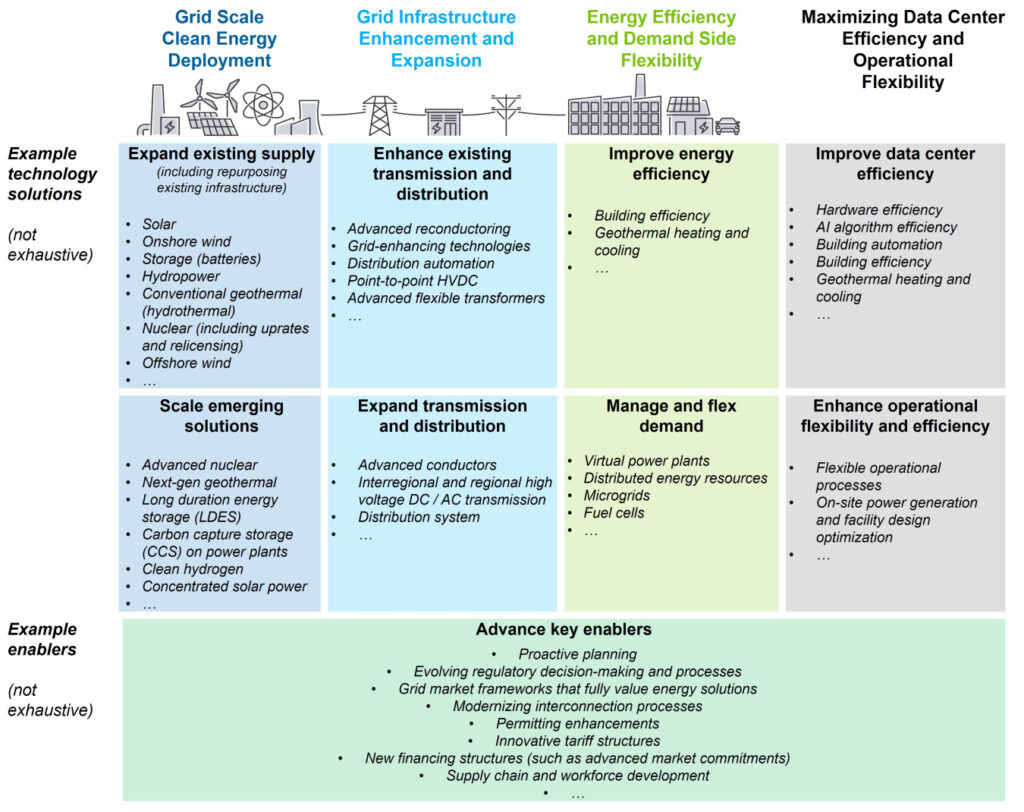
Another bill, PA House Bill 1834, included a similar pay-your-own-way requirement without the in-state baseload restriction. It already passed the PA House, and Williams voted against it.
I’ve written deeper dives on the details. Read them here and here, or listen here (Instagram).
Faster, cheaper solutions Williams’ bill excludes
At least four big categories of solutions wouldn’t count under Williams’ bill.
1. Solar, wind, and batteries
Data centers could build utility-scale wind or solar with batteries to meet part of their energy needs. Utility-scale solar is the cheapest source of new energy and the fastest to build.
Williams’ bill says these sources don’t count, even though they provide perfectly good electrons. We need all the electrons we can get. Why take them off the table?
Before someone says, “But the sun goes down” — I know. Batteries are real, and we need the most new power when the sun is shining. Solar isn’t THE solution. It should be PART of the solution.
🏠 For a deeper dive, check out THIS solution that helps meet growing electricity demand and puts money directly in your pocket. None of it would count under Williams’ bill.
2. Energy efficiency
Reducing demand frees up electricity just like building a new power plant does. When we’re short on energy, why wouldn’t using less be part of the answer?
3. Grid upgrades
This means investing in the wires and systems that move electricity and manage its flow so they work more efficiently. There are many ways to fix grid bottlenecks and unlock more electricity without building new power plants. Williams’ bill excludes all of this.
4. Demand response
This means contracting with customers to use less energy when demand is extremely high. Think of an airline offering a voucher when a flight is overbooked: you get a little bonus for being flexible.
In practice, it usually looks like contracts between PECO and big energy users (data centers, manufacturing plants, even ice rinks). PECO pays those customers to cut back when demand spikes.
IceWorks in Aston has a contract like this. During last winter’s deep cold spell, PECO paid IceWorks not to run its heat for a few days. I know because I was there, watching my boys play hockey with no heat in the middle of winter. 🥶
In some cases, this demand response is available to residential customers too. It’s an emerging technology, but will likely be a standard part of our energy paradigm in the future. Check out Virtual Power Plants if you’re curious.
“But data centers need power 24/7”
You might be thinking: data centers run around the clock, so why would solutions that don’t produce power around the clock make sense?
That’s the intuitive answer, and it’s what Williams tells us. But it’s badly oversimplified, and as a self-described energy expert, he knows it.
Bear with me for a second of wonkiness. 🙏🏻 Capacity prices, which Williams has correctly told us drive our electricity rates, are driven largely by demand spikes, or “peaks.” Those price-setting peaks happen for just a few hours each year. Yes. Hours.
All four solutions above help bring prices down and free up capacity from resources we already have. None of them is a fix on its own. All of them are low-hanging fruit. Williams’ bill says no to every single one.
✈️ The airport analogy
Williams’ answer to those peaks is to build brand-new natural gas plants first. That’s like building a new airport terminal to ease congestion on the Wednesday before Thanksgiving.
If traffic goes up for good, maybe we need a new terminal eventually. But you don’t skip the easy fixes that handle the busiest days. These options aren’t mutually exclusive.
Imagine you’re managing an airport and trying to reduce congestion. Williams’ bill does the equivalent of saying airlines can’t use any of the following solutions (i.e., they wouldn’t “count” towards compliance):
- Offer vouchers to switch flights
- Lower prices on slow days to spread out travel
- Invest in technology that gets planes in and out more efficiently
- Partner with bus and train companies to give travelers other options
The only option that counts: build a new terminal. Why would we take all of those tools out of the toolbox?
Good stories travel best from neighbor to neighbor.
If this story matters to you, pass it along. It’s the best way to keep community journalism growing in Chadds Ford. Email or text it to a friend. Share on socials. Spread the word.
You and I are not his top priority
Williams’ bill excludes a whole set of viable solutions, and not by accident. If he won’t put every option on the table and let the market choose whatever works fastest and cheapest, then customers and affordability aren’t his top priority.
His bill tips the scales toward Pennsylvania natural gas, even when it’s more expensive, slower to build, and adds more pollution to the air we breathe and the water we drink.
Maybe he has reasons for these exclusions. I strongly disagree with them. But a representative with integrity should be able to explain them plainly. That’s Representation 101.
🚩 After months of promoting this bill, he hasn’t mentioned the in-state baseload restriction once in his messaging to constituents. This is a glaring red flag.
Might I suggest he knows you won’t like it because the bill wasn’t written for you? It was built for the fossil fuel and energy companies that fill his campaign contribution list and give far more to his campaign than you do.
Let me say it again: He’s committed to taking the fastest, cheapest energy solutions off the table, leaving your energy bills higher to protect the fossil fuel and utility industries.
He. Is. Not. Working. For. Us.
Not even jobs for PA 160
Williams has said in House Energy Committee meetings that we need to focus on shale gas development in Western Pennsylvania. He might argue his in-state baseload requirement is about jobs.
Jobs for whom?
No one is building baseload power plants in our district. Whatever jobs or tax revenue he’d use to justify the restriction aren’t jobs or tax revenue for us.
You know what creates jobs here? Solar installation. TerraSol Energies, a reputable installer, is right here in Chadds Ford, and this and other local contractors install systems in our own neighborhoods. That’s local jobs.
And who benefits when the grid runs more efficiently, or when we invest in efficiency? You and I receive lower electric bills. Who benefits when we skip demand response and efficiency? Power producers and utilities collect higher fees from us.
He. Is. Not. Working. For. Us.
Maybe our little district is just a stop on his ambition train to higher places. He wants a bigger role? How about doing a great job at this job before moving up? Even at work, no one ought to get promoted without doing the previous job well.
Is it all just politics? Only when we tolerate it. Stop voting for the people whose behavior needs justification with “that’s just politics.”
You’re the buyer. Ask for the disclosure. Then vote.
If you bought a house and found out the seller knowingly painted over mold, would you feel betrayed? Might you choose a different agent next time?
You get to decide whether leaving out material information counts as a lie. It certainly doesn’t make me trust him to look out for our best interests.
And you get to decide, with your vote, whether you want a representative who puts every option on the table to bring energy prices down, or one who picks winners and losers in Harrisburg.
The election is just a few weeks away. I’ll never tell you how to vote, even if I tell you how I plan to vote. It’s your vote to use as you choose. But I’ll remind you a gazillion times to use your vote.
Even if you don’t want to “do politics,” politics is doing you — your energy bills, gas prices, health care, groceries, road safety, and land development.
Register. Make a plan. Cast your ballot. Not sure how? Ask a friend, a parent, a neighbor. Heck, email me. We can do this together.
Maybe you see what’s behind those walls differently. Tell me why. We’re allowed to disagree.
But register by October 19, and cast your ballot by November 3. You’ve got this.