Want lower PECO bills? We need to understand grid utilization.

Energy is the hot topic du jour, so how about we dabble in electrons through the lens of life in Chadds Ford. Enjoy this pop-up series, Energy in Chadds Ford, exploring conversations about energy in our neck of the woods.
When I’m not drooling over pie baking or pontificating about the best places to get local produce, I’m probably nerding out about energy. ⚡ Energy and energy affordability are key issues going into the upcoming election, locally and nationally. It’s been THE topic of discussion in our local State House Rep. Craig Williams’ recent newsletters and social media feeds for good reason.
But there’s a big topic (well… several, but one we’re going to cover today) within the energy affordability conversation he hasn’t covered, and you need to understand the basics to make an informed decision this fall. Let’s discuss grid utilization and its impact on our PECO bills.
I know. I know. Most of you don’t want to nerd out about this stuff with me. But in the words of Sharon McMahon, “we need to know stuff to do stuff.” Better grid utilization could significantly decrease your electricity bill, so it’s worth spending a bit of time to save a bunch of money. Let’s learn some stuff, so we can do some stuff to make things better.
We’ve got this! 💪🏻
Quick highlights on grid utilization
- Better grid utilization (using more of the electricity grid more efficiently) could save us money on PECO bills.
- Pro-fossil-fuel advocates and politicians rarely discuss grid utilization (it’s not a narrative that supports fossil-fuel growth).
- Many grid utilization actions are faster and more affordable than building new generation to reduce power prices.
- A basic understanding of grid utilization helps us make sense of and debunk some of the propaganda, misleading, or incomplete information from politicians about energy affordability.
Now let’s dig into why. 🤓
What is the electricity grid?
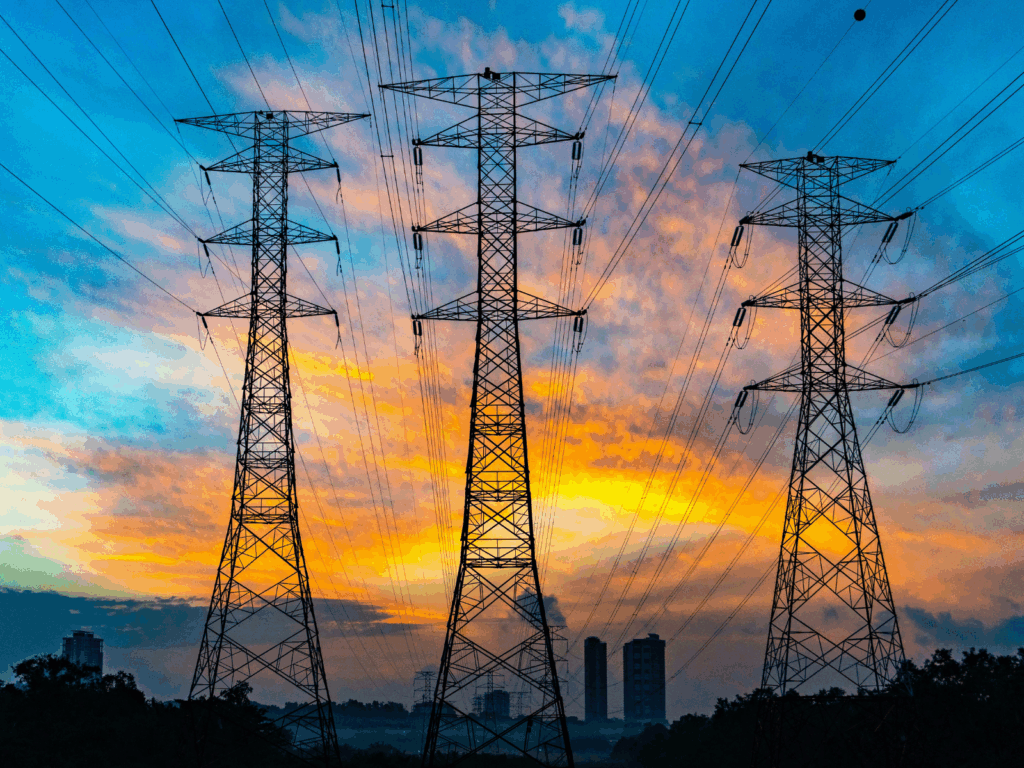
“The grid” is the interconnected system of power plants, transmission lines, and distribution lines that generates electricity and delivers it to your outlet — everything between a power plant and your light switch. There are two parts: generation and delivery.
- Generation includes a variety of ways to create electricity: everything from large, centralized, industrial plants belching coal emissions and burning gas to nuclear power plants splitting the nuclei of uranium atoms to small, decentralized rooftop solar systems that turn sunlight into loads of electrons. All of these generate electricity to power our lives.
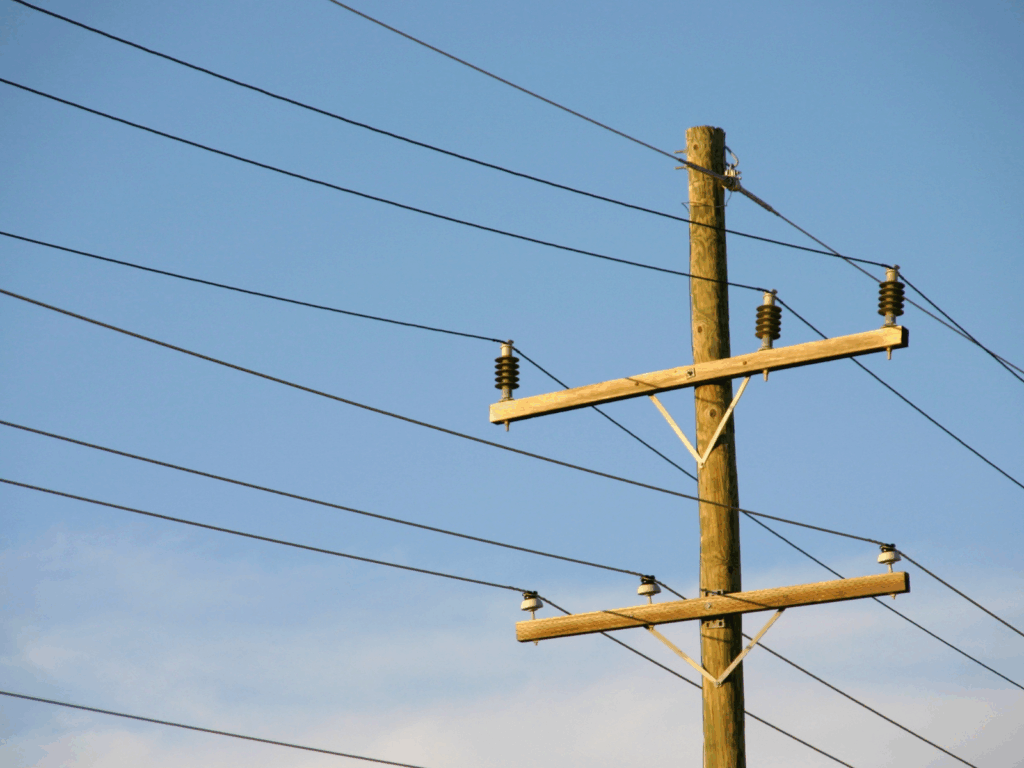
- Delivery infrastructure includes the transmission lines that move power long distances and the local distribution lines (poles and wires) that bring electricity to where we use it.
Both generation and delivery infrastructure must be built to handle the peak-demand moments of the year (like the heat wave we’ve experienced this past week). Together, they compromise “the grid.”
What is grid utilization?
Grid utilization describes how much of the grid is being used at a particular time (or over a certain period). The grid is built to meet all electricity needs, even when demand is very high. Often, the grid is not being fully utilized (in fact, it’s very rarely being fully utilized).
For many good reasons, we build power systems that can reliably handle the highest demand the system might see in a year, plus a cushion for the unexpected (this is known as the peak demand). That means power plants, transmission lines, and substations are sized for a handful of the most extreme hours annually, even though the system spends the vast majority of its time operating well below that capacity.
That’s not a flaw in planning; it’s the tradeoff for preventing blackouts and brownouts even during a rare worst-case hour. But it means a lot of very expensive infrastructure sits idle a lot of the time, and all of us pay to build it and keep it standing by, ready for the moments we need it.
📍These “peaks” of energy demand are one big driver of the recent increases in our PECO bills. Keep this in mind for later.
What drives grid utilization patterns?
Our collective electricity usage is pretty predictable, especially when combined with data like weather forecasts. Picture a typical summer weekday. Overnight, while most of us sleep, electricity demand is low — homes are dark, businesses are closed, air conditioners are cycling gently if at all.
As people wake up, demand climbs. It increases throughout the afternoon as air conditioners work harder to cope with the rising heat. Demand usually peaks in the early evening, when workday cooling loads overlap with people arriving home, cooking dinner, and running appliances. Then it falls again overnight. It looks something like this:
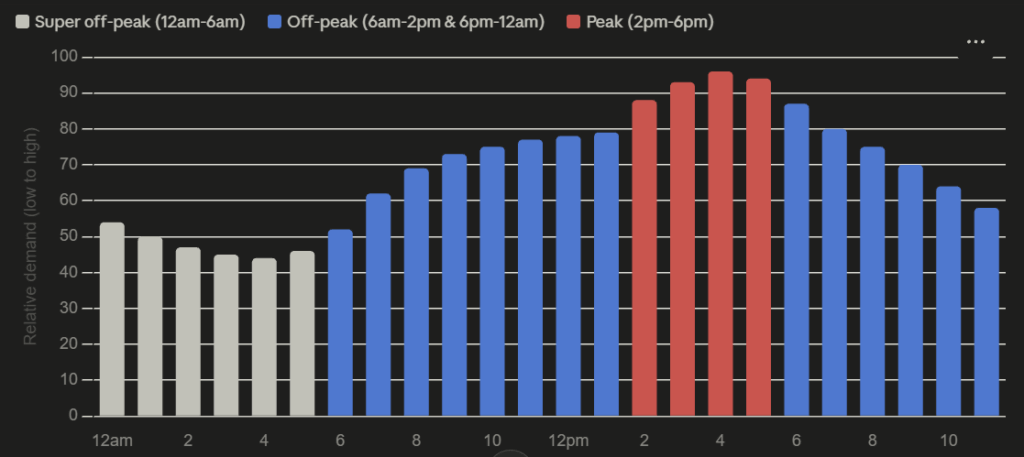
For PECO, the time-of-use categories suggest that “peak” grid utilization happens between 2 and 6 p.m. on weekdays. That’s when they’ve decided electricity should be most expensive, presumably based on supply and demand.
Zoom out to a full year, and patterns emerge at a larger scale. The dog days of summer, driven by air conditioning, tend to produce the highest demand of the year in most of the country. Winter can bring its own peaks in heating demand when temperatures plummet. But for huge stretches of the calendar — mild spring and fall days, weekends, overnight hours in every season — demand sits well below those peak levels. It looks generally like this:
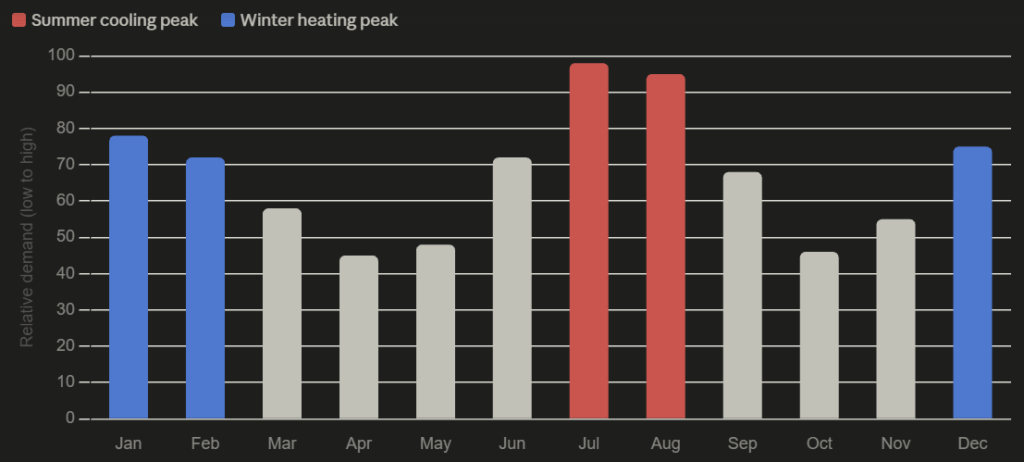
The grocery store analogy
For more tangible context, think about the grocery store. Sunday afternoons and the days before holidays feel hectic and crowded. An average Tuesday morning, though, is almost guaranteed to be calm, cool, and collected. You’ll likely find more employees than customers wandering the aisles.
Now picture all the checkout registers at Wegmans. The company built far more registers than they typically use, and the registers remain whether in use or not. They need to be maintained no matter how much they’re used.
Wegmans opens more registers when it’s busy and fewer when business slows. Very rarely do they open those registers way down at the end. Have you ever seen them open?!
Electricity use experiences similarly predictable ebbs and flows, yet the grid infrastructure (like the registers) must be suitable for the “busy times,” even if most days feel like a casual Tuesday morning at the grocery store, with most registers closed.
How often is the grid unused?
A recent report by Brattle, a global consulting group, found that the grid is used, on average, 43% of the time. In other words, well over half of the system’s built capacity goes unused at any given moment during the year. This research wasn’t specifically about Pennsylvania, but it more or less applies. It’s directionally accurate even if the number isn’t exactly 43% for us.
Why grid utilization matters for your PECO bill
More efficient grid utilization connects directly to affordability. The cost of building and maintaining transmission and distribution lines sized for peak demand (those hot as heck summer days 🥵) gets recovered from all of us, spread across our electric bills. When we can shift demand away from the peak or add new demand during the hours when the system has room to spare, we get more value out of infrastructure we’ve already paid to build — instead of paying to build more of it (and power lines are really friggin’ expensive!). 💰💰💰
In this context, growing electricity demand — driven by data centers, electrification, and manufacturing — is not necessarily a crisis that requires us to build our way out solely with new plants and wires. It can be an opportunity to share costs among more customers if increased demand is steered toward the hours and places where the grid already has unused capacity.
That same Brattle report stated that better grid utilization could save U.S. customers $110-$170 billion over the next ten years. You can read the summary or the full report yourself. But generally, increased grid utilization can reduce expensive “peaks” and spread the total cost of grid infrastructure across more customers. PECO gets more total revenue because electricity demand is higher, but it gets less money per customer (i.e., our bills go down) because we aren’t all trying to use electricity at the same time.
Remember our grocery store analogy? No one would complain if more people shopped on Tuesday morning (with more open registers), or if a bunch of Sunday shoppers chose to shop on Tuesday mornings instead, especially if these changes meant everyone paid a little less for their groceries because Wegmans spread its store costs over more customers. That’s good for everyone.
The “peaks” drive electricity pricing
It’s also important to know that the peaks on the charts above, when we’re using the most electricity at once, drive up prices a lot! Even though the grid doesn’t reach peak capacity very often, the peaks have an outsized influence on the cost we pay for electricity.
It’s complicated and beyond the scope of this piece, but just know that lowering and flattening the peaks is one way to meaningfully lower electricity prices. This consideration informs decisions about how to reduce prices without just building new ‘baseload’ generation.
Why not more discussion on grid utilization?
If better utilization can meaningfully lower bills, you’d expect it to be front and center in every conversation about rising electricity costs. It mostly isn’t (though some politicians are starting to talk about it).
Instead, the dominant political response to rising demand — especially from officials who lean heavily on support from the fossil fuel industry — is a call for more “baseload” generation. “Baseload” generation includes “always on” or “always available” energy sources. Historically, “baseload” has meant power plants like nuclear, coal, or natural gas types of plants.1
I presume the lack of discussion around grid utilization from our politicians is a function of (at least) two factors: simplicity and campaign influence from the fossil fuel industry.
Grid utilization and its impacts on electricity bills are hard to convey in campaign messaging and short slogans, especially to those less familiar with the complexities of the energy industry. But we’re here doing this “let’s dive in” thing right now to try to mitigate that. Because to make informed decisions, we have to know stuff. 🧠 We can do this; I believe in us. ☀️
Rep. Craig Williams regularly skips over grid-utilization solutions and jumps straight to building new “baseload” natural gas plants as the predominant and only reliable way to keep the lights on and prices down. At a House Energy Committee meeting on June 17, 2026 (starts around minute 9:00), he said about a bill related to adding batteries to the grid:
“We’re in a crisis right now. The only thing we can do is encourage the development of new, actual generation of electricity that exists in the marketplace right now, and we keep offering bills like this to nibble at the perimeter of, I guess, what, green ideas, and socialize those costs back on the shoulders of our ratepayers?
This is not what we need to be doing. We need to be encouraging gigawatts, gigawatts, worth of new generation, predominantly in western Pennsylvania, taking advantage of Marcellus Shale. And we are the number one electricity exporter in the country, and we could double down on that right now and overnight, immediately reduce our ratepayer bills, and instead we’re doing this.”
So much wrapped up in this, but a few things:
- Nothing. Nothing. Nothing will reduce our PECO bills “overnight, immediately.” Rate cases, pricing auctions, hedges, and other inputs that set prices for at least the next couple of years have already happened. Those prices are locked in. He’s a former PECO lawyer. He knows this very well. 😡
- It’s clear he thinks there’s one solution: build more power with natural gas. Nothing about better grid utilization. I counter this; we can pursue multiple solutions at once.
- P.S. Increasingly, utility-scale solar plus battery storage is actually less expensive than the gas plants Williams is pushing. They’re also much faster to build (by many years!) due to both engineering considerations and growing supply chain delays for gas turbines. While there are many, many variables, ignoring (and even fighting against) the opportunities of widespread solar power and battery storage is increasingly likely to make our power more expensive, not less.
- If you’re feeling particularly motivated, listen to the disdain in his tone for “green ideas” in the video. If he ever tried to pretend he’s an “all of the above” guy, let his tone confirm otherwise. He and clean energy are apparently … not friends. 💔
- P.P.S. U.S. clean power (solar, wind, and batteries) delivered 90% of all new capacity (over 50 gigawatts) added to the grid in 2025. Battery storage grew 41% year-over-year, adding 4 GW of new capacity in 2025. Batteries are babies compared to old-fogey fossil fuels, but they’re very real. Babies grow; old fogies not so much. The days of clean energy being expensive, pie-in-the-sky, altruistic favors to Mother Nature are behind us. The economic and qualitative benefits of clean energy continue to improve every year.
As for adding more fracking and pollution plants to our energy mix, new gas plants take several years to come online. Some enhanced grid utilization options can be implemented within a few months to a couple of years. If he’s so concerned about energy emergencies and bringing prices down now, why does he seem hyper-focused on a single solution? Shouldn’t we be tapping into all the tools in the campaign donor purse toolbox?
Hint: His campaign finance reports definitely offer some clues. 💰
Squeezing more value out of existing infrastructure by making better use of underutilized capacity is quieter, cheaper, and faster than building gigantic new power plants. Unfortunately, it doesn’t have a large lobbying team in Harrisburg, nor does it come with a photo-op ribbon-cutting ceremony (and Craig’s always up for a quick pic sesh). 📸
Good stories travel best from neighbor to neighbor.
If this story matters to you, pass it along. It’s the best way to keep community journalism growing in Chadds Ford. Email or text it to a friend. Share on socials. Spread the word.
What does better grid realization actually look like?
Remember this chart, which generally shows when the grid is more or less “busy” during the day? And recall that the “peak” drives a lot of the pricing.
🏭 Those peaks also drive higher pollution, but let’s set that aside for today. Just know the peaks are a big problem for our wallets and our lungs.
We can shift energy generation and demand away from peak periods to other times of day. How? I’m so glad you asked! Here are just a few ideas to get us brainstorming.
Time-of-use electricity rates: charge lower rates to use electricity when the grid is less busy to incentivize more timely use.
This already exists. You can toggle this option on in your PECO account. We use it. Run your dryer and dishwasher, charge your EV, and cool or heat your home outside 2-6 pm, when the grid is most congested and at its peak.
Most days, your home will be comfortable if you turn down the AC for a few hours from 2- 6 pm, if it’s already nice and cool at 1:59 pm. No one is forced to change behavior, and those who choose this option reduce the peak (and thereby prices) for everyone.
Batteries – add utility-scale batteries to the grid.
Charge the batteries overnight when the grid isn’t busy and run them during the peak periods. They spread infrastructure costs across more electricity generation and reduce peak-period generation demand.
Allow data centers to use batteries to count toward their Bring Your Own Generation mandates, so data centers pay for the batteries and ratepayers don’t have to. Batteries also increase reliability overall on the grid. They’re great for grids all around.
Craig Williams has publicly opposed batteries because he thinks they’d cost ratepayers (or, in his words, socialize the costs of “green ideas” 🙄). With proper cost allocation and rate design, that doesn’t have to be the case.
Encourage rooftop and community solar investments
Those who are interested and can afford it invest in building their own mini power plants on their roofs and in their open spaces. Because hot weather comes from the sun (i.e., heat waves and high solar energy production generally coincide), rooftop solar reduces electricity demand among solar system owners and generates excess energy during the afternoon peak, precisely when we need to reduce demand and increase generation. How sensible! 🤯
Distributed energy reduces the wear and tear on transmission infrastructure and reduces the need for new transmission lines. Local solar users draw less electricity from large power plants and also share excess electricity locally. Paired with batteries, this is particularly effective. ✨
These are just a few ideas to “flatten” the electricity demand curve and increase demand during the “unbusy” periods, which helps share those expensive grid costs over more customers.
We need all the tools in the toolbox
I don’t have a definitive answer to solving our rising energy demand and pricing dilemmas. (No one does, especially not a state legislator married to one type of fuel as the panacea to rising prices.) It’s complicated. The full suite of solutions requires expertise from energy companies, utilities, consumer advocacy groups, PJM, the public utility commission, and other industry experts.
Anyone who’s genuinely serious about energy affordability and caring for customers is seeking solutions that increase grid utilization. It’s one of the faster and, in many cases, most efficient ways to create more electricity at the most affordable price. If they aren’t serious about it, they aren’t serious about customers being the top priority. 👀
And don’t hear what I’m not saying. I haven’t ruled out new fossil fuel plants as a necessary piece of the solution to our skyrocketing energy demands. But I know with certainty it’s not the only option, and it’s certainly not the lowest-hanging fruit on the energy affordability tree. 🌳
📍 We’ll talk more soon about several ways to increase grid utilization that are faster than building new natural gas plants and don’t require PECO bill increases to pay for them. The Brattle report includes 10 categories of tools to improve grid utilization, so there are lots of options! 🎉
The takeaway
Don’t be fooled by someone who tells you there’s just one single answer. Our energy markets are way too complex for such an explanation. Furthermore, there are way too many ways to generate electrons for one method to be the answer for all.
I implore you to get curious about our electricity grid and all the puzzle pieces we can snap together to electrify everything in a way that benefits all of us. Massive paradigm-shifting advancements in energy technology, especially clean energy, over the last handful of years have unlocked opportunities we once thought were impossible. This is no longer Grandpa’s electricity grid.
The grid isn’t a single, constantly maxed-out system. It’s a system built for its worst moments, sitting comfortably underused most of the rest of the time. Understanding that distinction ensures you know better the next time someone tells you the only way to lower electricity prices is to build more power plants. That’s most definitely not the only option. Better utilization is a real, well-documented lever for lowering bills, and it deserves as much, if not more, attention and investment as the next gas plant proposal.
The more of us who understand that better grid utilization is a real opportunity for more power at lower prices, the better equipped we are to ask why some of our elected officials keep reaching for the more expensive, slower, more polluting answer — and to ask who benefits when they do.
What did I miss? Let’s discuss!
Did I get something wrong? Got more questions? Leave a comment so we can discuss and learn from each other.
Source: Kate Peters, Ryan Hledik, and Long Lam, “The Untapped Grid: How Better Utilization of the Power System Can Improve Energy Affordability,” The Brattle Group, prepared for GridLab and the Utilize Coalition, March 2026.
- Some argue that solar and wind with batteries are making a run at this distinction as renewable and storage technologies get cheaper and more reliable, and as batteries become “available.” In the context of today’s discussion, our local politicians use “baseload” to refer to fossil-fuel or nuclear power plants. ↩︎