Let’s uplift the Magical Electrification Trifecta

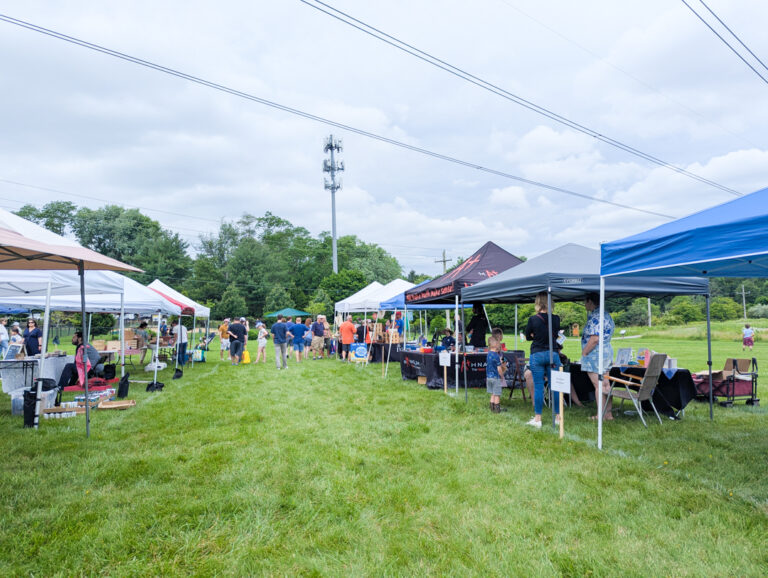
Thank you to everyone who came to the Electrify Everything at Home Open House. We had a great turnout with a steady stream of visitors asking all sorts of fantastic questions. If we had had many more attendees, people might not have been able to get all of the information they needed.

⚡ Not sure what I’m talking about?
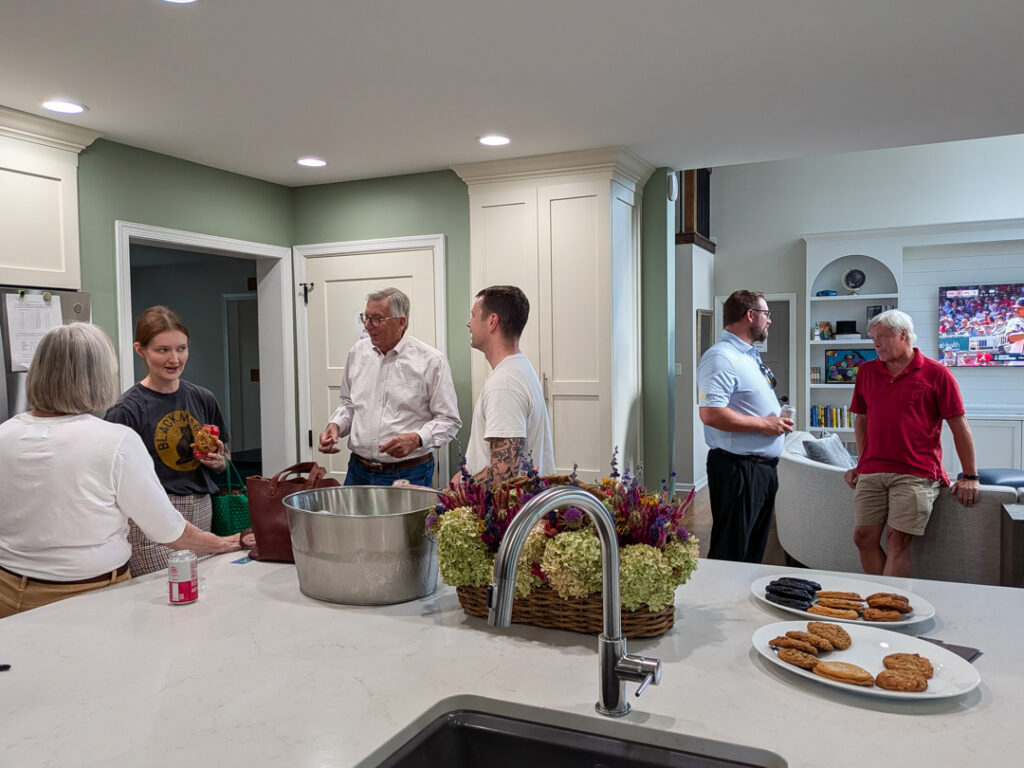
A couple of weeks ago, I hosted an Open House (you can see a little video here) for neighbors to stop by and learn more about rooftop solar, EVs, heat pumps, induction stoves, time-of-use energy rates, and more. I know. I know. I’ve been telling you about it for a few weeks, and Chadds Friends, it was amazing! If you’re thinking about hosting an event to hang with your neighbors, DO IT! You won’t regret it (even if your pajamas are looking really comfy).
I was really nervous there wouldn’t be enough people. But it was just the right size because everyone came with a ton of questions, and we had time to answer them all. Some left with plans for their next clean energy home investment. Others were happy to meet TerraSol Energies, a local, reputable rooftop solar installer. We all loved finding like-minded neighbors looking to move forward into a clean energy future.
I got SO many questions about what I call the Magical Electrification Trifecta: rooftop solar + EV + time-of-use energy rates. I’ll totally nerd out about it if you ask me in person, and I indulged below. 🤓
🕰️ Couldn’t make it?
If you couldn’t make it but wanted to come, let me know. I don’t know that I’ll host another event that’s so publicized. But if enough people are interested, I can definitely bring the crew back together for an encore. So far, a handful of people have been interested in a follow-up.
🌍 Your neighbors care about climate change; band together to take action
A huge majority of Americans know climate change is real and are especially concerned when they’re asked about its local impacts. Yet several of our local elected officials don’t believe in climate change (or pretend not to believe to appease their fossil fuel buddies 🙄). We’ve got local electeds putting wrenches in everything from community solar programs to Bird Town (because the organization that sponsors it believes climate change is contributing to bird loss). We can’t make this stuff up. It is SO PATHETIC. 🐦
We can move forward despite these albatross elected officials. We can’t override all of their dumb decisions, but we definitely have agency to make progress until they see the electrified light. 💡There’s power in neighbors!
The Magical Electrification Trifecta ☀️ + 🚗 + 🕰️
One question came up again and again about how time-of-use energy works with EVs and rooftop solar. I call this the Magical Electrification Trifecta. This is where the money-saving magic really starts to compound, and it doesn’t take much work. Once you set the systems in place, they do the work for you. Let me explain.
☀️ Having rooftop solar is fantastic. 🚗 Driving an EV is a great experience and also saves us thousands of dollars per year compared to buying gasoline. 🕰️ Choosing time-of-use energy rates from PECO, a quick toggle to turn on in your PECO account, supercharges the savings. But when you layer them, sh*t gets real.
🕰️ Time-of-use what?
Time-of-use energy (TOU) rates are different rates a utility customer pays for electricity generation depending on the time of day and day of the week. The separate time buckets incentivize customers to use energy when the electricity grid has excess capacity and reduce usage when capacity is low. It’s a classic supply-and-demand price-matching strategy.
For PECO, there are three TOU buckets:
- Peak: 2 – 6 pm, Monday through Friday (except holidays)
- Off-peak: 6 am – 2 pm and 6 pm – midnight, Monday through Friday, 6 am – midnight on all holidays and weekends [I call this the “everything else” bucket after clarifying the other two.]
- Super off-peak: midnight to 6 am, seven days a week
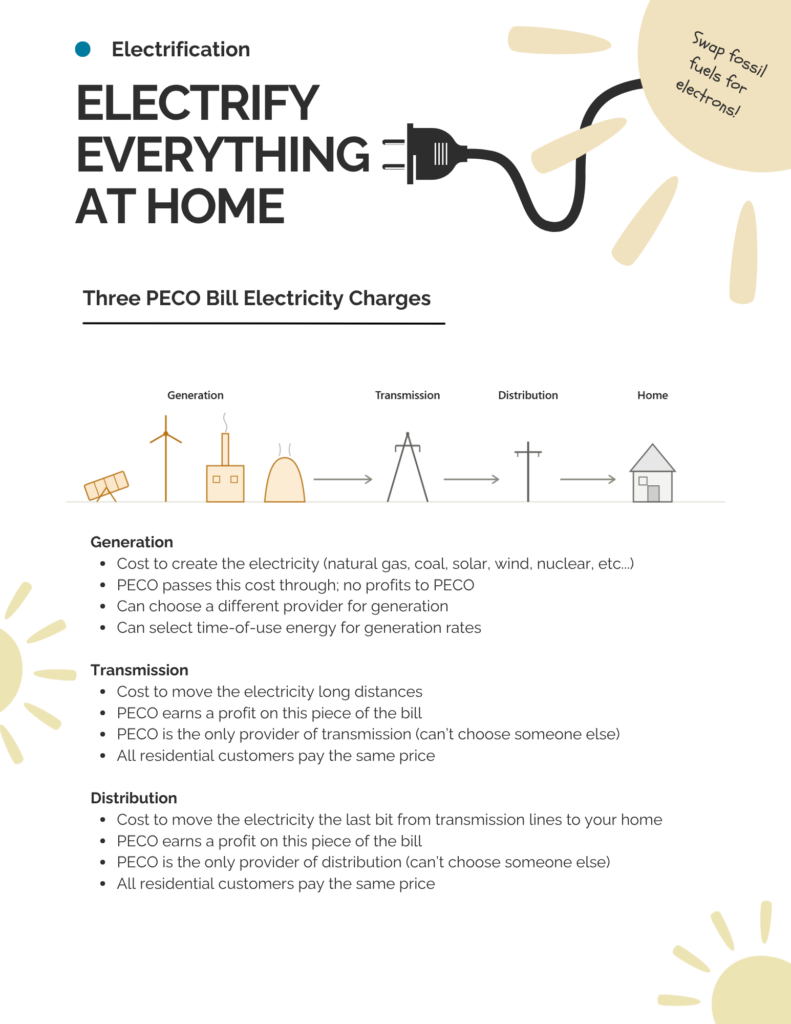
Quick note: Our PECO bills consist of three main elements: charges for generation (making the electricity) and charges for transmission + distribution (moving the electricity). Time-of-use energy rates only apply to the generation portion of the charge. All customers pay the same transmission and distribution rates, whether they have TOU rates or not.
🚗 Charging EVs at lower electricity rates
For most families who drive electric vehicles and charge at home, choosing time-of-use energy rates makes a lot of dollars and cents. Electric vehicles generally allow you to set a schedule for active charging. You can plug the charger into the wall, but the vehicle won’t start drawing electricity until the scheduled time.
We plug our car in before bed, but set the schedule to charge only from midnight to 6:00 a.m., during the super off-peak window when electricity rates are lowest. Even though the car is plugged into the charging outlet, the car doesn’t use electricity until the scheduled charging window starts. And it stops at 6:00 a.m., even if we aren’t there to unplug it.
While charging at home at regular rates is significantly less expensive than buying gas, charging during super off-peak hours brings the cost down even more, supercharging our savings.
☀️ Producing energy from solar panels at higher electricity rates
At the other end of the spectrum, rooftop solar interacts with time-of-use energy to supercharge our savings, too.
To understand this interplay, we need a little Net Metering 101. Net metering is the pricing program PECO uses to credit customers with solar systems for the energy they send back to the grid. When my solar system generates power, my home uses it first. Then any excess power goes back to the grid.
I get a one-unit credit for every unit of energy I export to the electricity grid. So if I produce 10 extra units of energy, those will net against 10 units of energy I pulled from the grid at a different time. If I don’t use all my credits in one month, they bank for the next month, and so on.
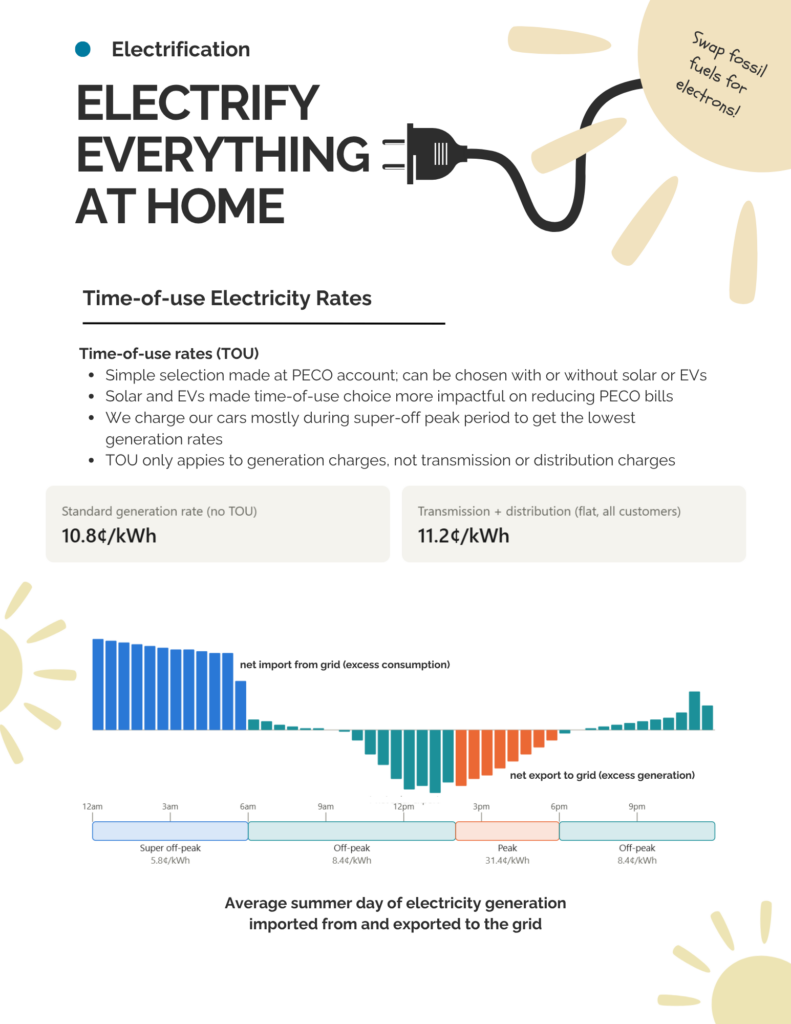
The most important part of net metering for us is that the credits are bucketed within their respective time-of-use energy groups. In other words, when my rooftop solar generates power during the peak window, I get peak credits that don’t offset off-peak or super off-peak charges.
The sun is strongest during the middle of the day, so most of my solar credits fall into the off-peak (late morning, midday) and peak (late afternoon, early evening) periods. We build up a lot of energy credits (especially peak-period credits) during spring, summer, and fall, when the sun is strongest. During the winter, when production is lower because the sun sits lower in the sky, we use up some of those credits for peak energy usage. But here’s the key. Our banked peak energy credit balance never drops below zero.
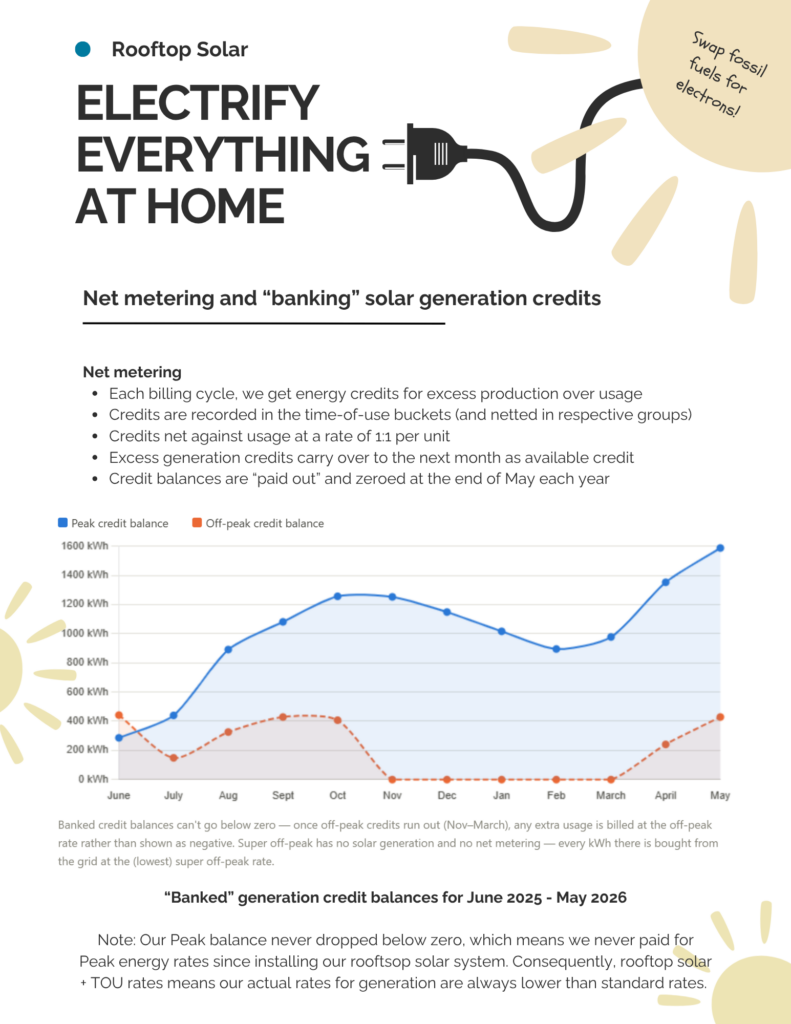
Rooftop solar protects against the risk of excess peak usage under a time-of-use pricing scheme
With time-of-use energy rates, peak rates are about three times standard rates. Without rooftop solar, you might offset any financial benefits by using too much energy during peak hours from 2:00 to 6:00 p.m., Monday through Friday. With solar, however, we bank peak credits. Thus, we’re never charged peak energy rates. We only incur net energy consumption from the electricity grid during off-peak and super off-peak hours, and our billable rates are always lower than the standard rate.
It’s a little confusing to explain, but hopefully the charts above help highlight how electricity generation, consumption, and time-of-use incentives overlay to supercharge our savings while also being a good steward of the electricity grid (i.e using energy when it’s readily available and producing excess energy to add to the grid when demand is high and other people need electricity).
Is it hard to change your lifestyle to use less energy during peak periods?
We get a lot of questions about how much active lifestyle management it takes to get these benefits. It’s not much.
- We try not to use much energy during peak periods, so we rarely run our dryer or dishwasher from 2-6 pm on weekdays.
- We still use heat and air conditioning seasonally and let the heat pump manage the temperature through its efficiency-driven software.
- We set the schedule on our car so it only charges from midnight to 6:00 a.m., and then it’s a “set it and forget it” habit.
As for production from the panels during peak periods, the rising and falling sun does the heavy lifting, building an accumulated credit balance that covers excess wintertime peak electricity usage.
The Magical Electrification Trifecta doesn’t show up overnight. It takes some time to invest in these lifestyle changes.
- Selecting time-of-use energy is an easy toggle in your PECO account, but it takes a few weeks to process through PECO’s administrative system. While it’s an easy change to make, be sure it makes sense for your lifestyle if you’re choosing it before you have an EV or rooftop solar. We only selected it after we got an EV.
- Buying or leasing an EV makes sense when you’re ready to replace your car. The EV market is growing, and the used EV market is hot right now, creating a pool of relatively affordable EVs.
- Rooftop solar is certainly the largest investment. Some people say leasing is the only option right now. The leasing-versus-buying discussion is far too complicated for the context of this article. But the companies saying leasing is the obvious option right now are, as you would guess, the companies that lease rooftop solar to homeowners. Buying your own rooftop solar system offers a significantly greater return on investment, but it’s a very large financial commitment that unfortunately isn’t available to everyone right now.
If rooftop solar isn’t in the cards for you right now, check out plug-in solar panels. They’re not available in Pennsylvania yet, but you can buy them in New Jersey, Virginia, and at least nine other states. They’re a great way to start producing a little bit of your own energy for a very reasonable investment.
The energy of the future
Electricity, especially renewable electricity, is the energy of the future. The rest of the world is already on board. One day, future generations will look back and wonder why we burned fossil fuels to power the world for so long when the sun gives us so much clean, free power.
No one can capture and sell you the sun’s free fuel. Once you invest in the machine to “catch” it (i.e., solar panels), that energy arrives every day for free. Unlike fossil fuel machines (oil-powered heaters, natural gas-powered stoves, gasoline-fueled cars, etc.), once you pay for the “solar ray-catching machine,” there’s no variable cost to keep it running. Fuel is free, courtesy of the sun.
Burdensome regulations make solar power more expensive
Did you know the sun provides 10,000 times the power each day compared to what we currently use on this planet? We won’t be running out of rays from the sun anytime soon, even if AI wants to gobble up all the new electrons.
Right now, solar power can be really expensive (especially in the United States). But regulatory changes offer many opportunities to make it more accessible.
- Reducing permitting barriers (at state, local government, and HOA levels) can save thousands on a single rooftop solar installation because of the extra time and effort needed to navigate these hurdles. (We need permitting reform federally too, but that’s a separate topic for another day.)
- Legalizing plug-in solar in all 50 states makes a marginal investment in solar available to millions of Americans, even those who don’t own their property or have a roof of their own. Germany has more than 1 million plug-in solar panels. Every little bit adds up and gives us agency in this energy shortage.
- Passing regulation to allow community solar (not currently allowed in PA) can help make solar energy available to more communities, especially those who don’t own their homes.
If we can remove overly burdensome regulations, solar costs will drop precipitously. In Australia, rooftop solar systems cost 1/3 to 1/5 the price of those in the US, largely because of soft costs like permitting.

Many people don’t yet know enough about home electrification
We can also help educate neighbors about solar and uplift reputable installers. It’s incredibly overwhelming to know what to ask, how to invest, and how to feel confident the installer is legit. The rest of the globe is leaving us in its solar dust. If you can be the messenger, spread the word. Maybe host an open house with neighbors! 😉
Around the world, EV adoption is exploding. The United States is buried under fossil fuel propaganda, making EVs an ideological issue. This is silly! Why do we have cultural fights over motors versus combustion engines?! Does mainstream America really have an emotional connection to what type of mechanical engineering moves their car from point A to point B?
Just test-drive cars with an open mind. Pick the vehicle that matches your preferences and lifestyle and leaves the most money in your wallet. EVs are great to drive, climate drama aside. And with gas prices lately????
💖 I officially give you permission to drive an EV or get rooftop solar, even if you hate the planet or think climate change is a hoax. 🫶🏻 Someone, somewhere, gave me that official permission-giving authority. Probably Elon when I had a giant crush on Tesla back in 2012. 🤣 Your wallet will thank you!
In all seriousness, if you’re curious, ask away! No dumb questions.
I’ll do my best to answer them, and others with solar, who drive EVs, or who use TOU energy can chime in too! Let’s debunk the propaganda, eliminate unnecessary regulation, talk about how all this works with neighbors, and create a financial and cultural market where we simply buy what serves us best, eyes wide open.
I have a funny feeling many more of us will be adopting this Magical Electrification Trifecta when we spread the word about how easy and lucrative it can be.
P.S. The Magical Electrification Trifecta is lucrative because it makes market sense and takes advantage of classic supply-and-demand incentives, not because I’m profiting on someone else’s dime. Don’t let the fossil fuel industry and its mouthpieces convince you that this trifecta is exploitative to “everyone else.” That’s just not true. I wonder why they’d want us to think that… 🙄
![Hey Ladies! Get Strong[HER] at Align Fitness](https://connectchaddsford.com/wp-content/uploads/2025/12/Align-Fitness-Chadds-Ford-768x578.jpg)