Craig Williams puts fossil fuels before energy affordability

Energy is the hot topic du jour, so how about we dabble in electrons through the lens of life in Chadds Ford. Enjoy this pop-up series, Energy in Chadds Ford, exploring conversations about energy in our neck of the woods.
How’s your PECO bill these days? Kinda high? Pennsylvania House Rep. Craig Williams, who represents our district (PA-160), has proposed a bill he says will reduce energy prices “immediately” and protect electricity customers from the massive costs associated with new data centers. But when we dig into the details of the bill, it’s first and foremost a fossil fuel industry protection bill, not a customer protection bill.
Quick Summary
Williams calls his recently proposed legislation the Pennsylvania Ratepayers Protection Act. Despite his claims, a few choice words in the proposed legislation would pigeonhole Pennsylvania into limited options to power new energy-hungry neighbors and could offer fracked gas and coal plants a handsome windfall at our expense.
Williams touts his proposed bill as a Bring Your Own Generation (BYOG) bill, which calls for data centers in Pennsylvania to pay for the cost of the new energy and infrastructure they need instead of leaving that expense for ratepayers (i.e., utility customers). That description is woefully incomplete.
In practice, the bill’s language effectively requires that those data centers use only fossil fuels from plants built in Pennsylvania.
Consequently, the bill:
- Contributes more pollution to our local air, water, and land than necessary.
- Protects the fossil fuel industry at the expense of customers.
- Eliminates opportunities to use innovative measures to solve our energy crisis as quickly and efficiently as possible.
- Picks winners and losers from Harrisburg instead of letting the free market find the best solutions.
- Reduces opportunities for communities to extract concessions in exchange for welcoming data centers to their neighborhoods.
Just across the Delaware River, the New Jersey state legislature passed its own Bring Your Own Generation bill that gives new generation “credit” to data centers for a much wider variety of existing and innovative solutions that (relative to Williams’ proposal) reduce costs faster, include clean energy options, and take advantage of exciting new, free market-driven opportunities showing up all across the energy space.
Let’s dive into the details to better understand who really stands to benefit from Craig’s proposed Pennsylvania power up.
Formerly an “all of the above” energy guy
Once upon a time, Craig Williams claimed to be an “all of the above” energy guy. “All of the above” means supporting generation of all types of energy in pursuit of whatever makes the most sense for the community where the energy is needed. This could be driven by price, geography, pollution, local climate, etc.
This “all of the above” messaging has been a cover for the fossil fuel industry for years because clean energy used to be much more expensive than its fossil-burning counterparts. It’s been an easy way to say “We’re not the bad guys. We just want whatever is the cheapest and best option. And golly gee, that’s us!” 😇
Over the last couple of years, however, as clean energy technology rapidly advanced, some types of renewable energy gained price parity with (and sometimes became less expensive than) most new fossil fuel power generation. “All of the above” no longer implicitly benefited fossil fuels, so many fossil fuel stans have dropped the label.
Williams’ new proposed legislation heavily favors fossil fuels
Craig’s new legislation is called the Pennsylvania Ratepayers Protection Act (as noted above). He argues it helps bring down utility rates “immediately.”
This is very misleading. There’s no bringing down electricity rates “immediately.” Requiring data centers to bring their own generation might change how PJM (our electricity grid operator) determines pricing. But prices are set through auctions years in advance. For all intents and purposes, there’s no changing electricity rates “immediately” from the perspective of me, you, everyday Pennsylvanians, and the PECO bill that draws funds from our bank accounts.
As for his legislation, let’s break it down.
Williams’ proposal is House Bill 2372. The objectives include:
- Requiring data centers to pay for any costs required to connect to the grid (transmission and distribution lines, for example)
- Requiring data centers to Bring Your Own Generation
- Compelling electricity providers to enter into long-term purchase agreements for power (to compete against hyperscalers doing the same)
Those goals sound innocent enough, but when we get into the nitty-gritty, there’s a lot more to this bill than he’s advertising. We’re ignoring parts 1 and 3 for today. It’s too much for one article. But suffice it to say that they don’t negate the argument I’m about to make.
Here’s an excerpt from his proposed bill related to part 2, the Bring Your Own Generation (BYOG) section:
“(iii) That hyperscale data centers built in this Commonwealth shall provide their own baseload generation which shall consist of new generation build or repurposing previously retired generation assets which may be refitted to comply with existing law. The following shall apply:
(A) Baseload generation shall be built in this Commonwealth.”
🚨 Two things to notice: “baseload generation” and “built in this Commonwealth” mean that he’s taken a lot of potential solutions off the table. Why?
He says data centers use power all day, so the new power has to match that use. That flawed logic immediately breaks down when we understand the real problems and possible solutions. Even our current U.S. Department of Energy acknowledges this. (More on this below.)
“Baseload” generation is not a specific term defined legally, by PJM (our electricity grid operator), or by the PA Public Utility Commission. Instead, “baseload” is a widely understood engineering term for steady, round-the-clock generation, which by extension means gas, coal, nuclear, geothermal, and sometimes hydro power plants.
While some clean energy advocates might argue that renewables have the possibility to become base load generation when paired with batteries, we aren’t there yet, and especially not in Pennsylvania.
On fracked gas and coal
Most of us are familiar with these options. They’re prevalent in Pennsylvania and dirty, polluting sources of energy. Coal is also more expensive than many other options. Craig noted in legislative committee meetings that fracked gas is his preferred source of energy for data centers. But new fracked gas plants take 5-10 years1 to come online.
We need more energy now. Data centers are not waiting 5-10 years to come online. There are way too many missed opportunities for copyright infringement, nude deep fakes, and misinterpreted dreams between now and then to just sit around and twiddle thumb drives. I joke… sort of… but AI is also trying to cure cancer, replace human drivers, and carry our industrial military complex on its shoulders while building a new civilization on Mars. That kind of agenda won’t wait for gas turbines to come off the manufacturing line in 2030.
On nuclear power
Nuclear plants are prohibitively expensive to build in the United States and take a decade or more at best. In reality, there is no path for large-scale data centers to bring their own generation via nuclear power in Pennsylvania in the foreseeable future other than by restarting Three Mile Island, a project already underway between Constellation Energy and Microsoft.
On hydropower
Hydropower has high upfront costs, long permitting processes, and very specific geographic constraints. It’s also not necessarily “baseload” depending on how you run it. This is a limited option for new power in Pennsylvania for data centers right now.
On geothermal power
Utility-scale geothermal electricity generation does not yet exist commercially in Pennsylvania. In this chart (shown below) from the United States Energy Information Administration, geothermal energy doesn’t even register as a net electricity generation source in the state, and that’s only among renewables.
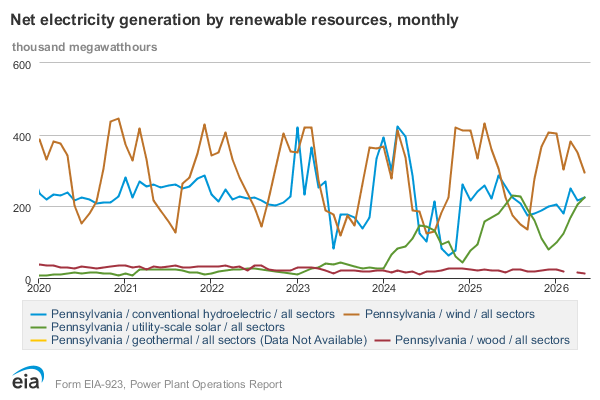
Notably, Williams is a co-sponsor of a proposed bill (House Bill 2076) that seeks to open up more geothermal opportunities in Pennsylvania. The bill is designed to allow “abandoned oil and gas wells to be repurposed into geothermal wells,” called enhanced geothermal systems. One of his co-sponsors, Elizabeth Fiedler, is the Chair of the House Energy Committee and a leading legislative advocate for clean energy in our state.
This technology is so early-stage that in April 2026, the “Pennsylvania Department of Environmental Protection (DEP) received a $14 million federal grant from the U.S. Department of Energy (DOE) to pilot an enhanced geothermal system (EGS) demonstration project.” Geothermal energy in PA is still in the pilot/demonstration stage. We’re nowhere near commercialization.
Williams deserves credit for supporting clean energy in this bill, but notice who benefits. This bill is good for the fossil fuel industry.
Repurposing abandoned oil and gas wells for geothermal energy directly benefits the fossil fuel industry by converting multi-million dollar liabilities into revenue-generating assets. Instead of paying to safely plug and abandon depleted wells, the new technology could turn the old, costly wells into revenue-generating geothermal generation and offer a seamless transition for their existing workforce.
It would be great if this technology comes to fruition. I’m glad it has bipartisan support, and that Williams favors it. But co-sponsorship of this bill doesn’t make him an “all of the above” energy guy or a clean energy guy; it just reinforces that he picks and chooses what he supports so long as it aligns with his fossil fuel friends.
With respect to the Bring Your Own Generation element of his proposed bill, large-scale geothermal energy using old wells may be promising for the future, but it’s not yet ready for mass commercialization. The PA DEP grant makes it clear the technology is still in its infancy, and that is confirmed in Canary Media:
““Oil and gas well conversion presents an enormous opportunity, … but it’s pretty far away technologically from being a reality,” said Emily Pope, a geologist and senior fellow at the Center for Climate and Energy Solutions who authored a recent study on next-generation geothermal power.”
It’s worthwhile to support an up-and-coming clean energy option should it ever become scalable, but for now, it’s not viable enough to be relevant for immediate generation needs. If data centers aren’t waiting around for technologically proven gas turbines to come off the manufacturing line, they surely aren’t waiting to find out if repurposed oil and gas wells might someday create sustainable power.
📢 Williams advertises his proposed bill as a call for new generation paid for by data centers without communicating important caveats. By qualifying which types of energy “count” toward Bring Your Own Generation mandates, the proposed legislation effectively requires that those data centers use only fossil fuel generation from plants built in Pennsylvania. It takes off the table all other innovative and market-driven solutions, regardless of cost or benefits to the community and constituents. ‼️
Good stories travel best from neighbor to neighbor.
If this story matters to you, pass it along. It’s the best way to keep community journalism growing in Chadds Ford. Email or text it to a friend. Share on socials. Spread the word.
The bill ignores the quickest and fastest energy solutions
I previously wrote dissertations on Williams’ lack of engagement with grid utilization and his disdain for “green ideas” like utility-scale batteries and rooftop solar, tools already being deployed at scale with success all around the United States and the world.
- In California, batteries provided 8.5% of peak energy needs in 2025.
- In oily Texas, solar, wind, and batteries represented 37% of total generation in 2025 and more than 70% of new generation waiting to come online in the state. Texas’ energy market is more “free market” than any other place in the country. Renewables are beating fossil fuels so badly in Texas, a state flush with oil and gas, that fossil-fuel-friendly state legislators are contemplating creating fossil fuel minimum quotas because fossil fuels can’t outcompete renewables in a free market.
- Even Exelon, which owns PECO, is asking to put large batteries on the electricity grid in the Atlantic City area because they increase reliability and dampen peaks.
Grid utilization enhancements, demand response, batteries, and renewable energy resources offer real, affordable ways to generate more power with less pollution and bring our PECO bills down. There are also a host of other solutions that don’t require building new generation that could alleviate some of the stress on our grid and electricity prices. Many of the cleaner, more affordable options are also WAY faster to build than new fracked gas plants. But Williams’ new bill doesn’t allow any of this to “count” toward BYOG mandates.
New Jersey chooses innovation and free market-driven BYOG legislation
Williams’ bill is incredibly limiting, as there are so many other creative and innovative ways to make more electricity available that are faster, cleaner, and cheaper than new fracked gas or coal plants.
For comparison, let’s look at the recent Bring Your Own Generation bill passed in New Jersey. It’s actually a BYONCE (pronounced like Beyoncé) bill and stands for Bring Your Own New Clean Energy.
Assembly Bill No 796 in New Jersey defines new capacity as any:
“energy resource, including generation, energy storage, demand response, demand reduction, energy efficiency, or any combination thereof.”
The New Jersey bill goes on to define principles that protect ratepayers but leaves open a variety of options to meet increased demand from data centers. It also defers a bunch of authority to the public utility board, which arguably has more expertise and flexibility to adhere to principles in response to rapidly shifting market conditions and technological advancements than the rigid language in Williams’ BYOG bill.
💡 Note: I know most people don’t follow the innovation happening in the clean energy space right now, but it’s incredible. New ideas are rolling off R&D desks and into commercialization every day. Soon enough, we won’t even recognize the energy space as we know it today.
🪙 The New Jersey bill creates more space for innovation and the free market to dictate which solutions are best for the grid and ratepayers. It does not restrict any types of energy generation but says the Board of Public Utilities should “incentivize large data center customers to bring their own new clean generation or energy storage to meet their energy needs.” It also recognizes that more energy supply can come online through a variety of ways, like efficiency, demand response, and batteries (not just building new power plants).
Possible solutions and excluded opportunities
I’m sure an energy expert could add to these lists. But here’s a quick comparison of the major categories of energy generation and tools Williams’ bill allows and excludes as eligible solutions:
Allowed:
- Fracked gas
- Coal
- Nuclear (not currently available)
- Hydropower (limited and unlikely)
- Geothermal (not currently viable)
Not allowed:
- Solar power
- Wind power
- Batteries/storage
- Demand response
- Energy efficiency upgrades
- Grid enhancements
Recently, the U.S. Department of Energy updated this list of clean energy resources to meet data center demand (chart below). It’s called “Examples of Tools to Address Growing Electricity Demand from Data Centers.” Essentially, every option on this chart wouldn’t “count” or isn’t realistic under Williams’ legislation, and this is where so much of the innovation is happening!
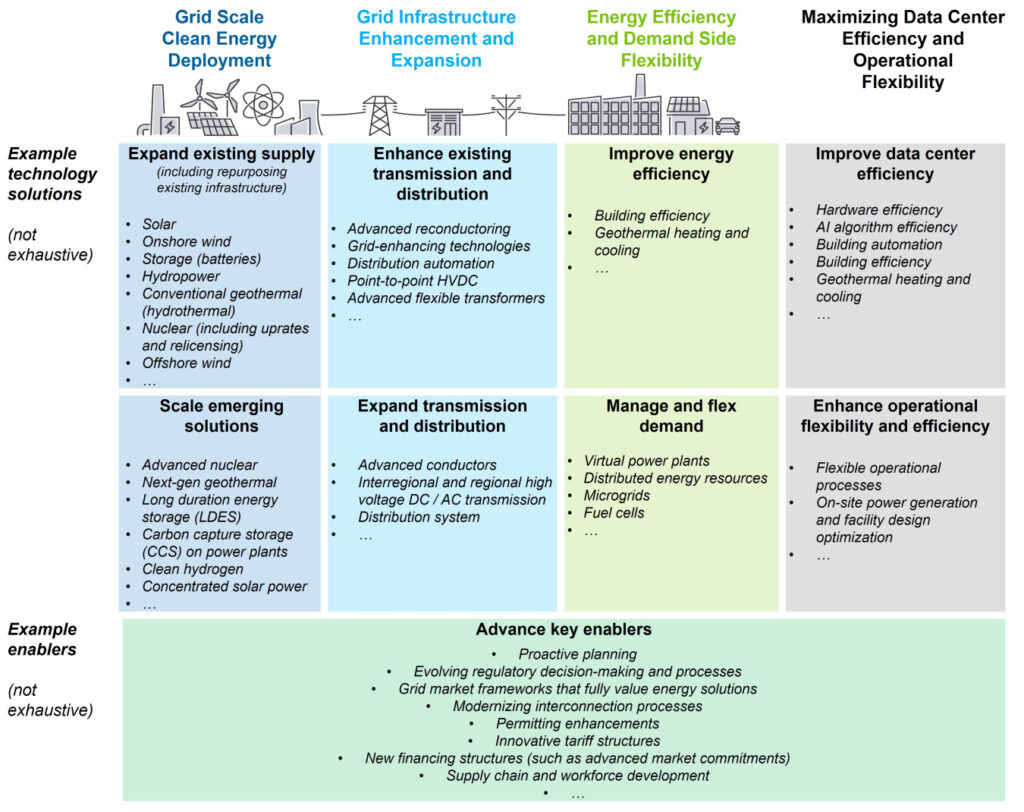
⚡ None of these alone are silver bullets. But each solution provides its own unique benefits to make our electricity grid better and produce more power. Almost every disallowed option is faster to implement, makes our grid more resilient, and is better for humanity than the baseload options allowed in Williams’ bill. Why in the world would we take all of these tools off the table?!
Williams’ bill doesn’t match the most pressing problem
A few weeks ago, I wrote that stupidly long piece on grid utilization because it’s so important to understand the concept at a high level to anticipate the implications of Williams’ legislation. “Baseload” generation means Williams only wants to allow data centers to count power generation that runs (or can run) all the time.
But the most immediate fix we need is to address the “peaks,” those high points during the day when everyone wants to use power all at once. Williams’ bill does little to directly address this. His solution is not the best fit for the most pressing problem, and it’s woefully incomplete.
The New Jersey legislation, however, gives data centers “credit” for whatever new generation they make available, regardless of its source. The bill’s flexibility allows electricity supply to better align with demand and solutions to respond to market conditions more quickly and effectively.
The opposite of free market capitalism
In his May 15, 2026, newsletter, Williams said, “More energy production means cheaper prices; it really is that simple.” If that’s still the case just three months later… Why be such a stickler in the bill about where that new energy production comes from? Why not let innovation flourish, and markets decide?
Personally, I like that New Jersey incentivizes clean energy production over dirty fossil fuels. There are lots of external costs from burning fossil fuels that are ignored in a data center’s pure cost-driven market analysis.
Climate-induced disasters continue to get worse. Fossil fuels are incredibly polluting and harm our health. Clean energy prices continue to fall rapidly, so I really don’t want to be locked into long-term fossil fuel energy contracts or paying for stranded fossil fuel infrastructure as clean energy grows and becomes more affordable.
But even if you’re a capitalist purist, why not let innovation and the free market choose the best options, especially when the energy landscape is shifting and advancing so rapidly? In other parts of the country, and especially around the world, the market is choosing clean energy time and again.
Renewables are winning because they make sense, and Williams’ legislation would take these clean-technology opportunities off the table. Why?
I already wrote my public love letter to solar power. And battery technology is getting better every day. Even our renewable energy-hating federal government is still heavily investing in battery research and development. The future of energy includes batteries, batteries, and more batteries. They’re far from some whimsical “green idea” floating through the heads of “greenie” scientists.
Oh, but the mining and recycling and … Yep. I know. A huge part of the battery R&D is focused on resolving those issues, and there are already many solutions being tested and scaled. This flywheel battery technology is so cool and not at all what you think of as traditional batteries!
Aren’t batteries really expensive? It depends. Some are right now. Technology advancement (especially in China, but also in the US) continues to bring prices down rapidly. And over the 30 or 40 (ish) year life of the new fracked gas plants that Williams’ legislation would ignite, battery prices will almost certainly plummet.
Also, so what if data centers pay a bit more
Here’s another angle to consider. Data centers have deep pockets, and care about speed to power more than anything. If they’re going to come into communities, disrupt energy and water supplies, make lots of noise, and be a nuisance, make them pay a bit more for cleaner energy and/or other community benefits where they’re showing up.
In some places, this might be a requirement to prioritize clean new generation. It might be funding rooftop solar and energy efficiency investments for local homeowners to get “credit” for new generation (like this proposal from Rewiring America). It might be investing in electric buses, rooftop solar for schools, a new water treatment plant, a community center, electricity price subsidies, or a variety of other benefits that make the tradeoff more worthwhile for the existing residents.
The hyperscalers using all this new power have billions of dollars to invest. Make them pay for investments that are good for the community, not just the cheapest possible option that leaves everyone else in their Big Data dust.
Hyperscalers have shown that they’re willing to make “concessions” to get power fast. Exploit that! Get creative! What can they do for their new neighbors?
We need a lot more energy!
Data centers, increased domestic manufacturing, and electrification of our society in general will demand immense amounts of new energy generation in the coming years and decades. Building that power is hard. Solutions are complex. The energy market and the utility space are super complicated. I’m not suggesting there’s one simple answer.
Quite the contrary, in fact. We need lots of solutions, and we certainly don’t want data centers locked into getting power only from new baseload generation built in Pennsylvania. The legislation Williams is offering Pennsylvania is lackluster at best, heavily favors fossil fuels, is hostile toward renewable energy, and excludes many creative, free market solutions. We can do so much better than playing favorites from Harrisburg. We only have to look across the Delaware River to the New Jersey legislation for ideas.
Be mad at everyone else?
We can only assume that Williams knows exactly what he’s doing. How could he not?! He’s an energy industry insider. He used to be an attorney for PECO. He’ll be the first to tell you he’s on all sorts of energy committees and commissions. He’s deep in the game.
While he’s trying to slide legislation across the table that puts his thumb on the scale for polluting fracked gas and even dirtier coal, he’s telling us to be mad at:
- data centers
- PECO
- our neighbors with rooftop solar
- PJM
- neighboring states who are taking all of our power
- Democrats
- the list goes on…
And he’s supposedly the energy hero who’s going to swoop in and save us. Give me a break.
Unleash good energy + innovation
If we need more energy production (we do!), and “More energy production means cheaper prices. It’s really that simple,” then unleash it. Open the floodgates. Let the market decide. Support energy innovation of all kinds. Don’t pick and choose the winners from Harrisburg.
Demand solutions that are good for actual humans, not just corporate profits. Get creative about how to take advantage of the deepest pockets that ever roamed this Earth, looking to build more energy generation than we ever thought we’d need in a way that makes humanity better off in the long run.
Don’t pit neighbors against each other to make us believe we’re each other’s problems. Be collaborative. Give us real, robust solutions with broad support. And be honest and forthcoming about what you’re proposing.
- New fracked gas plants don’t have to take 5-10 years to build. But right now, permitting can be slow, and there are some significant supply chain backlogs that cause construction delays. Penn State’s Institute for Energy and Environment says that “Many advanced turbines are effectively sold out years in advance, with manufacturing slots booked into the late 2020s,” levels not seen in decades, according to Utility Dive, all while utility-scale solar prices continue to fall. ↩︎