Why my rooftop solar is good for you, too 🌞

Energy is the hot topic du jour, so how about we dabble in electrons through the lens of life in Chadds Ford. Enjoy this pop-up series, Energy in Chadds Ford, exploring conversations about energy in our neck of the woods.
I’ve got a “secret” that I want to shout from the rooftop. 😉 We have a rooftop solar system, and my solar panels might help save you money. Did you know that?

If you’ve spent any time in energy conversations lately, you’ve probably heard some version of the argument that rooftop solar is a luxury for people who can afford it. Meanwhile, everyone else gets stuck covering the grid costs we (rooftop solar owners) leave behind; this is called a cost shift. In short, the story goes that my rooftop solar jacks up your PECO bills. House Rep. Craig Williams is shouting it loud and clear.
It sounds intuitive, but it’s wildly incomplete and misleading. It’s also the story fossil fuel interests would very much like you to believe. The actual math tells a much more nuanced story. I would expect Williams, a former PECO attorney, to better understand and represent these nuances. But… campaign dollars from the fossil fuel industry speak volumes, I guess?
I have solar panels on my roof, but this isn’t an article about me. It’s about why distributed solar — solar panels on your neighbor’s roof, the community solar array down the road, the panels on the new business park, and agrivoltaics (combining solar generation and active farming, creating another revenue stream for strained farming budgets) — makes the grid better, more resilient, and maybe even cheaper for everyone connected to it, whether or not they ever install a single panel themselves.
Quick summary: why rooftop solar is good for all of us
- Some studies show rooftop solar may shift certain distribution costs to non-solar customers (the data is inconclusive on correlation versus causation)
- A more holistic view of costs and benefits shows that the overall benefits provided by rooftop solar to the grid and thereby all customers outweigh the cost shifts from rooftop solar owners to non-solar customers. In other words, my rooftop solar is good for you and your wallet!
- In our ultra-capitalist society, and even in an altruistic society, compensating rooftop solar owners for their private investment that benefits the entire community isn’t such a bad thing, and certainly not as reprehensible as Craig Williams suggests.
Now, let’s take a deeper dive into the data and the details to understand why this is the case.
I know what you’re thinking. Seriously, Jen? This many words? I put the cliff notes in bold. You’re welcome. 🫶🏻
The “Cost-Shift” Argument
General cost-shift argument
The core claim behind the cost-shift narrative is that solar owners still use the grid (for backup, nighttime power, and to send power back to the grid) but don’t pay their fair share for the grid infrastructure. The argument suggests that rooftop solar owners don’t pay their “fair share” of grid costs to maintain transmission and distribution infrastructure because:
- They use less electricity from the grid.
- Their electricity production offsets their consumption (under a mechanism called “net metering”) at an unfair rate.
Consequently, those grid costs get shifted onto everyone else.
Craig Williams’ cost-shift argument is misleading, at best
As far as I can tell, Williams recognizes these two components separately. I haven’t seen him criticize rooftop solar as unfair simply because it generates its own power and rooftop solar owners use less grid electricity. After all, why should those who use less energy be punished for their efficiency and frugality? Should we charge people more when they turn off their lights or lower their AC because they’re using less electricity? Of course not!
He is, however, very unhappy with the second element, which dictates how much financial value rooftop solar owners receive for the electricity they send back to the grid. I’m not going to get into the rate design mechanics because they are complicated. I’m already nerding out way too much in this piece.
But let’s leave it at this: I agree with Williams that a small piece of the rooftop solar crediting method (“net metering”) shifts a portion of transmission and distribution costs incurred by rooftop solar owners to non-solar customers, as he explains.
However, cost shifts are occurring throughout the shared system. He’s picking the one that shifts costs from rooftop solar to non-solar customers and saying, “Look here! Look here! Unfair! Bad solar!” Meanwhile, he’s ignoring all the other costs that shift the overall cost in the other direction and benefit everyone (at the expense of rooftop solar customers).
I believe that’s called… Cherry picking! 🍒 Cherry picking! Unfair! Bad messaging!
His argument, and the cost-shift myth generally, ignore how rooftop solar affects when and how the grid experiences demand, as well as other qualitative impacts that enhance everyone’s quality of life. These “macro” factors have significant positive impacts on grid utilization, long-term investments in transmission and distribution lines, peak period energy rates, pollution, and more.
Williams claims he wants “prolific solar” but…
His desire to change the rate design for net metering (the generation-and-consumption-offset mumbo jumbo I mentioned above) would make rooftop solar less affordable for everyday Pennsylvanians.
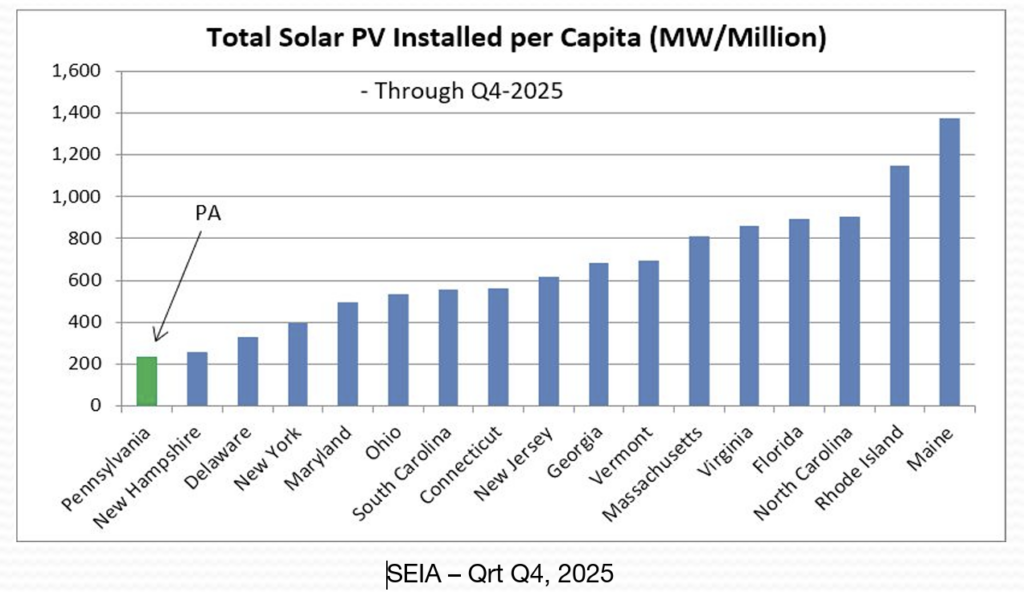
We’re already dead last among East Coast states in solar capacity installed per capita; we don’t need any more headwinds.1 We’re losing to states where a majority of their politicians think (or pretend to think?) climate change is a hoax. Sigh… 🙄 What are we doing, friends?!
Moreover, Williams wants to block other solar legislation until this “problem” is “fixed.” While he says he wants prolific solar, he’s acting like a pretty big hurdle to its proliferation. womp womp
It’s a fairly well-established fact that residential rooftop solar ultimately saves money for panel owners over the life of the panels. We anticipate our solar system will pay for itself in about 7-8 years and last about 25 years. That’s not atypical for other rooftop solar owners. But what about all my neighbors who don’t have solar?
There are so many variables that it’s not surprising that different ways of slicing and dicing the data arrive at different answers. Instead of cherry-picking for political points, let’s dive in and discuss the bigger picture.
How rooftop solar is good for everyone
⚡ Peak demand is a significant cost driver, and solar flattens it.
Electricity is most expensive to generate and deliver during peak-demand hours, typically the hottest afternoons and early evenings when air conditioners are running at full capacity. Utilities have to build and maintain enough infrastructure to handle peak periods, even though they occur only a fraction of the year. I wrote at length about this in my piece on grid utilization. Go nerd out on that if you’re curious.
Solar generation is strongest during those high-demand daylight hours. By adding supply when demand is highest, distributed solar flattens the peak. A flatter (or lower) peak means less need for the most expensive “peaker” power plants, which run only a few hours a year but set sky-high prices in wholesale capacity markets.
In other words, when rooftop solar generation collectively lowers that midafternoon peak, the electricity prices for that peak usage go down for everyone. There are complex auctions and analyses that drive this, but lower peaks mean lower prices for all.
P.S. When we combine rooftop solar with the utility-scale batteries Williams disdainfully calls “green ideas” (while they’re generating gigawatts of capacity in other parts of the country 🙄), this benefit gets even stronger. More on that another day.
⚡ Solar power is used locally, which spares the grid.
When a home’s solar panels send excess power back to the grid, it typically gets used by the house next door or down the street, rather than being shipped hundreds of miles over long-distance transmission lines. That means less wear and tear on the expensive transmission infrastructure, whose cost is covered by ratepayers. Distributed generation, like rooftop solar systems, reduces the need for new poles, wires, and substations. It doesn’t eliminate it, but every bit of avoided infrastructure spending reduces our PECO bills.
⚡ New generation without new build-out costs.
Every new rooftop or community solar installation adds generating capacity to the grid without requiring a utility to build a new transmission line or substation to connect it. Compare that to a new natural gas plant, which typically requires significant new transmission infrastructure — often paid for by all ratepayers over decades.
Bring Your Own Generation and related policy proposals require data centers to pay for their own transmission investments, so some new transmission might not be paid for collectively under new legislation. Some of these costs, however, are pretty squishy and tough to assign to a specific customer.
However, we’re also experiencing significant increases in society’s overall electrification. These shifts will require additional investments in transmission and distribution, spread across all ratepayers. Distributed energy generation can reduce the need for new infrastructure, thereby saving all ratepayers money.
⚡ Diversification of the energy mix increases reliability
Different types of energy generation across more locations create greater reliability for the grid overall. If a storm knocks out generation in a specific area or hampers a certain type of generation, other sources can fill the gaps.
Adding renewable energy to the grid also reduces reliance on an increasingly unpredictable global fossil fuel market subject to the erratic behavior of those who control the fossil fuel supply chains.
⚡ Distributed generation (like solar) better aligns growth with new demand
According to The Untapped Grid report (March 2026) from Brattle, a global consulting firm specializing in economics and finance, “Distributed Energy Resources (DERs) can be scaled to match load growth more effectively than larger resources, managing the risk of overbuild and stranded assets.”
That’s a lot of industry jargon, but here’s the gist. We have a significant need for new power generation due to data centers, widespread electrification, and growing manufacturing. It’s hard to predict where and when we will need the new generation. Distributed generation (i.e., smaller systems spread out and built over time) allows a more measured approach to building generation capacity, ensuring demand matches supply. Solar systems are also much faster to build (provided they aren’t burdened by excessive permitting and regulation). We need more power now, and solar is one of the fastest ways to get new energy online.
⚡ Solar adoption is pulling better tools onto the grid for everyone.
As utilities deploy more solar and storage, they’ve also normalized providing customers with better visibility into their usage — real-time data showing exactly when electricity is cheapest and most expensive. That data lets any household shift laundry, EV charging, or other flexible usage away from peak hours. More sophisticated thermostats can also use more grid data to make the heating and cooling system far more efficient and less expensive to run.
Time-of-use pricing structures, which reward customers financially for using less power during peak periods, work the same way: the more people respond to price signals, the flatter the demand peak gets, and the cheaper power becomes for the whole grid.
Rooftop solar cost shifts to non-solar customers
While several studies support the net benefits rooftop solar provides to the grid and non-solar customers when viewed holistically, some research suggests certain costs shift from solar to non-solar customers. Let’s take a deeper look to understand why costs shift and by how much, according to the science.
Heads up: we’re about to get really nerdy. Welcome to my wheelhouse. 🤓
📉 Lower utility usage from rooftop solar customers
A November 2025 working paper from the University of Maryland found that rooftop solar adoption led customers to purchase less electricity, thereby reducing the utility’s overall revenue by a small percentage. Makes sense, right? You make your own power and get less from PECO.
Because grid costs are shared based on usage, lower usage means less sharing of those costs, and they get allocated to everyone else. The same logic applies to people who turn off their lights or lower their AC to conserve energy and reduce their electricity bills.
It makes sense that using less electricity should mean sharing a smaller portion of grid costs, right? That seems fair.
The Institute for Local Self-Reliance, an organization that advocates for rooftop solar, counters that the study’s timeframe was too short to draw a meaningful conclusion about the fairness of cost allocation. It argues that the study overvalues short-term supply-and-demand impacts without considering the long-term benefits of distributed generation for large-scale grid management. That refers to the hundred-million-dollar-plus grid infrastructure build-outs (mentioned above) that distributed energy generation, such as rooftop solar, can defer or prevent.
🏭 More technical burden on distribution systems (correlation vs. causation?)
A recent MIT study suggests rooftop solar might increase costs for non-solar customers and examines which costs are shifting.
First, the report finds a correlation (not necessarily causation) between rooftop solar adoption and higher prices, and it includes considerable nuance. It’s important to keep in mind that just because two things move in tandem doesn’t mean one causes the other. In fact, higher rates might be the cause of more rooftop solar adoption (and not the other way around).
That would make sense, right? It’s reasonable to believe that more people invest in rooftop solar when their electricity bills go up. The higher your electricity bill, the faster you recover the costs of the rooftop solar investment, and the more it makes sense to get it.
Specifically, the paper says about this relationship:
“reverse causality remains plausible. Higher retail prices can encourage rooftop-solar adoption, as households seek to offset utility bills, or motivate policymakers to accelerate renewable deployment. If price increases partially cause renewable growth rather than the reverse, our estimates may overstate the causal impact of rooftop solar on rates.”
To the extent costs are shifting, the study concludes that the shift is primarily in operational and maintenance costs for distribution lines. Our distribution systems are old. Because rooftop solar systems force bidirectional power flows (drawing power from the grid and sending it back to the system), there may be more complexity than in dealing solely with a one-way power supply.
The study specifically says:
“Rooftop solar, by contrast, has a more nuanced relationship with capital requirements, particularly on the distribution side. Previous research has found that increased rooftop solar penetration reduces strain on the distribution grid by enabling more households to self-consume during peak hours; as a result, utilities can defer capital upgrades in feeders, transformers, and voltage-regulation equipment…
… rooftop solar is correlated with higher distribution O&M [operational and maintenance] costs. A potential explanation is that deferring investment in distribution networks while offering incentives for rooftop solar exports forces utilities to manage the physical and administrative complexity of harmonizing small, decentralized generators with antiquated infrastructure.”
So rooftop solar might increase certain types of distribution costs that get shared across all customers. But there are several things the study doesn’t seem to wrestle with (and that’s fine, because you can’t cover everything all at once).
Are investments in antiquated distribution infrastructure specific to rooftop solar?
While rooftop solar might be driving the timing of grid updates, many argue that infrastructure upgrades are necessary to increase grid utilization even without rooftop solar. These technology enhancements and physical updates help manage distributed electricity generation and bidirectional energy flow, but they’re updates we should be making to the grid anyway. If that’s the case, they aren’t driven solely by rooftop solar (though they should be shared across all grid users to some extent).
What about other considerations?
Neither the University of Maryland nor the MIT research takes into account the very recent and massive price increases we’ve seen (especially in our area) due to capacity pricing. While complicated, capacity pricing surges are driven significantly higher by peak demand, and rooftop solar directly tackles this problem. The studies also don’t address new, long-term grid construction, for which forecasts have risen dramatically over the last couple of years. Nor do they account for any of the qualitative benefits of distributed clean energy, such as:
- reduced pollution (and the corresponding health care costs)
- reduced fossil fuel use to mitigate climate warming, or
- increased overall grid reliability when power generation is spread across the system’s geography.
Does PA have enough rooftop solar for any cost shift to matter?
Probably not. Another research study from MIT concluded that the “imbalance for non-solar households kicks in only once about 20 percent of people in an area install solar on their rooftops.” In Pennsylvania, 1.41% of our electricity comes from solar as of June 2026, according to the Solar Energy Industries Association. We’re nowhere near 20% rooftop solar adoption (remember, we’re dead last on the whole East Coast!), so no one needs to be worried right now that my solar panels are jacking up your PECO bills.
That could change with a massive upswing in adoption, but we have time to gather more information and determine fair cost allocations before we need to be mad at our neighbors for using their own money to add power to a shared grid that desperately needs more electrons.
Our energy bills are skyrocketing because we need more energy generation now. Yet Williams is committed to hampering solar generation now to prevent what he considers an “unfair” pricing structure that won’t meaningfully impact Pennsylvanians for (most likely) many years to come.
💛 Chadds Friends… that means he’s unwilling to pursue all avenues to bring down energy costs today by increasing generation capacity to maybe prevent an unfair cost shift (that’s not even definitive) that we won’t feel until well into the future. C’mon. We can do better. 💛
All this is to say there are clear reasons rooftop solar makes the grid better for everyone. There are a handful of costs that might shift from solar to non-solar customers, depending on how you slice and dice the data. Overall, however, the collective benefits of rooftop solar outweigh the single cost shift cherry-picked by our fossil fuel friends.
Rooftop solar owners should be compensated, to some degree, for the system benefits and additional power they’re adding to the grid, though there is no consensus on exactly how much those benefits are worth. Honestly, the value is likely highly dependent on local factors in each energy market.
One more thing… about net metering
Williams wants to change the formula to reduce the value of the credit that rooftop solar owners get for the energy generated and sent back to the grid. They’ve already done this in California. Want to know what happens? Many people with solar buy home batteries and stop sending energy back to the grid because it’s more cost-efficient to keep it themselves.
That’s not really a great outcome, especially for non-solar customers. The excess solar energy no longer helps reduce peaks. Alternatively, utility-scale batteries on the grid could ensure that excess solar power benefits everyone more efficiently instead of being stored in individual homes.
But that’s all a story for another day. The moral, however, is… rooftop solar owners are going to maximize the benefit they get from the investment they made in their homes, either through the grid or without it. Their panels can add excess generation, flexibility, and resilience to the grid, or… they choose to hold on to that valuable resource for their own benefit.
Utility-scale renewable investments lower overall energy costs
As an aside about this recent study from MIT:
- It specifically concluded that there was no correlation between clean energy policy and increasing electricity costs. In other words, when states pursue clean-energy investment mandates, this doesn’t lead to higher electricity bills.
- Utility-scale solar and storage investments actually decrease customers’ rates, not increase them.
While not specifically related to residential rooftop solar, I wanted to call it out because it’s not uncommon to hear complaints that renewable energy policy is a reason for increased rates. This study, together with many recent analyses showing that clean energy is the least expensive new power to generate, refutes that claim.
So what are we to make of all this?
There are cost shifts happening across our electrification system for so many reasons. With respect to rooftop solar, it’s clear that it provides quantitative and qualitative benefits to the grid, including to non-solar-owning customers.
Many independent studies of the actual costs and benefits of distributed solar have found that the grid-wide benefits — reduced peak demand, deferred infrastructure spending, and lower wholesale power prices — outweigh the costs attributed to non-solar customers. The cost-shift narrative treats solar owners as if they’ve left the grid, when in reality they’re still paying into it and making it cheaper to run for everyone who’s still on it.
There’s research suggesting that some specific costs may be shifted toward non-solar customers, particularly O&M costs associated with distribution. This could be happening or could be a function of high utility costs driving rooftop solar adoption (rather than high adoption driving higher prices).
The only thing that’s clear to me? Isolating certain cost shifts from solar to nonsolar customers and ignoring all the other considerations, as Craig Williams seems to do with his public messaging, is incomplete and disingenuous.
If you can’t see the Facebook post or don’t want to click through, here’s the relevant portion of the caption:
“Net metering means this: large-scale and rooftop solar is paid currently the full retail market price for all the energy they can produce when the sun is shining. That is the top dollar we can pay for that energy, and it reflects an energy policy decision to give maximum incentives for people to grow solar on the grid.
That means that solar customers make more money then the energy they consume. That is an environmental good. However, they are also able to avoid all the costs of their entire bill, including their utility costs.
Instead, all of us pick up the rest of their bill. It is not hypothetical or theoretical. A portion of your electricity bill is to compensate your solar neighbor, since they are not paying anything to be hooked up to the grid.
I fight simply for the known inequity of the net metering rules. I want prolific solar. But I want the energy created to be sold on the market at fair prices, not paid by the rest of us through our utility bills.
The House majority voted down my amendment again 100-102.
I will never stop fighting to lower your electricity bills.”
What a joke. Some of this is simply not true. He’s a former PECO attorney and loves to list all the energy committees and commissions he’s on. He has to know the facts, right?!
He’s not fighting to lower my electricity bills, but whatever… 😜 To be clear, I’m fine with sharing costs of a shared system in a way that is fair. I just want any calculation to include not only the cost shift he mentions but also all the other benefits my rooftop solar system provides to everyone else. Fair is fair, right? ✌🏻
As for the truth, William’s portrayal of this matter is far from the whole story. To say my fellow solar neighbors and I are “not paying anything to be hooked up to the grid” is a flat-out lie. What a stupid thing to lie about when rooftop solar owners have PECO bills to easily prove that’s not true?!
We have certain fixed costs on our PECO bill, and very few of us fully offset our electricity usage, so we pay for some usage (which includes shared system costs). 💵 From August 2025 (when we installed our rooftop solar system) through May 2026, we paid PECO $2,397.53. Not zero. 😐
P.S. Williams has voted against several other bills and amendments that would make solar more accessible. In fairness, he voted for Solar for Schools (something Unionville-Chadds Ford has benefited from). But saying he wants “prolific solar” doesn’t align with his actions. 🤥
What about the solar panel’s end of life?
One more thing that often comes up: Many people question the value of rooftop solar because they don’t know what to do with the panels at the end of their lives.
I think this is an important question intellectually, but oddly frequent in a society that doesn’t really give a damn about how much waste they generate. No one bats an eye at buying anything and everything from Amazon, no matter how quickly it ends up in the trash, how toxic its contents are, or how many 96-gallon trash totes they fill every week.
Have you ever heard someone suggest that a furniture purchase didn’t make sense if they didn’t have a plan for getting rid of it in a decade? Houses are filled with televisions in every room, which are replaced every few years, and no one seems to think this is a waste problem. And precisely zero people are standing at Home Depot wondering whether to buy a diesel-powered generator without knowing how they’ll dispose of it when it dies.
The list of similar scenarios is nearly endless. We can’t even get most people to recycle their soda cans and cardboard boxes, yet for some reason, we’re all suddenly concerned about how to dispose of solar panels.
Solar panels have a 25-year lifespan and generate free electricity for many years after they’ve paid for themselves. Unlike all the other waste items that only cost money, solar panels save money and generate much-needed electricity, yet they’re still held to a higher waste standard than all the other crap we mindlessly add to our online cart. Why would we hold solar panels to a higher waste standard than diesel generators? Having a disposal plan is good, but why just solar panels?
💭 Does anyone think the fossil fuel industry has anything to do with this narrative? Just spitballing…
Luckily (and despite the double standard), we have an answer. Solar panels are made of 95% recyclable material. After a very long and useful life, 85% of the materials are simple and easy to recycle, such as glass, aluminum, and copper. 10% of the materials can be recycled chemically. The National PV Recycling Program helps facilitate the recycling of solar panels.
We may end up with 5% waste from a product that generates loads of electrons from sunlight over a quarter century. Not too shabby, especially when compared to all the other far less useful things being mindlessly tossed in our landfills and incinerators.
The Bottom Line
Solar on your neighbor’s roof isn’t just a cost being quietly passed on to you. It’s flattening the demand peaks that drive up everyone’s electric bill, reducing the need for expensive grid infrastructure we’d otherwise all pay to build, increasing grid resiliency, and helping keep our air clean and our climate healthier.
The data support a nuanced story about how it shifts costs and benefits among the community. Rooftop solar leads to a combination of cost reduction and cost shifting (which already occurs frequently in our electricity markets in other contexts).
It’s all pretty complicated. We don’t have to be experts in everything or have all the solutions. But we should push back, with actual data in hand, when the cost-shift story gets repeated as settled fact. It isn’t. And the more of us who understand why, the better positioned Chadds Ford — and the broader grid we all share — will be.
What do you think?
What did I miss? Do you agree? Let’s discuss.
- According to the SEIA as of Q4 2025. ↩︎