Have you thought about a stock donation?

How’s your investment portfolio looking these days? The S&P 500 is up big over the last handful of years (you probably already know). Did you also know that you can donate those investment gains to some of our essential local non-profit organizations, like local libraries, without paying taxes on gains?
I’m about to tell you about how stock donations support non-profit organizations in a way that’s usually more beneficial to donors than regular cash donations. I’ll use the library as an example, but this strategy applies to any non-profit organization with the financial infrastructure to accept stock donations. The library would love your support, and so would many other wonderful non-profit organizations in our community!

It’s annual fund drive season at the Rachel Kohl Community Library, which means it’s time to ask for your financial support for this vital community hub. As Chadds Ford’s appointed member of the library’s Board of Trustees since 2017 and the current president, it’s my job to remind you that community donations make up 40% of the library’s budget and fund some really excellent programs.
Last year, the library provided over $4.6 million worth of goods and services (based on the Library Value Calculator from the American Library Association) on a budget of about $682,000 in revenue. That’s a pretty healthy return on investment! 💪🏻 Beyond books, the library offers very popular community clubs and programs, computers and Wi-Fi, Kindles and ebooks, story time for families, and so much more!
Chadds Ford Township provides $10,000 in annual funding to the library, about $2.53 per resident. This is one of the lowest funding-per-capita rates in Delaware County and well below Pennsylvania’s “Quality Library Aid” threshold of $5.00 per capita (a minimum local contribution required to unlock additional state funding).
I’ll come back to this $5.00 threshold another time. For now, it serves as a benchmark for what the state of Pennsylvania considers a minimal municipal investment, one metric indicating a reasonable financial commitment to public libraries.
Your donations are a darn big deal
Without getting too much into the wonky weeds, the Rachel Kohl Library heavily relies on private donations to ensure it can serve the local community. Your donation is vital to helping the library live out its mission.
Of course, the librarians are happy if you decide to cut a check or donate online. The library has an easy-peasy, 🍋 lemon squeezy online donation portal where you can pop in your credit card information and donate whatever amount feels right to you.
But did you know that the Rachel Kohl Library also accepts stock donations? When the library receives stock donations, its investment manager sells the shares and converts the proceeds into cash. The library is not an investment management firm after all. 🤓
While simple for the library, stock donations can be snazzy for donors because they come with a pretty neat tax benefit. Stock donations may allow you, as the donor, to avoid capital gains tax, receive a full-value deduction, and potentially even write off losses. Many donors save about 30% compared to cash gifts of the same value to the non-profit organization.
How stock donation works
Let’s say you wanted to donate to your favorite non-profit organization (like the RK library 😉. I had to say that.) We will assume you have a 25% tax rate and the entire sale price is a capital gain. Tax rates vary by individual; capital gains can be subject to special tax rates; and the cost basis won’t likely be zero. But let’s keep the math really simple to illustrate the point.
If you sell $10,000 worth of Palantir stock to fund a cash donation, you pay $2,500 in taxes on the capital gain and can donate $7,500 in cash to the library. You get credit on your tax return for $7,500 in charitable contributions.
If, instead, you donate $10,000 worth of Palantir stock to the library, you pay no tax on the capital gain, the library receives the full $10,000 value of the stock, and you receive a $10,000 charitable contribution deduction.
This is a very simplified example. Ask your tax professional to show you the exact numbers. But the premise is a win-win-win for everyone (except the government collecting your taxes). 💸
How to donate stock to the library
If you are interested in making a stock donation to the library or would like more information, you can:
- Get instructions on the library’s website
- Reach out to the director at [email protected]
- Call the director at 610-358-3445
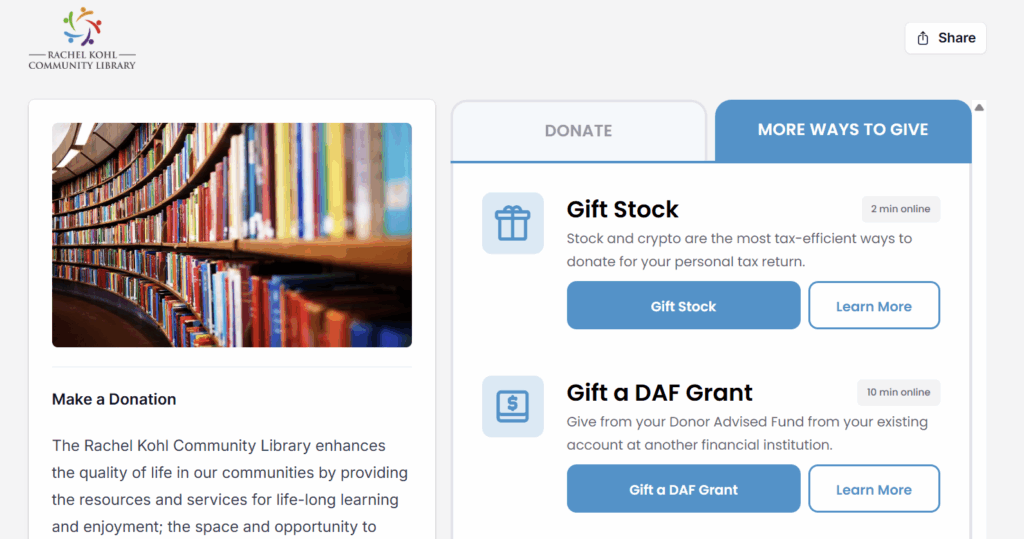
If you choose to use the website, click Donate –> Stock Donation (this page here). Click on “More Ways to Give” and then “Gift Stock.” After you submit the ticker and number of shares you intend to gift, you will receive an email with instructions to forward to your investment manager, who can transfer the stock gift to the library’s investment account with Infinite Giving. It takes just a minute or two.
Talk to your tax professional
I’m a CPA with 15 years of experience at a public accounting firm. But I specialized in financial audits and not in tax preparation. I’m actually pretty bad at taxes, so I don’t do them myself. 🫣 I know enough to be dangerous, though definitely not enough to give you tax advice.
Speak to your tax advisor to confirm any tax mechanics. But the treat of this donation trick is pretty simple and extraordinarily sweet.
Or choose the charity of your choice 💛
If the library isn’t your non-profit of choice, that’s ok! You can use the same tax-planning donation strategy with many other non-profits in our community that can also use your support. If the non-profit organization has an investment account that can accept stock donations, you’re probably golden. Reach out to their leadership team or development folks for details.
Stock donations might not be in your budget right now. If that’s the case, that’s totally understandable. If they are, however, now is a fantastic time to pass along some of your shares (especially if they have significant unrealized gains) to your charity of choice.
Have you used this tax planning strategy to donate to a local nonprofit organization? This can be an advantageous way to support the critical organizations in our neck of the woods doing the great work of community building, social justice, and fostering local resilience.
Let’s chat! What else did I miss? Have you used this donation method before?