I think Amy Coney Barrett would tell you to vote ‘Yes’ for retention of PA Supreme Court Justices

Let me tell you why ⚖️
Quick Note: This piece is a bit long. If you’re a skimmer, I put the most important points in bold. Scan the headings and the bolded parts.
But here are some highlights you won’t want to miss:
Gerrymandering claims are blatant lies; not campaign spin, but the exact opposite of the truth. The nonpartisan League of Women Voters in PA is Big Mad. If the actors behind this smear campaign lie so egregiously about this, what else are they lying to you about?
Definitely don’t skip the section about the sexual predator flyers from our old buddy Jeff Yass. It’s a juicy doozy; TMZ and Politico had a baby.
Just for fun, see if you can spot the nod to Regina George. 🩷
Raise your hand if you know who Amy Coney Barrett is. 🙋🏼♀️ For those who don’t know her, she’s the conservative-leaning Supreme Court Justice who replaced a much more liberal Ruth Bader Ginsburg just weeks before the 2020 election.
We swapped one set of catchy initials (RBG) for another (ACB).
Last month, ACB released a new book titled “Listening to the Law.” In it, she discusses her journey to the Supreme Court, which is an interesting read. More poignantly, she reflects on how she interprets the law and her view of the role of the courts in our constitutional republic.
Throughout the book, she often emphasizes the importance of separating the decision-making process and legal analysis from the outcome of case decisions.
She consistently maintains that a proper legal analysis is crucial to the integrity of our courts and the stability of our government, even though it sometimes leads to an undesired decision. Following appropriate legal principles is far more important than achieving a popular outcome.
She goes so far as to say:
“A judge may be rightfully outraged by the crimes committed by a violent defendant. But the Constitution entitles a defendant to certain procedural protections, and if the defendant didn’t receive them, the judge is obligated to rule in his favor, even if she thinks the result unjust to the victims.”
In other words, a judge must follow the law, even if the outcome is abhorrent.
She further argues that dedicated adherence to the law, rather than achieving a desired outcome, is one of the consequential justifications for long-term and lifetime judicial tenures.
Not having to answer to the ebbs and flows of partisan politics allows justices and judges to feel more confident that strict adherence to the law, even if it means foregoing a desired outcome, won’t compromise their ability to follow the law and serve honorably in the judiciary.
ACB says that life tenure:
“is designed to make judges resistant to the lure of democratic majorities that call for actions that violate constitutional commitments. When that lure overcomes the political branches, judicial review offers another layer of protection.”
While our legislature is designed to respond more readily to the pendulum of cultural and societal energy and emotions, the judiciary is intended to serve as a nonpartisan counterbalance to these forces. It’s one of the many integrated checks and balances built into our government.
In fact, ACB expects every judge to reach unpopular decisions, including outcomes that the judges themselves may not even like.
She says of judges who always like the outcomes of their cases:
“A judge who never sees such divergence should do some soul-searching, because as Justice Scalia rightly observed, ‘the judge who always likes the results he reaches is a bad judge.’”
She continues:
“Just as it’s a problem when a judge likes all the results she reaches, so too is it a problem if the judge wants others to like the results that she reaches.”
In other words, judges should expect their decisions not to always be popular with the public. Sometimes, the most appropriate interpretation of our Constitution and statutes leads to an undesired decision, but maintaining adherence to the laws is of the utmost importance.
While our legislative body is explicitly designed to respond to and represent popular opinion, the judiciary is explicitly not. That’s the point.
Amy Coney Barrett reminds us that we should assess the judicial fitness of judges and justices based on the integrity of their decision-making process, not on the outcomes of the cases.
Which brings us to the Pennsylvania Supreme Court retention vote
Retention votes in Pennsylvania are nonpartisan and historically very sleepy affairs. 🥱 Can you ever remember even recognizing a Supreme Court justice’s name on a ballot? Probably not (even though we probably should). They typically don’t make headlines (and that’s a good thing).
The spirit of the retention vote offers citizens an opportunity to remove a justice who has exhibited egregiously inappropriate or bad-faith behavior. That has not been the case with these three judges, as evidenced by their endorsement from the nonpartisan Pennsylvania Bar Association.
So far, I’ve seen no challenges to the judicial integrity of the three justices up for retention. Those opposed to retention have only critiqued the outcomes of the cases, and ACB tells us this is not a valid measurement for critique.
The efforts to aggressively oust these three judges without any significant reason other than apparent disagreement with their judicial decisions undermine the purpose of the long-term tenure of justices, a principle long held sacred as part of the checks and balances of our democracy.
You decide based on facts
Below, I dive into some of the public accusations circulating in our mailboxes and on social media.
I explain why the allegations are misleading and sometimes blatant lies. I offer links to the cases and some poignant facts to help you make an informed decision about whether these three Supreme Court judges have met the expectation of exhibiting good-faith judicial analysis in their work.
And I remind you to vote.
Some of you won’t make it through all the gobeldly gook coming your way. I get it. Really, I do!
If you want to skim, I’ve bolded the parts I hope you read. And don’t forget that juicy doozy section I mentioned earlier. Everything else is yours to enjoy as you wish. It’s a lot. We can wade through it together. 💛
Let’s clarify some of the accusations
Despite ACB’s warnings, the critiques of these justices focus on the outcomes (not the judicial reasoning) of cherry-picked decisions they’ve issued over the last ten years. Although even the “smoking gun” cases we’re about to discuss aren’t much to write home about when you dive into the details. 😴
To better understand the critiques of decisions, let’s examine a few examples listed in the opposition flyers funded by Yass (remember that one billionaire guy paying for all the bad press?) and the letter outlining voting suggestions from the Chadds Ford Republicans.
I assume the cases listed as justification for voting “no” on retention are among the more egregious violations of justice decided by the justices in question. After all, wouldn’t you focus on those ones if you’re trying to convince the general public that the justices are unworthy of their seats?
Let’s start with the objections enumerated in the letter from the Chadds Ford Republican Party. The letter offers three reasons for voting against retention:
voted to extend COVID lockdowns
overrode the PA legislature on their redistricting plan
allowed for an additional three days for mail-in ballots to be received, after election day in 2020
All are offered without citations, so I’m making my best guesses about which cases they’re referring to.
A note about being good neighbors
I know, at least tangentially, many of the people behind this Chadds Ford Republican Party flyer. You probably do too. There are fewer than 4,000 of us living in this little town.
We can love each other’s artwork, landscaping, environmental advocacy, and conversations along the sidelines of the soccer field while also hoping we can all be above this partisan poppycock.
The message about gerrymandering being amplified by the flyer from the Chadds Ford Republicans is intentionally misleading (see details below). I challenge us all to be better neighbors.
You want more people on your “team”? Compel them with an interesting platform; don’t trick them into supporting something the truth can’t sell.
We each have a choice to participate in these shenanigans or not. We are complex people, and all of us (including me) have times when we offer our best selves and times when we don’t. But we can aspire to do better next time.
There’s space to be good neighbors and have hard conversations about playing politics with more integrity. Heck, sometimes it’s the hard conversations that make us better neighbors.
Onto the claims:
1. They voted to extend COVID lockdowns?
Is this even something judges do? That feels more like an executive or legislative branch activity.
I assume they’re referring to the April 2020 case that asked the Supreme Court to overturn Governor Wolf’s emergency declaration closing non-essential businesses (or maybe this one, with similar context). In April 2020, friends! All 50 states were doing the same thing at this point, and no one had any idea what was going on… but whatever.
Back to the facts of the case. The Supreme Court didn’t vote to extend COVID lockdowns; they said the governor had the authority to implement them. Presumably, if the Governor had decided to end the emergency declaration, they would have said, “That’s your call, too.”
They didn’t vote to extend. They didn’t even vote to implement. When the Governor said, “It’s my party, and I’ll cry if I want to,” the Supreme Court said, “Not for us to stop you.” You may or may not like that outcome, but it’s not a vote to extend lockdowns.
🏀 They ultimately said the ball is in the Governor’s court, not the Supreme Court’s, to decide on a state of emergency. In the context of who holds that authority, the Governor’s court is probably the proper court to play that game.
And guess what else?! Dougherty, one of the three justices up for retention, joined a concurring and dissenting opinion with the two Republican-elected judges. Does that change how we feel about voting to retain him?
One more nugget they forgot to mention? 😉 These same judges ruled against mask mandates in K-12 schools and child care facilities. Sometimes the Governor steps out of the lines of his court, and the Supreme Court says, “You’re out of bounds.” 🚨
Can we put that in the “vote yes for retention” column? Here’s the case if you want to check it out.
2. What about the gerrymandering claims (overriding redistricting plans)?
The language in the Chadds Ford flyer is a toned-down version of the gerrymandering lies in related Yass flyers you’ve probably gotten in your mailbox. The Chadds Ford flyer says the PA Supreme Court “overrode” the maps, which is technically true, because the Supreme Court deemed the maps unconstitutional gerrymandering. But that’s what the Supreme Court is supposed to do when it believes the legislature violates the Constitution. 🧑🏻⚖️ That’s literally the definition of their jobs. 👀
The Yass flyers go further, claiming the Supreme Court gerrymandered voting districts. PennLive addressed this, saying:
“One widely circulated mailer alleged that the justices ‘gerrymandered our congressional districts to help Democrats win.’
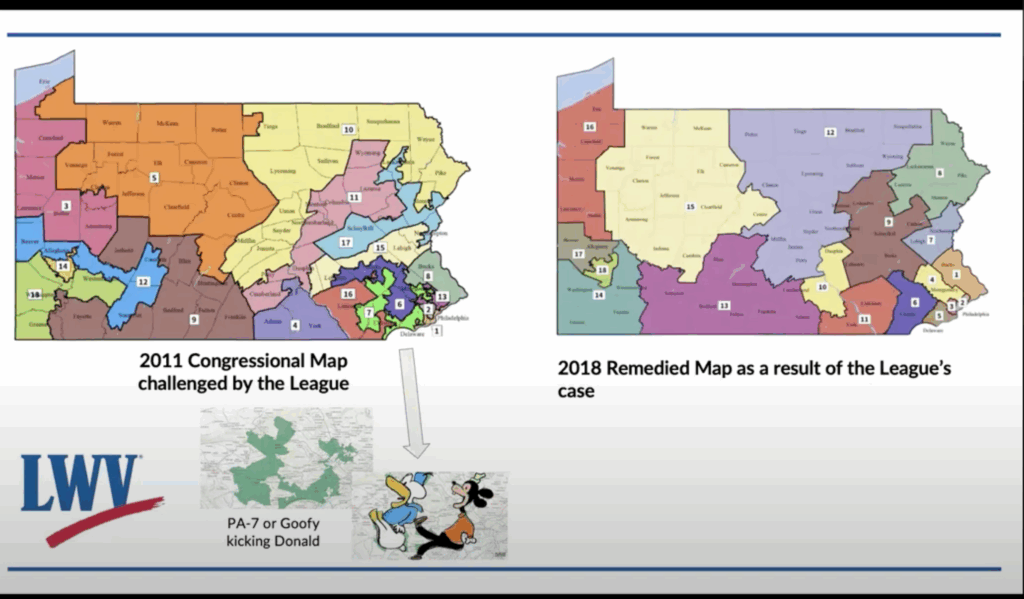
In reality, the distorted map pictured was a 2011 plan drawn by Republican legislators, later struck down by the court as an unconstitutional partisan gerrymander. When the legislature and governor failed to create a new map, the court appointed a neutral expert to draw a fair replacement. It’s hard to argue that the justices tipped the scales for Democrats given the partisan balance in the Pennsylvania Congressional delegation: 10 Republicans vs 7 Democrats.”
In other words, the Yass mailer uses the Republican map to suggest that districts are gerrymandered. When the court appointed a neutral expert to redraw districts, it led to 2 U.S. House seats flipping from Democrat to Republican, giving Republicans a 10-7 advantage in Congress after the 2024 election.
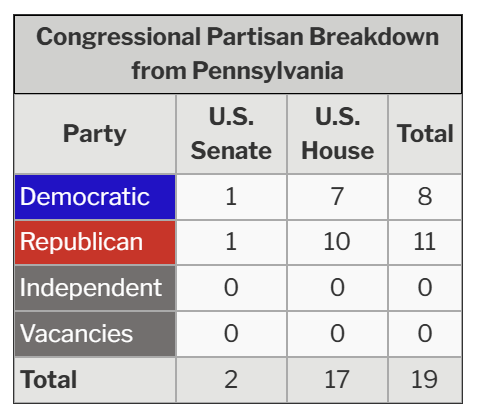
Does that sound like a map gerrymandered by partisan justices trying to tip the scales for Democrats? If it was, those justices did a really sh*tty job, and Republicans should be rooting for these justices all the way to the ballot box! 🎉
If you think the PA Supreme Court overstepped, the nonpartisan League of Women Voters disagrees. They are angry about it and called the gerrymandering claims “deliberately false information.” (Get the facts here.) The Executive Director of the League of Women Voters in PA said,
“The Pennsylvania Supreme Court didn’t gerrymander a map — it ended one. It didn’t act political; it acted constitutionally.”
Want to decide for yourself? The map on the left is the map Republicans wanted. The map on the right is the one drawn by a neutral expert. Which one do you think looks more gerrymandered?
Look at District 7 in bright green on the map on the left (that’s right around us). It’s in three sections that barely even appear to touch one another. Are we serious, here?!
Aren’t you glad the Supreme Court tossed out that map on the left and gave you back your voting agency?!
3. How about allowing mail-in ballots received up to 3 days after the election due to COVID?
Did you know overseas ballots can be received up to 7 days after the election? Just sayin’.
The ballots still had to be postmarked by election day. Among other reasons, the 3-day delay provided flexibility for unexpected postal delivery delays over which voters have no control during the pandemic.
You can read the full opinion if you’d like to understand how the justices reached their decision more fully. The particular issue of accepting ballots received after election day is addressed in section B. COUNT II OF THE PETITION FOR REVIEW on pages 20-38. It’s too long to rehash here, and I’m not going to pretend to be a legal expert.
Instead, let’s mention a few nuggets that the little voting cheat sheet forgot to mention:
Split decisions
The case included five petitions to “protect the franchise of absentee and mail-in voters.” The Supreme Court decision rejected two of the five items. What does that tell us about the decision? Maybe it’s more nuanced than meets the eye?
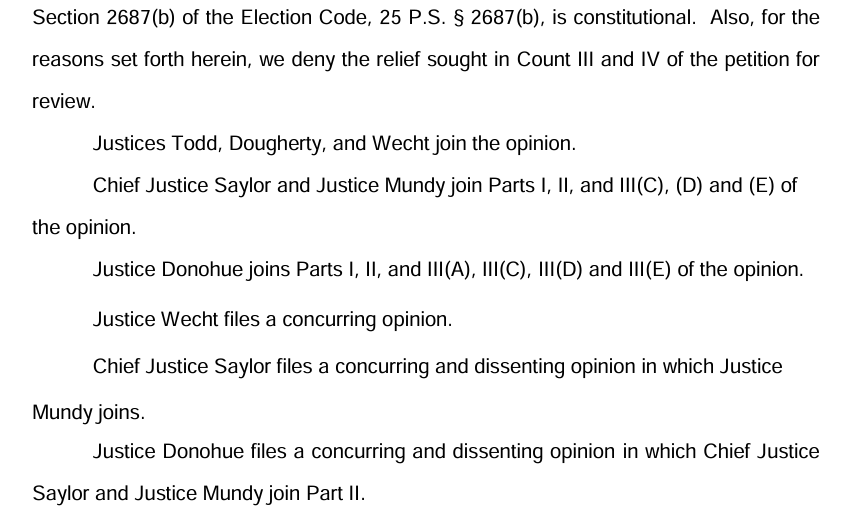
Moreover, Part II (the 3-day ballot delivery relief) includes support from the two Republican justices (Saylor and Mundy). Should we use this as fodder to vote “no” on their retention when the time comes? I doubt it.
I’m not going to dive further into the opinion. But note (in the screenshot below) how the justices’ opinions varied. They agreed in some areas, disagreed in others, and it’s far from a party line split. That’s an indication of good-faith judicial review, not evidence of a bunch of partisan hacks.
Support from nonpartisan pro-democracy orgs
The requests for relief were supported by Common Cause and The League of Women Voters, two nonpartisan organizations dedicated to promoting robust democracy, election integrity, and voter enfranchisement (i.e., ensuring that as many eligible voters as possible can cast their votes). These are respectable organizations, and yet, only three of the five requests were granted.
The United States Supreme Court agreed
📣 The United States Supreme Court upheld the decision! Let me repeat that. The case was appealed to the U.S. Supreme Court, and the decision was allowed to stand. The 6-3 conservative-leaning U.S. Supreme Court did not find any compelling violations of legal integrity to overrule the decision. Ugh… seems like it may not be so bad? Maybe this wasn’t the smoking gun?
What about all those sexual predators the Yass flyers told us these justices set free?
Boy oh boy. If they want a story about sexual predators, have I got a good one for them about a President convicted of sexual assault who was close friends with a world-class sexual predator named Jeffrey Epstein. He even moved Epstein’s sidekick, Ghislaine Maxwell, to a comfy little sleepaway camp despite sex trafficking women and children for years.
But we’re shutting down the federal government so that we don’t have to talk about Jeffrey Epstein and his milieu of famous pedophile (or at least pedophile-adjacent) friends. Instead, let’s discuss the outrage-bait cases in these propaganda flyers filling our mailboxes and wasting our trees.
Yass’ “big swinging d*ck” bombshell sexual predator case, according to the footnote on the flyers, is the case of sexual assault allegations against Bill Cosby. You can read the case, if you’d like.
You know what Cosby did. For the case in question, the PA Supreme Court said the prosecutor, Bruce Castor, botched the trial and violated Cosby’s due process with a nonprosecution agreement similar to the one Jeffrey Epstein finagled down in swampy Florida.
That’s quite the circus of criminals. When ☠️ Trump, Epstein, Cosby, and Castor ☠️ walk into a bar court room, does anyone really think the PA Supreme Court justices are the bad guys?
👀 Anyone??? Anyone??? 👀
The Cosby case gets technical fast, but here are some key takeaways the flyer *conveniently* forgot to mention:
Republican-elected justices joined in the opinion and concurred with this decision. As with other cases, there are some concurring and dissenting opinions on various elements, but none that ride party lines.
Fun fact! Bruce Castor was also Trump’s attorney for his second impeachment trial (remember that little insurrection thing?). Does this guy go out of his way to make sure lifelong creeps aren’t held accountable for their horrific crimes?!
📣 And here’s where it gets really good! I saved the best for last!! The Commonwealth of PA asked the US Supreme Court to review the opinion, and here’s what the US Supreme Court said: “the Pennsylvania Supreme Court relied on a robust, factually unique record when it concluded,” and “the Commonwealth’s petition offers no compelling reason for this Court to disrupt the state supreme court’s decision which is legally uncontroversial.”
“Legally uncontroversial” friends, according to our 6-3 conservative-leaning United States Supreme Court.
⚖️ This Cosby case is a classic example of the type of case ACB discusses, where the judges unequivocally decide in a certain way to maintain the integrity of the law, even though the decision’s outcome is distasteful (and they know it might upset the general public). Yet it reflects sound judicial reasoning.
Meanwhile, Yass and his buddies are trying to convince Pennsylvanians that what the US Supreme Court calls “legally uncontroversial” is the egregious reason why the three judges up for retention should no longer serve our Commonwealth.
🤡 Bear with me for a minute. Yass digs through a decade of court cases with his $65 billion, and “legally uncontroversial” is the dirtiest dirt he can find?!
Surely each of these justices has a more incriminating social media post or text thread buried deep in cyberspace he could publish, right? Maybe a special birthday card they sent to a friend many years ago regarding their wonderful secrets? 🥸 Perhaps he should have hired the Wall Street Journal to help with his reconnaissance to rig the system.
I feel pretty confident Amy Coney Barrett would disapprove of these antics. 👎🏻
Separately, give me a break that any of our judges, let alone all three of them up for retention votes in one year, are willy-nilly “siding with sexual predators” so those monsters can rush back into our communities and abuse our kids. 🤬 GTFOH.
If you really want to reach your own conclusion, take ACB’s advice. Read the opinions yourself. Know the facts, and then decide what you think. If this retention vote is as existential as some want you to believe, maybe it’s worth a few minutes to do your own research.
You know what else none of these “vote no” messaging pieces highlighted?
Divergent voting records
These justices don’t always vote together. They’ve taken dissenting positions on hot-button cases. Not only does this confirm they aren’t a partisan bloc, but it also reflects their commitment to proper judicial review and to a good-faith interpretation of the law through their own lens. Many cases aren’t black and white, so it’s very possible to exercise sound judgment and arrive at different decisions.
Again, let’s remember what ACB tells us. We judge judges by their judgment and legal rationale, not by the outcomes of their decisions.
Votes related to reproductive rights
None of the material discusses how the justices up for retention voted on cases protecting women’s reproductive rights. They’ve generally supported these rights.
Even though this is a spicy issue in the media, protecting reproductive rights is popular across political lines. We know this is true after seeing ballot measures protecting reproductive rights in red states like Kansas, Missouri, and Ohio pass with overwhelming support.
Many Republican candidates removed their positions on reproductive rights from their websites before the 2024 election because they know a majority of Americans want them protected. It’s no surprise that this is intentionally excluded from the conversation when attempting to convince Pennsylvanians to oust these justices for partisan purposes.
My takeaways
These are the big judicial integrity violations? 🧐 They feel pretty weak, and in some cases, more like hot garbage. The gerrymandering message is a flat-out lie. The US Supreme Court specifically supported their decisions in two of the four examples.
This is the best they could muster to compel us to fire these folks?! 🤯 Middle school girls write better Burn Books than this. 🩷
Friends, if this is the bar we set for not retaining elected officials, I have a long-ass list of people who should not be reelected to Congress or the Presidency. Call me if you want to chat.
More specifically, few of us are sufficient legal experts to know whether these justices have respectfully fulfilled or dishonorably abdicated their duty to “decide every case based on the reasoning rather than the result,” ACB’s words, not mine.
When I fill out the little boxes on the ballot with my dark black pen, I’ll have Amy Coney Barrett whispering in my ear about how listening to the law is more important than listening to public opinion on the outcome of the decision, even when the outcomes are yucky and uncomfortable.
As such, to guide our retention votes, we must rely on recommendations from organizations like the nonpartisan Pennsylvania Bar Association and on the U.S. Supreme Court’s words when the PA Supreme Court decision was “legally uncontroversial,” rather than on the outcomes of any particular case.
Have you filled out your ballot yet?
I hope you have a plan to vote. As I always say, vote how you wish. It’s your vote to use as you choose. But be a responsible voter and make your choices based on facts and honest discourse as best you can. None of us will get perfect information when the media landscape is ablaze in nonsense bullsh*t, but we can and should try.
At least you have some context for the inflammatory flyers flying into your mailbox. They’re not exactly as honest as they’d like you to believe. Surprise, surprise… yay, politics. 🫶🏻