The rising power and falling prices of solar energy

Energy is the hot topic du jour, so how about we dabble in electrons through the lens of life in Chadds Ford. Enjoy this pop-up series, Energy in Chadds Ford, exploring conversations about energy in our neck of the woods.
I’m about to drop some deets about solar power and how it’s seriously awesome (and getting a lot more “awesomer” 😉 and more affordable). As I wax poetic about a world drunk on solar power, understand that I’m not suggesting solar alone is some panacea for all our energy problems. All things energy are complicated. They vary depending on climate, geography, population, infrastructure, and more.
But in the United States, we’re drowning in fossil fuel propaganda that, in my opinion, is blinding us collectively to the possibility of the sun as a major source of electrons to reliably and affordably power our lives. The rest of the world has seen the light of solar and how it is one of several keys to affordable, accessible power that also offers energy independence, both individually and geopolitically.
In short, solar power isn’t THE solution, but it should be a much larger part of our energy solutions than most people consider today. And in this country, we’re doing a lot of stupid things that make solar power harder to access and more expensive than it needs to be. Let’s discuss why we should all fall in love with solar. 🌞
The global energy landscape is transforming before our eyes, if we’re only willing to watch and learn. For now, it’s leaving the United States behind. Don’t believe me? Ask our Chadds Ford neighbor and energy industry expert, Joe Dominguez (the CEO of Constellation Energy). At a Semafor World Economy event:
“If this is going to be a race between China and the US to build energy, might as well call it a day,” [Dominguez] said, noting that since 2010, China has built the entirety of the US electric system plus 50% more in terms of capacity.
Dominguez notes, though, that the goal shouldn’t be just building more generation; we can start by better utilizing the grid we already have.
“But the US can catch up if it uses its grid more efficiently, Dominguez said. “Their [China’s] system is running pretty much 24/7 at high capacity,” Dominguez said. “Most of the time in the country [the United States], most of the power plants, most of the lines, most of the substations aren’t being used … So if we could manage the peak energy demands, we [would] have a lot of slack in the system we could take advantage of.”
“By making data center load more flexible and using targeted demand response for just a few critical hours each year, we can meet near‑term AI demand, maintain our competitive edge and keep energy costs stable — even as we continue building the next generation of power infrastructure,” Dominguez said in a LinkedIn post.” (source)
Read that again. “Just a few critical hours each year.” Each year! 🤯 Solar power and batteries can be a really great way to manage those peaks without building out massive new fossil fuel plants that are expensive, pollutive, take many years to build, and lock us into paying for infrastructure for decades. We might need new power plants, but that’s not the low-hanging fruit, and it shouldn’t be our first priority.
While we pick up our jaws off the floor after seeing our latest PECO bills and our politicians fight over how to reduce energy prices, people in other countries are busy installing solar panels here, there, and everywhere to solve many of the same problems we’re bickering about at home.
Our politicians, many captured by fossil fuel lobbyists, disingenuously debate the merits of drilling more oil and piping more liquefied natural gas across the country (and eventually the ocean). Meanwhile, the rest of the world has been steadily choosing renewables (and especially solar power) as a primary source of electrons for the future.
Residents of Jamaica, Pakistan, South Africa, India, the UK, Cuba, and Australia (to name a few) install rooftop and community solar systems at record rates (and for a fraction of the cost we pay in the United States). Germany’s apartment dwellers plug cheap “balcony solar” panels into standard outlets, and solar generation in Germany is expected to increase over 30% this summer, according to Bloomberg. Germany isn’t exactly the sun capital of the world, yet it still sees the promise of the rising sun. ☀️
Even in the United States, renewables (especially solar) are having a moment, despite our current administration’s best efforts to hamper their advancement. Texas — yes, that Texas — is adding more solar capacity than any other state in the country (by a lot).
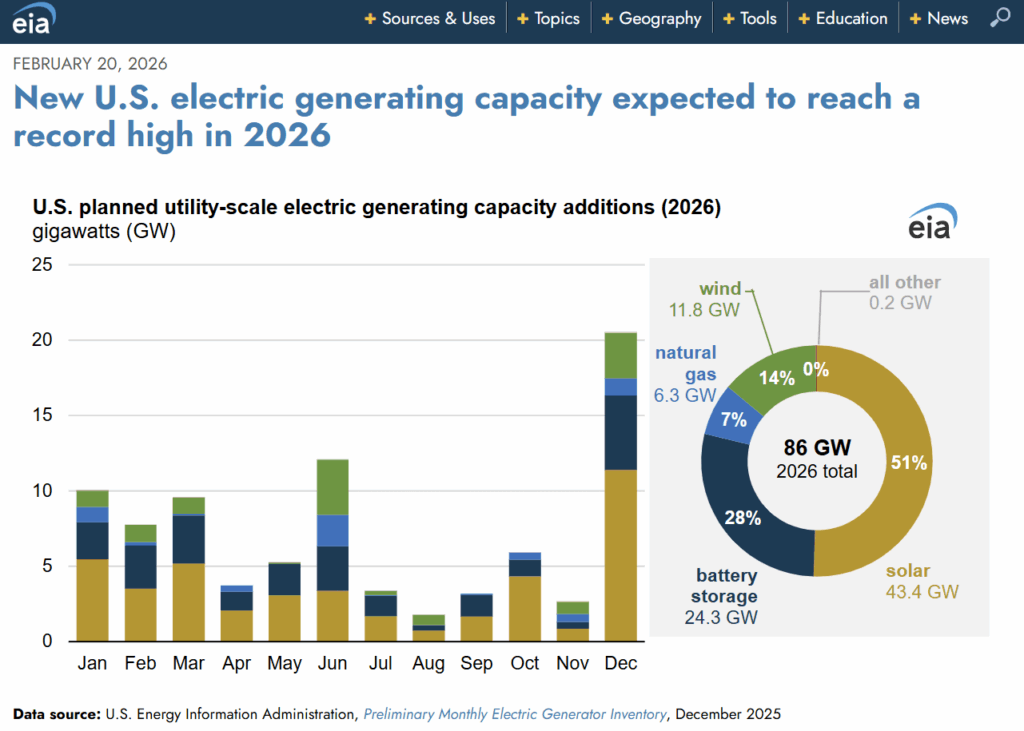
The U.S. Energy Information Administration predicts that in 2026, 93% of all new electricity generation capacity added in the United States will come from solar, wind, and battery storage (51% of that is solar). The same report states that “More than half of the new utility-scale solar capacity is planned for four states: Texas (40%), Arizona (6%), California (6%), and Michigan (5%).” The sun is not partisan, and neither is the cohort of states investing in utilizing its amazing (and free!) power.
Solar is less expensive than you might think
For decades, solar power was too expensive to be mainstream. But that is no longer the case, and the pace of change has surprised even people in the industry.
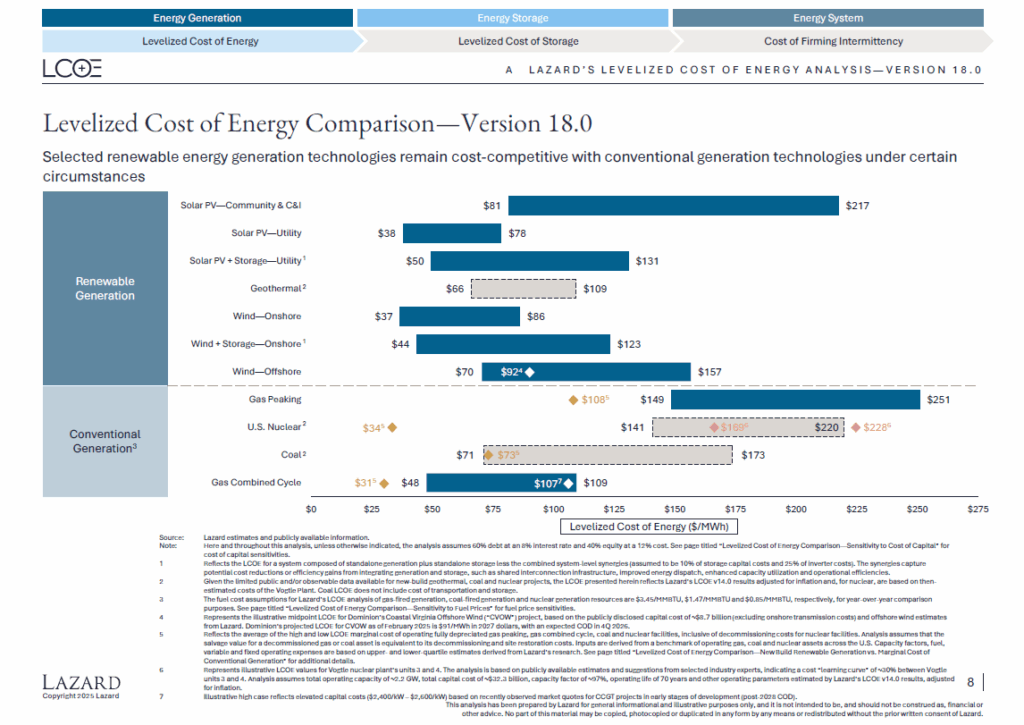
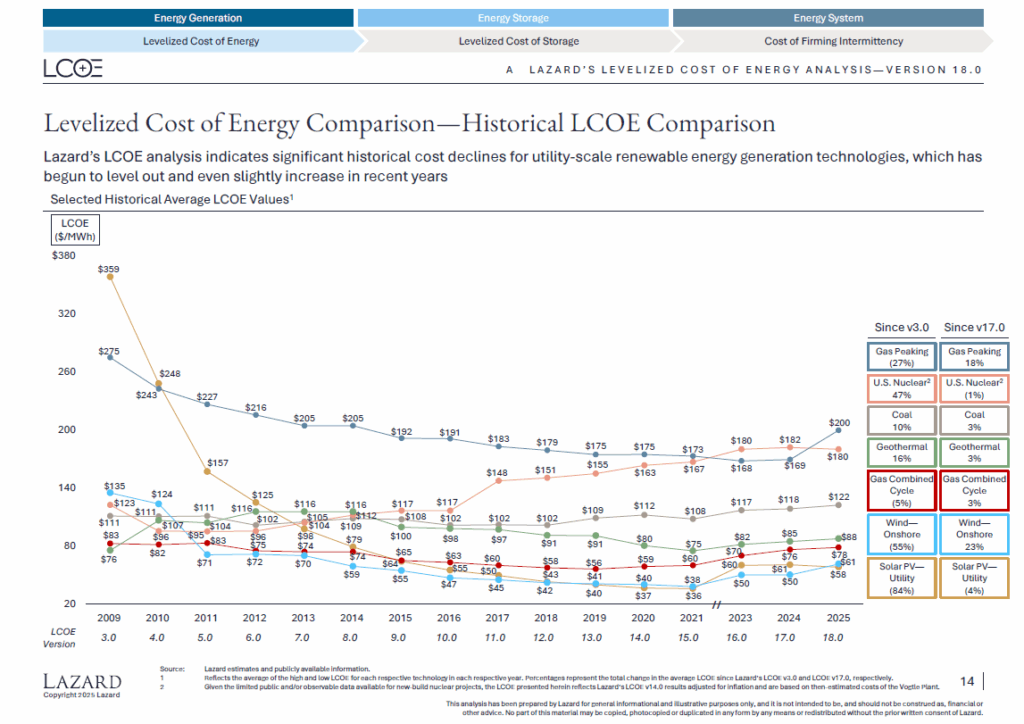
The way energy economists measure the true cost of generating electricity over a power plant’s lifetime is called the Levelized Cost of Energy, or LCOE. Lazard, a respected energy industry analyst firm, issued its latest LCOE report showing that renewables are cost-competitive and often less expensive than new fossil fuel, coal, or nuclear plants. And renewable energy generation prices keep falling.
It gets complicated fast, and there are plenty of nuances beyond the scope of this article or my own knowledge. But the chart below highlights that renewables are cost-competitive with (and often more economical than) other types of energy generation.
The next chart shows the historical LCOE for different energy generation types (natural gas, solar, coal, nuclear, etc). I’m sure hardcore energy industry folks can do a lot more with this chart than I can. But this chart highlights how much solar generation prices have dropped over the last couple of decades and where they sit relative to other energy sources. That old story about solar being prohibitively expensive is dead.
Renewables are the least expensive! I know, I know. Someone is going to say, “But the sun doesn’t always shine, and the wind doesn’t always blow.” That person might be surprised to find out that… I already know that. And so does everyone else who sees promise in the power of the sun. 🫶🏻
Battery technology is advancing spectacularly and addressing many of those problems. Moreover, we don’t actually need more power generation all the time. We’re mostly constrained by a few tight peaks during certain hours of the year (remember what Joe Dominguez said above? 👆🏻). Renewables with batteries can have a huge impact in addressing those demand crunches.
Lastly, don’t forget that we aren’t looking to replace all our power sources with solar rays next Sunday. There’s a lot of room for creative solar integration between “run the world on just the sun, sister” 🦋 and “fossil fuels all the way all the time, bro.” 💪🏻
Technology (solar) vs. commodity (fossil fuels)
Why are solar energy power prices declining while other energy sources are remaining flat or getting more expensive? There’s a fundamental distinction between solar power and fossil fuels that doesn’t get nearly enough attention: solar is a technology, while fossil fuels are a commodity.
Efficient gains over time (technology wins)
Commodities like coal, oil, and natural gas have a utilization ceiling. We’ve spent over a century optimizing combustion engines and gas turbines. They’re good at what they do, but the physics of burning things to generate heat to spin a turbine has been squeezed for most of the available efficiency gains.
Technology works differently. Engineers continue to find ways to make solar panels more efficient, installations faster, and batteries cheaper and more robust. The improvements compound, decreasing energy costs substantially with each iteration. Commodity efficiencies, however, have largely reached their limits due to the laws of physics.
Fossils as a variable subscription; solar as a fixed expense
Moreover, you have to keep buying fuel in perpetuity. You’re basically locked into a variable-rate subscription with a potentially adversarial supplier. Every kilowatt-hour from a gas plant requires gas that must be extracted, transported, and paid for, with prices fluctuating based on markets, geopolitics, and the amount remaining that’s economically recoverable. The easy-to-reach fuel is largely gone, and it only gets more expensive to extract the harder-to-reach inputs.
Crucially, the fuel from the sun is free, so once the panels are installed, the costs are largely fixed. The sun shows up every morning1 and sends Earth about 10,000 times as much energy as our entire civilization uses. The sun does not invoice us. It does not belong to a cartel. It doesn’t get stuck behind blockades in the Straight of Hormuz. It does not have shareholders expecting outsized returns.
The basic case is pretty simple: a solar system is a fixed cost, not a subscription. Once it’s paid off, the fuel is free. The sun doesn’t issue rate hikes or price spikes. PECO, big fossil fuel companies, and global oil cartels do.
Energy independence: national security + individual liberty
Speaking of cartels… 🤑
National energy independence
When most of us hear “energy independence,” we envision decoupling our reliance on oil from the Middle East and other foreign countries. This is definitely part of the equation, especially as our current administration has chosen to go to war with Iran (for reasons even they can’t seem to consistently articulate).
The closure of the Straight of Hormuz has exposed the fragility of many countries that rely on other sovereign nations to power their economies. Access to power is a matter of national security and maintaining basic living standards.
In response, other countries around the globe have been turning to solar power in droves. Once you own the solar panels, no one can close a waterway, blow up an oil tanker, or use threats of supply cuts to extract geopolitical concessions. The sun just keeps rising every day (but clouds… see footnote 1 🙄).
Moreover, we have sufficient production in the United States to be energy “independent,” but we’re still subject to global commodity pricing and market movement. Supply extracted in the United States is often sent elsewhere, particularly when demand in other countries is higher. The United States recently hit a record high for oil exports. Just because we extract it here doesn’t mean it stays here for us to use.
Individual energy independence
Energy independence can also mean more individual freedom to access power and rely less on the shared power grid. More Americans across the political spectrum are arriving at this conclusion.
Rural Republicans, for example, who’ve never thought of themselves as environmentalists, are installing solar because they don’t like being dependent on a grid they don’t control. After Hurricanes Helene and Milton, families in the Southeast with solar-plus-battery systems kept the lights on while their neighbors waited weeks for utility crews to fix power lines.
Polling shows that support for solar power is not a partisan issue. As reported in Semafor, a survey commissioned by Kellyanne Conway and conducted across five Republican-leaning states found that “83% of all voters (including 75% of Trump voters) support greater use of solar to strengthen the country’s energy supply. Majorities of Trump supporters also agreed that solar is key to making electricity more affordable and to closing the energy gap with China.” Conway’s own conclusion: “Solar should be seen not as government-favored or ideological.”
Broad support for solar exists on both sides of the aisle, even if our pretend-to-represent-us-but-really-represent-lobbyists Congress people haven’t quite caught up to voters yet.
Bill McKibben, the environmental writer and activist, has been making an argument lately that I think cuts through all the political noise: “if you have solar panels, a heat pump, and an EV, you’re the boss of you.” You’re not sending money every month to distant corporations. You’re not subject to rate hikes tied to global commodity prices. You’re not one ice storm or pipeline disruption away from a cold house and a dark refrigerator.
Sounds pretty nice to be the energy bosses of ourselves and not let the Big Energy and Big Utility bosses boss us around, right?
What’s happening around the world (and why it matters here)
Other countries are leaving us in their solar dust. China has invested heavily in clean energy, especially solar, on an extraordinary scale, driving down global prices and building out renewable infrastructure faster than any country in history.
I have a hunch that China isn’t acting out of a strictly altruistic agenda. 🧐 Chinese leaders have correctly identified solar power as an economic and strategic advantage. Additionally, the rest of the world is benefiting from falling prices of Chinese-manufactured solar technology, buying up and installing cheap panels.
Whether or not our government acknowledges the increasing benefits of solar power, the rest of the world is soaking up the sun and powering its communities forward.
Jamaica installed solar microgrids ahead of its 2025 hurricane season. When storms knocked out the conventional grid, those solar-powered communities had their lights back on in hours, not weeks.
Ukraine has relied on solar through its war with Russia. It’s much easier to replace a few busted panels destroyed by Russian artillery than to rebuild entire fossil fuel facilities.
Many African countries are seeing an explosion of utility-scale solar and rooftop solar installations driven not by subsidies but by simple economics.
Pakistan saw escalating fuel prices and imported and installed cheap solar panels at mind-boggling rates.
In Australia, homeowners can install rooftop solar systems for 1/3 to 1/5 of what we pay in the United States, in part because they use cheaper panels from China and have streamlined permitting processes. Australia produces so much solar power that the price of electricity has dropped to zero at times when the grid is producing more than it can use.
Large-scale solar success stories from around the world aren’t anti-fossil-fuel propaganda, nor are they heavily subsidized by government incentives. These reflect present market forces that we aren’t currently allowed to access in the United States.
Solar’s seemingly high cost in the United States, especially at the residential level, is a political choice. And there’s growing interest from across the political spectrum in letting solar loose so we can meet skyrocketing power demands (hello, data centers and electrifying everything) quickly and cost-effectively.
Pennsylvania’s natural gas problem
Our state is sitting on an enormous amount of natural gas. That fact, combined with significant political pressure from fossil fuel interests, has pushed some of Pennsylvania’s current leadership to double down on LNG infrastructure and fracking expansion at precisely the moment the global energy market is turning a corner.
I’m not suggesting we shut off every fossil fuel plant tomorrow morning. That would be neither practical nor smart. Our grid needs a transition time to maintain reliability.
But managing a transition thoughtfully doesn’t have to include making multi-decade investments in new infrastructure for an energy source whose glory days are behind it. Building a new natural gas facility locks in costs, pollution, and supply-chain dependence for 30 to 40 years. Those are assets that may well become liabilities, investments we’re still paying for long after they’re no longer the best energy alternative.
Pennsylvania’s Governor Shapiro, Senator Dave McCormick, and other statewide elected officials are simultaneously trying to attract data centers and AI investment to our state. Data centers need enormous amounts of electricity.
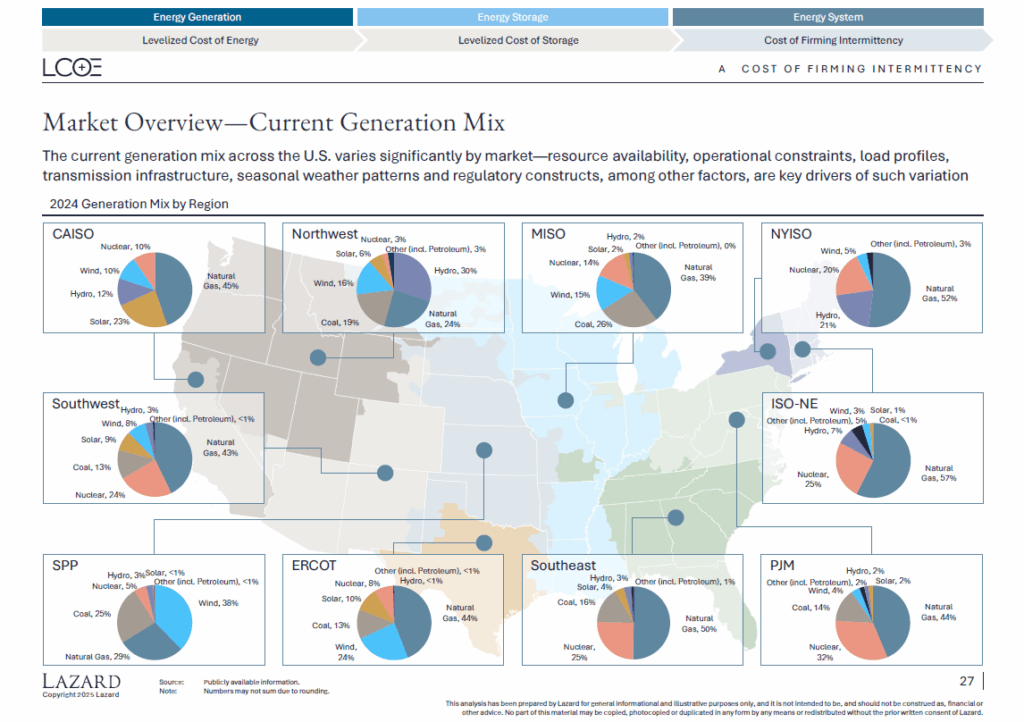
I won’t claim to be an expert enough to know exactly what mix of energy we need to meet rising energy demands, but new fossil fuels should be way down the list of the best alternatives. The fastest way to get more electricity is to better utilize the energy grid we already have.
We should exhaust all options to enhance grid utilization and maximize the efficiency of investments in distributed solar and storage (which take about 12-18 months to come online) before deciding to build more fossil fuel plants that won’t be ready for 5-7 years, even in the best-case scenarios.
Rewiring America has proposed that data centers fund electrification, energy efficiency, and rooftop solar investments as a “Bring Your Own Generation” alternative (listen to them discuss it here) instead of building new fossil-fuel generation plants, to make more energy available to them and benefit customers. It’s a really novel idea that could present great opportunities if there’s cultural and political will to consider it! A tiny fraction of what the big tech companies are spending on energy right now could transform Pennsylvania’s distributed energy capacity.
The jobs argument
Solar isn’t just good energy policy. It’s an industrial policy opportunity, and we’re in danger of squandering it.
Manufacturing solar panels, inverters, batteries, and the broader electronics stack required for a modern distributed energy system is advanced, skilled work. It creates jobs in factories, engineering, installation crews, maintenance, and grid integration. Those jobs are geographically distributed in a way that a pipeline or a refinery isn’t. A solar installer works in your community. The money stays closer to home.
We’ve largely ceded the manufacturing side of this to China, in no small part because of decisions made over the past two decades to offshore advanced electronics production. The consequences of that choice are now visible across many industries beyond energy.
Rebuilding that expertise, developing the R&D capacity, and training the workforce to design and manufacture the components of a clean energy economy offer a genuine economic opportunity for communities like ours and for Pennsylvania broadly. It’s also a national security argument that conservatives and progressives can agree on, even if they rarely find themselves in the same conversation about it.
The irony is that “energy dominance” and “made in America” are phrases you hear a lot from people who are simultaneously skeptical of solar. But if you actually want American energy dominance and American manufacturing jobs, solar is a perfect fit. The fossil fuel industry has been exporting Pennsylvania’s natural gas overseas. The solar industry could put Pennsylvanians to work here.
So what does this mean for us?
Back to Chadds Ford. Our little town of just under 4,000 people doesn’t set national energy policy. But we do make choices — in our homes, in our community conversations, in what we ask of our elected officials.
Solar discussions among neighbors
Let’s talk more with our neighbors about opportunities for solar energy in our community. Want to know what it’s like to have solar panels in Chadds Ford and how it impacts my PECO bill? Ask me! 💛 I’d love to tell you all about it.
There are objections to solar energy worth discussing. Fire risk from panels is a concern some homeowners raise. As with any electrical system, installation quality matters, and substandard work has caused problems. The answer to that is licensed, reputable installers and proper permitting, not avoiding the technology altogether. Modern residential solar systems, when installed correctly, have an excellent safety record.
Some people think solar panels are ugly. Today’s rooftop solar systems are much sleeker and easier on the eye than the systems of old. Additionally, and especially in this utility market, others think a utility bill that climbs every year is uglier than modern panels.
While those considerations may drive personal decisions, they offer limited reason to prevent neighbors from making their own choices about their rooftops (I’m looking at you, draconian HOA rules 👀). The benefits of solar — financial, environmental, grid resilience, community energy independence — are substantial and well-documented. At some point, blocking a neighbor’s panels isn’t really about fire risk or curb appeal. It’s ideology.
Fossil fuel stans argue that solar adoption increases energy costs for others who continue to use the grid. Those of us with solar are no longer paying “our fair share” for a functioning grid. I strongly disagree with this; I think this argument conveniently ignores the collective benefits of adding solar power to the grid. 📌 Put a pin in this. I’ll come back to it another day.
If you’ve been curious about solar and haven’t looked into it in the last few years, it’s worth a fresh look. The economics have shifted substantially, payback periods have compressed, and Pennsylvania’s net metering policy (though it’s been under pressure — more on that in a future article) means excess power you generate goes back to the grid for credit on your bill.
If you’re not in a position to install solar yourself — you rent, your roof faces the wrong direction, the upfront cost isn’t feasible right now — community solar programs let you subscribe to a share of a larger installation and see savings on your PECO bill without a single panel on your house.
Solar policy in Harrisburg
If none of that applies to you today, there’s still value in understanding what’s actually happening in the energy world, as distinct from what our current political moment would like us to believe is happening. The trends are not subtle. The technology is not speculative. The economics are not theoretical. Solar makes a whole lot of sense (and cents).
There are several bills floating around Harrisburg that seek to make it easier to take advantage of all the promise solar power offers our communities, and they don’t require subsidies or big sacrifices from people who don’t accrue the benefits.
📌 Put a pin in this one, too. I’ll come back in a later article with more details about active solar-related bills in the Pennsylvania General Assembly for the 2025–2026 session
The sun is already sending us everything we need. We’ve gotten very good at catching it. And it gets cheaper every year. Let’s utilize it to reduce energy prices, diversify our energy sources, and gain the freedom to generate our own electricity.
What do you think?
I’d love to know what you think about growing our solar energy portfolio in Pennsylvania. What questions do you have? What do you see as the possibilities of solar?
- I know. I know. Just as I know it’s not always sunny or windy, I also know it’s sometimes cloudy. I’m familiar with the weather. 🌨️ For two weeks this past winter, our solar panels were covered in snow and ice, producing almost no power. They were so sleepy, the app thought they were broken. Ugh… I’m generalizing, and also reiterate that solar isn’t a solo panacea. It’s an important part of the solution. ↩︎