Voter’s guide to the 2026 PA-160 race: Who’s working for you?

We know a lot about national political candidates when we go to cast our ballots each Election Day. (I hope you have a plan to vote!) But it can be hard to find reliable information about local candidates, including many state-level candidates. They have a website and a social media presence. But I’ve often felt like the picture still felt pretty incomplete.
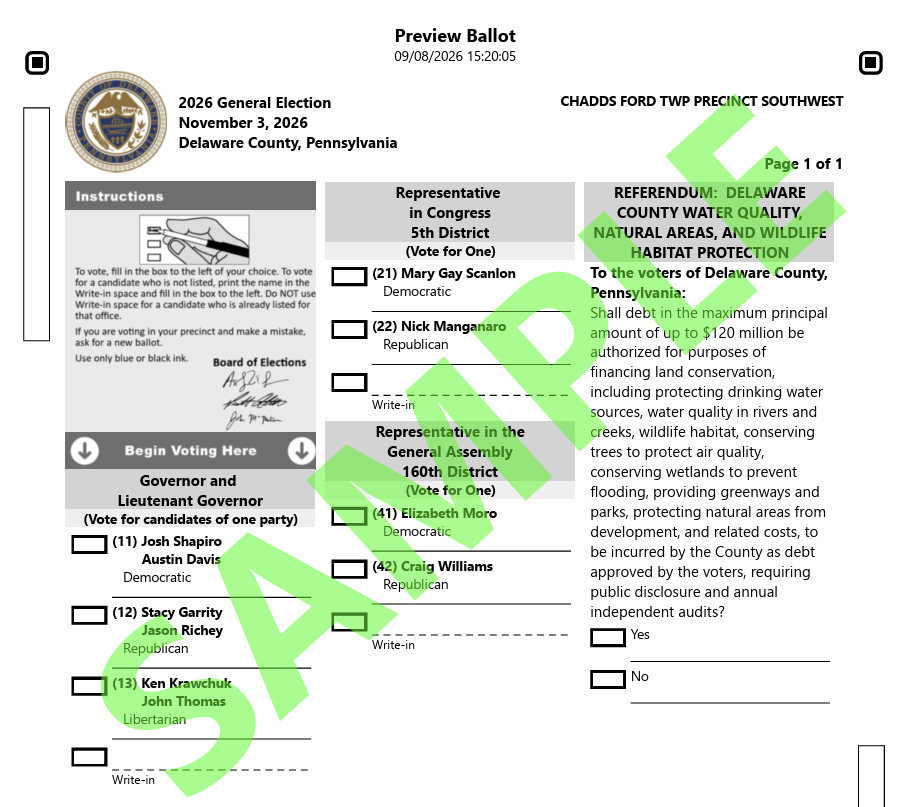
This year, our November ballots in Chadds Ford will include four items to vote on:
- Governor
- U.S. House of Representatives (5th district)
- PA State House Representative (160th district)
- A referendum on county-level open space municipal bonds (more on that here)
In Chadds Ford, your ballot will look like this. 👇🏻 For other local sample ballots, check here for Delaware County and here for Chester County.
Today, we’re focusing on the State House Rep. race. Who are the candidates? What do they stand for? Who are they working for? And what are their priorities? Let’s dive in.
The PA-160 race at a glance
Your vote in this race really matters!
In 2024, the PA 160th (a race between the same two candidates) was decided by about 1,500 votes (out of more than 42,000). That means if just 750 people switch their vote, the winner flips. With a shift from a Republican tailwind in 2024 to a Democratic tailwind in 2026, my spidey senses tell me it’ll be a close one. 🕷️. Your vote could be the difference.
Moreover, the winner could help decide who controls the PA State House. Democrats currently hold a 103–100 majority. Whoever controls the House controls each committee (which sends bills to the full House for a vote). In short, whichever party controls the House decides which bills even get a vote. Winning control of either chamber is a big deal (and in Pennsylvania, both chambers have been very close for many years).
📢 Let’s say it again for the friends in the back. Your. Vote. Matters!
Election Day is Tuesday, Nov. 3.
🚨 Quick Call to Action: Know someone else who needs more information on local candidates? Share this article with them.
Who is running for PA-160 state rep?
Here’s a quick summary.
| Candidate | Craig Williams (R) | Elizabeth Moro (D) |
| Status | In office since 2021 | Challenger, second run for this seat |
| Lives in | Concord Township | Pennsbury Township |
| Background | Retired Marine colonel, former federal prosecutor, PECO assistant general counsel 2009–2020 | Owner of Centreville Place Café + Market, real estate broker, cofounder of Neighbors for Crebilly |
| In Harrisburg | Republican chair of House Government Oversight Committee; also sits on Energy and Consumer Protection, Technology & Utilities Committees | N/A |
Where is the PA-160 district?
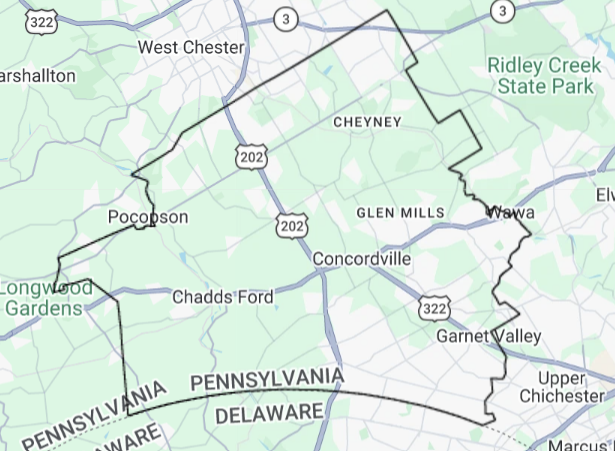
PA-160 includes Bethel, Chadds Ford, Concord, and Thornbury townships and Chester Heights in Delaware County; Birmingham, Pennsbury, Thornbury, and Westtown townships in Chester County.
Who answered voters’ questions?
Several media outlets reached out to both candidates for interviews, questionnaires, and information to help voters better understand the candidates and their policy positions. Moro answered every outlet I found. Williams answered one: the Delco Times. Here’s a summary with links to each resource so you can read more about their positions before casting your ballot.
| Who asked | Format | Elizabeth Moro | Craig Williams |
| Delco Times | Reporter interview | Answered | Answered |
| WHYY voter guide | Reporter interview | Answered | Did not respond to multiple requests |
| League of Women Voters / Vote411 | Written questionnaire, 4 policy questions | Answered all 4 | “Candidate has not yet responded” |
| PoliticsPA | Candidate questionnaire | Answered | “Has yet to respond” |
| Ballotpedia | Candidate survey | Completed | Not completed |
| Campaign website/social media | Issues or positions page | Issues section (Facebook, Instagram) | No Issues pages/posts |
Where they agree
On three of the biggest local issues, the candidates hold similar positions.
- Shoppes at Concord. Williams told the Delco Times he opposes the Route 202 project, calling it redundant given the businesses already here. His campaign site lists fighting overdevelopment at Ridge Road. He took $15,000 in campaign donations from the developer’s brother in 2022 and began publicly opposing the project in 2025 when residents expressed frustration with the development. Moro also voiced concern. She has experience fighting commercial development as co-founder of Neighbors for Crebilly, where she stood up to a large developer to conserve land in our community. For more on the Shoppes at Concord, see my previous articles on the community’s main concerns and what elected leaders knew before they spoke up.
- Data centers. Both say data centers shouldn’t come at residents’ expense. They differ on how far to go. More on that below.
- Crozer Hospital Closure: Both point to the hospital collapse and know it’s a significant problem for the community. In June 2025, after it failed, Williams filed a bill and a budget amendment for a $200 million Hospital Acquisition Assistance Fund to help buy and reopen closed hospitals, though it did not go through. Moro lists health care access as a top priority and offers more perspective on her position in the video Q&A below.
Where they differ
The two candidates take different perspectives on many issues important to members of our community. Here are snapshots of their positions on topics consistently relevant to PA-160.
| Issue | Williams (Past actions as elected leader + proposed policy positions) | Moro (Past actions as local citizen + proposed policy positions) |
| Data centers | Make them supply their own power and infrastructure; support municipalities zoning ahead of them. Hasn’t specifically expressed support for a moratorium. | Opposed to data centers locally; regulate before any come to the state. Supports a moratorium. Founded Neighbors for Crebilly to protect open land from development that the community did not support (similar advocacy). |
| Energy | Data centers should bring their own energy and “pay their own way” for infrastructure upgrades. Prioritize Marcellus Shale natural gas development and extraction in Western PA. Mixed support for clean energy; limited support for renewable energy; strong opposition to clean energy mandates. Require data centers to use “baseload” energy (which excludes renewables, batteries, and many other energy investment opportunities – more here) | Data centers should bring their own energy and “pay their own way” for infrastructure upgrades. Support affordable, clean energy alternatives Strengthen rebates on energy-efficiency upgrades |
| Health care | Proposed a $200M state budget reallocation to buy and reopen closed hospitals; it didn’t happen. Voted for strengthening protections for addicts in treatment in 2021 (voted for a suite of 3 bills) No forward-looking priorities disclosed related to healthcare. | Expand urgent care and telehealth, require insurers to cover mental health, stop private equity hospital buyouts, lower prescription drug costs. |
| Schools and education | Campaign site credits him with record education funding without tax increases (this references his vote to pass the most recent state budget that included record education funding). Does not support current multi-county funding adjustment proposal (Aug 28, 2026 newsletter) No forward-looking priorities disclosed related to education. | State funding should fill gaps so districts aren’t left covering for one another. Supports passage of solution for multi-county school funding inequities (more on that here). Make quality childcare more accessible. Make college and job training more affordable. |
| Housing and growth | Protect communities’ historic character | Reuse existing buildings, more room for accessory dwelling units, fund home repair (similar to this program) Build and preserve housing stock. Protect renters from unfair rent spikes. Expand property tax relief for families. Crack down on predatory investors. |
| Wages and costs | Cut wasteful spending; budgets without tax increases | Raise the minimum wage gradually; property tax relief; responsible use of taxpayer dollars |
| Public safety | Led efforts to secure $13M+ over several years for more federal prosecution of gun crimes in Delco and Philadelphia. (He fought for a state budget allocation for this that has stayed in the budget in subsequent years.) Voted against certain gun regulations. (details here) No meaningful assistance to help fund local fire departments through active state grant advocacy.1 | Support common-sense gun regulation. Actively advocate for grant and state funding for local first responders. |
| Elections | No stated position found. | Expand early in-person voting; let counties process mail ballots before Election Day. |
| State budget process | No stated forward-looking position found; has expressed frustration with missed budget deadlines in the past. | Earlier, more open, bipartisan budget talks to end late budgets |
Note: Information above compiled from interview sources noted earlier in this article, newsletters from Williams as a representative, respective campaign websites and social media pages, interviews, and publicly available information.
Where they stand on data centers
No issue has generated more ads in this race, so here’s what each candidate has actually said.
Moro didn’t hedge when asked. “I have said openly, despite the mailers, I am not for data centers,” she said. “I oppose them because I don’t want to see our areas that I and so many of my neighbors fought to preserve get paved over with a data center.”
Her earlier statements line up: she called for a moratorium (WHYY), said she won’t let them into the district without state regulation first (Delco Times), and cited the state constitution’s environmental rights amendment (Vote411).
Several mailers suggest Moro has received funding from data centers. On this issue, she says: “I have not accepted a dime from data centers.” Some trade unions that endorse her do build data centers, along with bridges, homes, and much more. She said she told them about data centers, “We’re going to have to agree to disagree on that one.”
Moro also said Williams voted against House Bill 1834, the House’s data center regulation bill, and that she would have voted for it. The bill passed the House 104–95 in March with support from only two Republicans; it would require data centers to cover the grid costs they create.
Williams told the Delco Times that data centers should supply their own power and infrastructure, and that they are the main reason electricity prices are so high. He supports municipalities getting ahead of data centers through zoning. He did not answer the League of Women Voters’ question about data centers.
I’ve also taken a deeper dive into Williams’ position on data centers, particularly the energy they use. I’m not aware of any discussion from him related to a moratorium on data centers. He has been strongly advocating for his signature energy bill, which implicitly assumes data centers are coming to Pennsylvania. Here’s more on that signature energy bill if you’re interested.
My conversation with Elizabeth Moro
I connected with Moro on Oct. 20 to ask the questions I kept hearing from neighbors. Watch the full interview below. Her responses are entirely unedited, so you get a clear look at who she is and where she stands. Here are a few highlights:
Why she’s running. “I just feel like our current legislator, it’s all about him and not about us,” Moro said. “I’m not a superhero. I don’t have all the solutions, but I think the power is when we bring people together to find the solutions together.”
What 47,000 doors taught her. Her campaign has now knocked on more than 47,000 doors and held nearly 60 “Mondays with Moro” open meetings at Hank’s Place. She hears frustration about rising costs, health care, and hospital closures. The conversation that hit hardest was about fire companies: a new fire truck runs about $1.4 million, and she said Williams told one company to hold a chicken dinner and bake sale. “We pay a lot into Harrisburg,” she said. “We need someone who’s going to go in there and bring the resources back to our community.”
Sidenote: The discussion about fire department funding has raised many questions in the community. It’s certainly a challenge. I wrote more about it in this article. I’ve spoken with many people about this issue, and this will be an ongoing series. Across a broad range of conversations, it’s evident Williams has done nothing to help resolve this issue or actively advocate for state funding to support local fire companies. You decide how this affects your vote, but the facts are crystal clear.
Affordability, from behind the counter. Moro says tariffs have raised her café’s costs, like coffee beans, and her health insurance rose 40% this year. She pays her staff $15 an hour or more. She supports raising the minimum wage, but gradually: “We can’t do it suddenly, because small businesses need us to do it gradually so that they can sustain their well-being.”
School funding and your tax bill. Moro supports the state’s fair funding approach, so districts with strong property values aren’t left covering for those without. “We need to make sure that schools are equitably funded so we don’t make up the difference in the long run,” she said. She also wants each county in a two-county district to pay its fair share, and a hard look at where school dollars go. “We also want to make sure that the people who are paying for that bill don’t get continually asked for more.”
Housing without losing open space. Moro calls the Crebilly proposal “the wrong project in the wrong place,” and says new housing should start with what’s already built: repurposing vacant buildings, allowing more accessory dwelling units (subject to local zoning), and funding home repair.
She’d vote to fund a successor to the state’s Whole-Home Repairs program, which launched in 2022 with $125 million in federal pandemic aid; the 2025–26 budget left out a state-funded successor. On the style of new housing, “Not everybody wants the two-acre lot and the house to take care of,” she said. “A lot of people want turnkey living.”
Where she breaks with her party. Spending and energy. “I don’t want to see us just spend money to spend money,” she said. She’d also put new nuclear technology on the table: “Let’s not just have one train on how we fuel our communities, but let’s look at all our options.”
Health care. Moro points to low insurance reimbursements and private equity ownership as what sank Crozer. “It’d be like if you came into my café, bought a cup of coffee, and said, ‘I’m only going to give you 50% of that value,'” she said. She questioned Williams’ $200 million hospital fund, saying the money was already allocated elsewhere. (Williams’ office said the budget amendment would not require new spending or revenue.) She also wants the state to stand behind good science as Pennsylvania deals with a measles outbreak.
Her pitch to 2024 Williams voters who might vote differently in 2026. “I live the experience that you’re living. I’m not a career politician,” Moro said. She promises to show up “for more than just a photo op” and to listen. “We need people there who understand what it is to be in our community and do the work.”
What else neighbors should know. “There’s more that connects us than divides us,” she said, borrowing from her book, “and I really look forward to building that kind of atmosphere here if I get the chance to serve.”
Editor’s note
Rep. Williams’ campaign did not respond to WHYY, the League of Women Voters, PoliticsPA, or Ballotpedia this cycle, though he did speak with the Delco Times. Connect Chadds Ford drew on that interview, his campaign website, and his public record.
Before you vote (‘cuz you’re definitely voting, right?)
Read their answers, especially when they offer them in their own words. Then make your voice count.
Don’t let strangers decide who represents you in Harrisburg. Maybe you’re really happy with one of the candidates. I love that for you!
And if you’re not…
As Sharon McMahon says, even if you think you have two bad choices at the dentist, you don’t ask a stranger on the street which one to choose (extraction or root canal?). Why do that with your elected officials? Don’t let other people speak up for you when you can use your own voice (because you never know what they will choose...).
- Mail ballot request deadline: 5 p.m. Tuesday, Oct. 27. Completed mail ballots must reach your county by 8 p.m. on Election Day. Postmarks don’t count.
- Election Day: Tuesday, Nov. 3. Polls are open 7 a.m. to 8 p.m.
- County election offices: Delaware County · Chester County
Lastly… Got a question neither candidate has answered? Ask it at a door when they show up to your home, at a public event, or in the comments below. That’s how a community gets the representation it deserves.
Now go make your plan to vote! 🫶🏻
- Local fire departments have approached Williams for financial grant advocacy. He suggested they host a Fireman’s Ball to raise money and has not actively advocated for pushing state funding to PA-160 district fire companies. ↩︎