How does one get an LSA grant in Pennsylvania?

Did you hear the news?! The Rachel Kohl Community Library received a $150,000 LSA (Local Share Account) grant to replace its ailing roof and add rooftop solar panels. The library has patched the roof more than 15 times in the last 18 months, so it desperately needs a replacement. Electricity is one of the library’s largest expenses after salaries, so rooftop solar is projected to save the library more than $350,000 (!!) over 25 years. That money goes right back into more programs, more books, and more reasons to love the library.
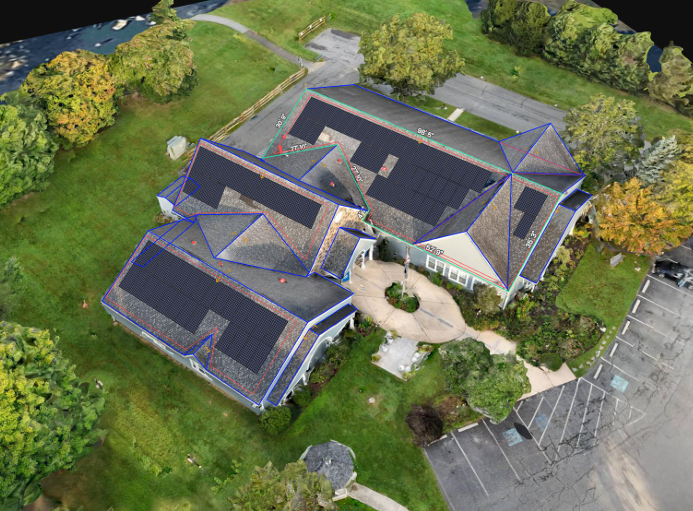
As President of the Board, I volunteered to lead this grant request and worked closely with the Executive Director, the Board Treasurer, other board members, and the Borough of Chester Heights to submit it. The library peeps solicited bids, prepared documentation, and completed the grant questionnaire information.
Why work with Chester Heights?
LSA grants must be submitted through a municipal organization, and Chester Heights generously offered to sponsor the library’s submission. Worth nothing, most municipalities don’t like to submit multiple grant requests because they naturally compete with each other for limited funding. Chester Heights made the library’s grant request its priority for the 2025 submission season. Surely there were other worthy requests, and the library is incredibly grateful that Chester Heights was a willing partner.
Announcements from local leaders
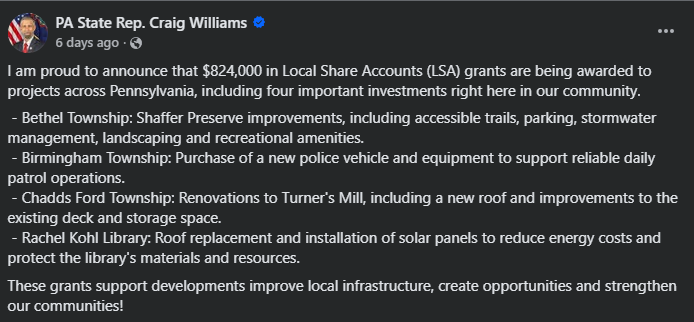
Just a few hours after the state announced the grant recipients for this cycle, Representative Craig Williams posted an announcement on social media.
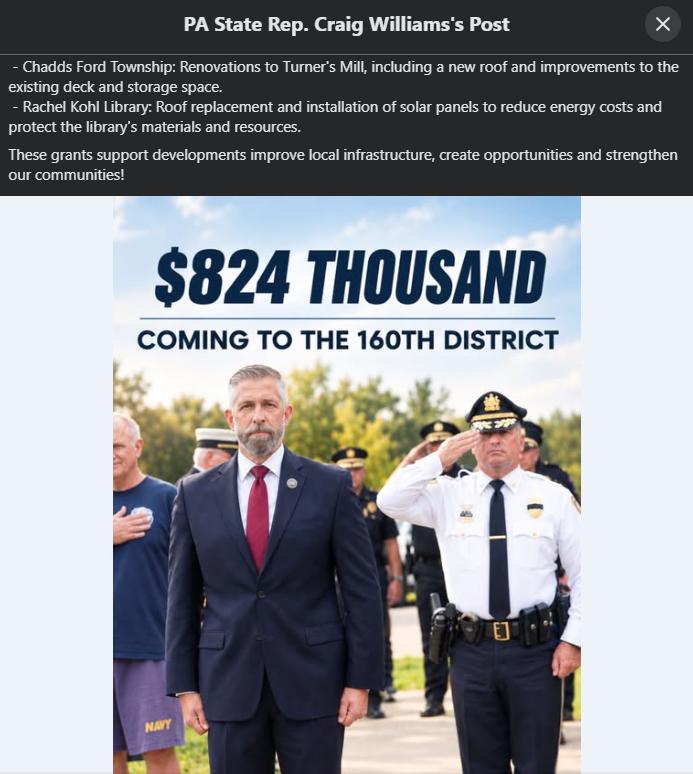
A picture says a 1,000 words. As the comments on the post make clear, many neighbors interpreted the photo and language as an homage to him for helping secure this funding.
His posture and the photo’s composition make it easy to see why someone might draw that conclusion. Even if it was supposed to pay respect to the police department pictured, the officers are not the focus of this photo. Many commenters felt it was a “look at me” photo implying Williams deserved credit for the grant awards.
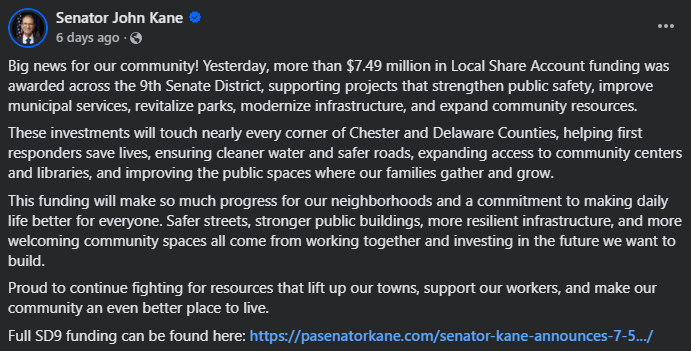
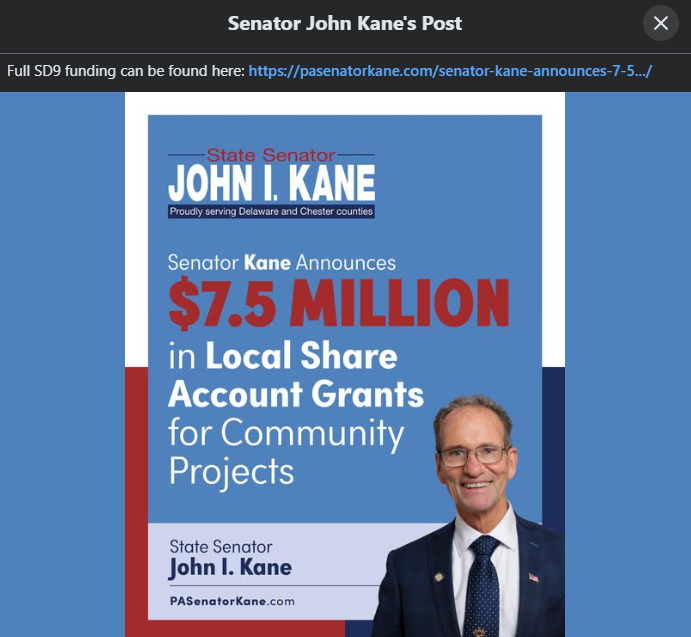
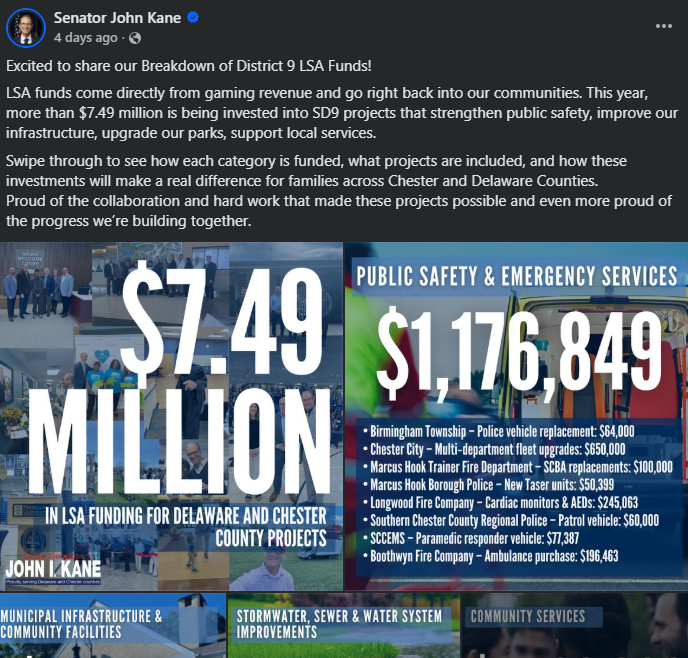
Senator John Kane also shared a similar post on social media announcing all the LSA grants awarded to his district. I suspect the smile and warmer tone of his message contributed to fewer comments about who deserves the credit, but I’m no mind reader. The more community-focused messaging below in a follow-up post doesn’t hurt either.
Who does all the work for LSA grants?
I suspect many people don’t know how the LSA grant submission process works (I didn’t until the library submitted one). Who does all the work? Where does the credit belong? In my never-ending quest to collectively learn and share more about civic engagement and municipal matters, I thought I’d share how the process worked for the library so you can see how each party was involved.
Who funds LSA grants?
LSA (Local Share Account) grants come from the Commonwealth of Pennsylvania. LSA funding distributes state gaming revenue to support projects in the public interest in Pennsylvania. There are a bunch of requirements to qualify, and you can dig into them on the state site if you’re feeling ambitious.
Steps to submit an LSA grant request
Several steps and many parties are involved in getting a grant submission across the finish line.
Prepare to apply for the grant
It takes many weeks, and sometimes months, from when an organization decides to apply to final submission. The library contemplated several options to resolve the roof maintenance concerns and debated rooftop solar installation before passing a motion to move forward with the grant request process in early fall 2025.
The grant application deadline was November 30, 2025, and awards were announced last week. It was a long wait!
Find a municipal partner
After deciding to apply, the library needed to find a municipal partner. The library told each of the five municipalities about its intentions for the LSA grant request, and Chester Heights quickly offered to be the sponsor.
Solicit project bids to prepare a budget
The library’s executive director and several board members solicited quotes from roofing and solar installation vendors over several weeks. One rooftop solar vendor presented at a board meeting to help board members understand the steps, risks, and benefits of installing rooftop solar.
Municipal resolution passed
Once the library established a budget, Chester Heights needed to pass a resolution stating its intention to sponsor the grant, including the amount of the grant request. Because municipal meetings only happen every few weeks, the application process couldn’t move forward until the next voting session. Chester Heights passed the resolution without issue.
Complete the grant application
An LSA grant isn’t easy to complete, but compared with other types of grants, like certain federal programs, it’s a lighter lift. Several library representatives worked together to answer a variety of grant proposal questions, from organizational information and project budget details to how the grant would help the community, why it was important to the library, who benefited from the funds, and several other similar questions.
The Borough of Chester Heights has access to the state’s submission portal, so the final application had to be filed through their portal access after the library provided the detailed information in response to each question.
As a fun anecdote, I was in Pittsburgh for a hockey tournament for one of my boys as we approached the submission deadline. I definitely took some calls and powered up my laptop from the parking lot of an ice rink to get this thing finalized. 😂 It was a team effort!
Request letters of support
Though not required, most grant proposals include a handful of letters of support from local elected officials and municipal leaders. The library requested letters of support from each of the five townships served by the library as well as state Senator John Kane and state Representative Craig Williams (as representatives of the library’s district).
Municipal letters of support
The library prepared templates for the letters of support. Each of the five municipalities made meaningful changes to reflect their priorities and specific reasons for supporting the project. I was impressed and pleased with these letters and their thoughtful perspectives. I suspect the unique wording and distinct priorities showed the state there were many reasons to fund this project.
State Assembly members’ letters of support
For Kane and Williams, the library wrote separate templates so each letter more closely aligned with their respective platform preferences. In both cases, administrative staff returned electronic documents within a couple of hours, signed (I assume electronically) by the respective elected officials. No one changed the language in either template. I guess the library’s crack at language was sufficient. 💛
It’s standard procedure to request letters of support from the local representative and senator. That was the extent of their involvement in the grant submission, and they aren’t expected to be involved in the funding or project implementation process.
For clarity, some local representatives take a more active role helping local organizations understand what state grants are available and how to apply for them successfully. In our case, the two local state elected officials weren’t intimately involved, but in other cases they could play a more prominent role.
So that’s that. That’s how a local non-profit submits an LSA grant application. Now you know who does the heavy lifting and who adds stamps of approval for the state’s review.
Now it’s time to get to work!
Hopefully in the very near future, you’ll see a new roof (sans holes) and money-saving solar panels adorning the Rachel Kohl Community Library.
Everyone at the library is ecstatic about receiving these funds. The projects will transform our building and lift a significant weight from our monthly budget, allowing library staff to continue investing as much as possible in making the library better for the community every day.
What about the cash money?
The library manages the project and pays vendors. Once the project is complete, the library prepares a report with receipts and supporting documents showing the project cost. Chester Heights submits this information to the state on the library’s behalf. The state reimburses Chester Heights $150,000 (assuming the project expenses meet or exceed the grant amount), and Chester Heights passes it along to the library.
The library requested $200,000 for the project out of a projected $230,000 project estimate, so all $150,000 should be spent and reimbursed, assuming the roof and solar installation go as planned.
Thank you. Thank you. Thank you!
Thanks to everyone who supports the library through program visits, book borrowing, volunteering, financial donations, advocacy, and general public support. You are appreciated!
Got any other questions?
I’ve submitted only this one LSA grant and helped execute a second LSA grant when the library renovated the children’s library section a few years ago. But I’ll do my best to answer.