Sizzlin’ Summer at Calvary Chapel continues to frustrate neighbors

A lot has happened since we last checked in on the concert venue that wasn’t a concert venue. Here’s an update on Sizzlin’ Summer at Calvary Chapel. See the full series on the Calvary Chapel conversation here.
If you’ve been following the Calvary Chapel development story, you know we’ve been tracking a slow-rolling land use dispute that keeps finding new ways to heat up.
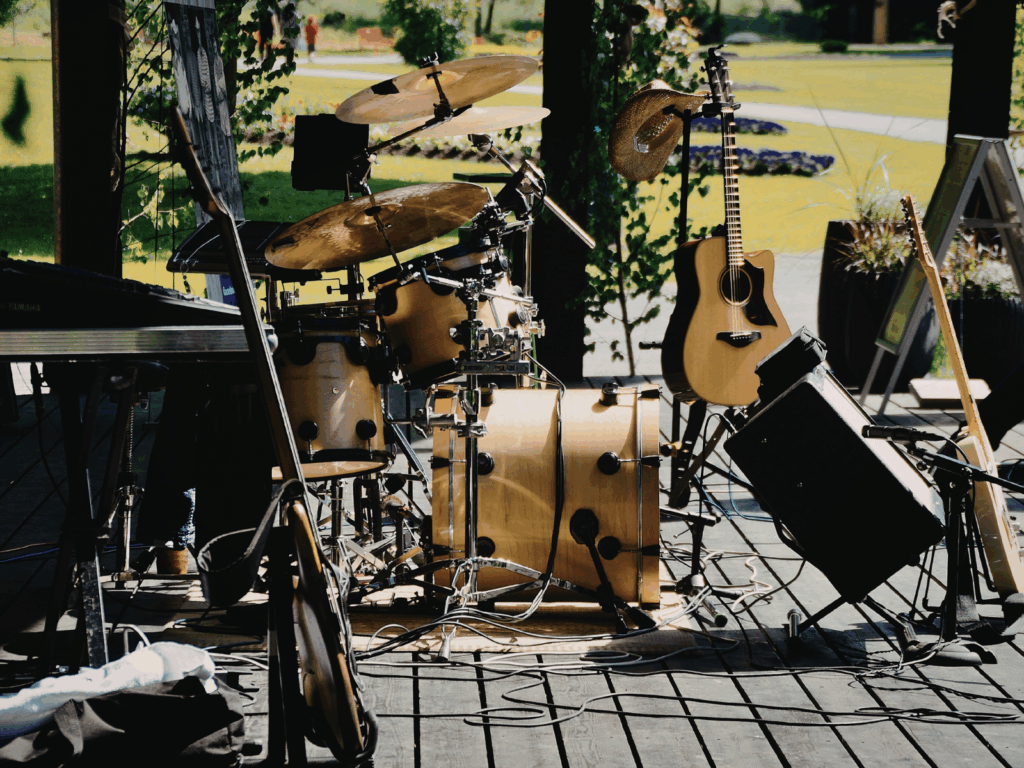
If you’re new to this matter, here’s the short version: Calvary Chapel, located at 500 Brandywine Drive, applied to build a large addition to its current campus that includes (depending on who’s doing the describing and for what audience) either a cozy coffee terrace or a full-scale outdoor entertainment venue with three large video screens, an audio room, a video room, a stage light bar, and four speakers. The architectural drawings and architectural renderings in their fundraising materials confirm the use of all the high-end stage technology, so draw your own conclusion.
In 2025, the township zoning officer ruled that it was not a permitted use in the POC (Planned Office Campus) zone where the church is located. Calvary Chapel appealed. The Zoning Hearing Board denied that appeal after a December 2025 hearing.
In November 2025, Calvary Chapel filed a federal lawsuit against Chadds Ford Township1 in response to the matter, hoping to force the township to allow it to build the amphitheater. After the Zoning Hearing Board appeal was denied, Calvary Chapel filed a second lawsuit against the Chadds Ford Township Zoning Hearing Board2 on March 25, 2026, in the Delaware County Court of Common Pleas.
What’s it like living next to Calvary Chapel?
Neighbors have been vocal for several years about the disturbances they endure from noise and light pollution from Calvary Chapel. It hit a fever pitch last year due to the proposed construction of the outdoor concert venue.
Michael, whose home property borders Calvary Chapel, addressed the township in a formal public comment on December 16, 2025, at the Zoning Hearing Board. He said:
“My wife and I support churches and religious freedom. We respect the role churches play in many people’s lives, and this is not an objection to worship or belief. What is at issue is whether zoning laws, prior conditions, and quality-of-life protections apply equally to everyone or whether certain institutions are allowed to operate outside of them.”
He described years of documented impacts. Headlights from the church’s one-way traffic pattern shine directly into his kitchen and living spaces during evening services. The church previously committed to planting non-deciduous trees as a screen, but those trees are still immature and do not provide meaningful mitigation. More significantly, low-frequency bass and drums from worship services and outdoor events are audible inside his home early in the morning and late in the evening. He continued about his household:
“On multiple occasions, low-frequency bass has disrupted their sleep, even with white-noise and sound machines in use. This is not a matter of volume preference. Low-frequency sound travels farther, penetrates structures, and is felt as vibration.”
When the noise gets bad, he asks church leadership to turn it down. He says the church generally has handled his concerns respectfully. But he continues that, “Compliance with township ordinances should not depend on neighbors monitoring activity, making real-time calls, or acting as informal enforcement officers.”
Many neighbors echoed his sentiments at the Zoning Hearing Board meeting and were glad to see the application for the amphitheater construction denied.
Sizzlin’ Summer at Calvary Chapel is back?
Recently, Calvary Chapel requested a special events permit to hold its annual Sizzlin’ Summer series in 2026. The Sizzlin’ Summer event series is not the only source of noise and light pollution that’s washing over the neighbors. But it’s the most prominent and pressing, particularly because it’s tied to the permanent outdoor theater construction, which is currently the subject of litigation.
In Calvary Chapel’s own words, Sizzlin’ Summer is when they bring “some of the best teachers, communicators, and artists right to our lawn” so they can “learn, worship, and celebrate baptisms.”
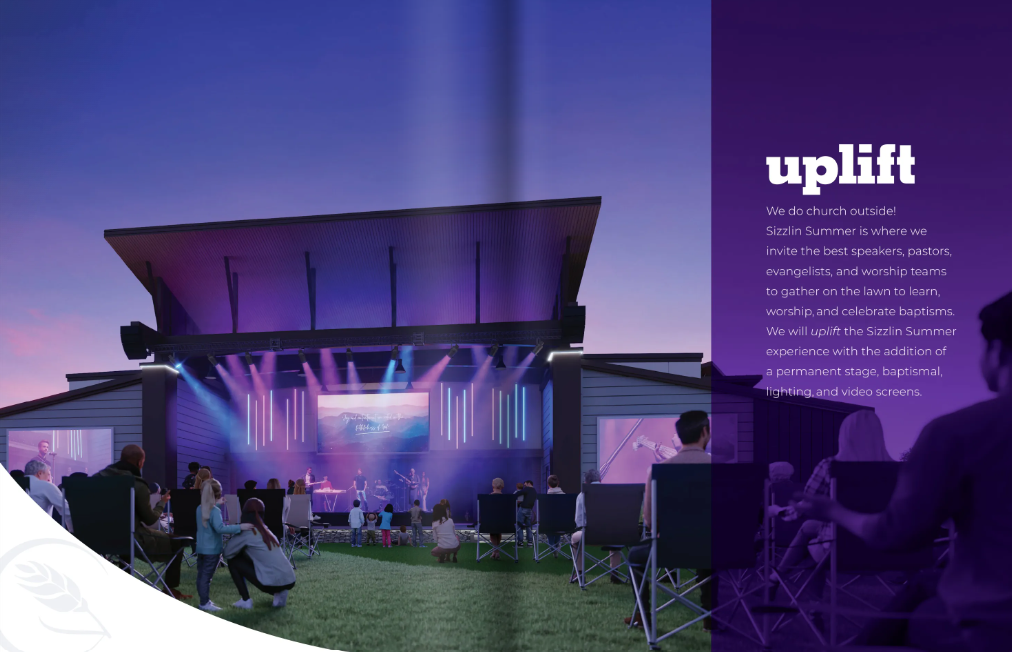
The outdoor worship series features amplified music, guest speakers, baptisms, food vendors, merch booths, and large crowds. The food court opens at 6 pm, and events start at 7:30 p.m, according to their website. It’s a well-organized community event for the congregation. It is also, by any reasonable measure, a large outdoor production in a residential-adjacent zone.
The fundraising campaign for the proposed construction tells you a lot about the intended scale of these events. The campaign goal is $4.7 million, with $3.1 million already committed and $2.3 million received, according to their fundraising site.
Plans include a multipurpose room, gymnasium, “a permanent outdoor theater,” and a Sizzlin’ Summer reconfiguration and stage. The phrase “permanent outdoor theater” appears in Calvary Chapel’s own donor-facing materials, even as the organization has characterized the structure to the township as something far more modest.
That gap between what’s being pitched to donors and what’s being described to the township continues to erode trust among the church, Chadds Ford residents, and township administrators.
Neighbors hoped the special events permit would not be approved; no such luck
Due to the size and scope of the event, the Sizzlin’ Summer series requires special events permits from the township. Despite approval in past years, neighbors implored the township not to approve the permit this year.
Chadds Ford resident, Chris Mohn, summarized the increasing frustration many neighbors feel about the special events permit:
“My wife and I have lived in Chadds Ford Township for 16 years, and we live on Harvey Lane. In the past, we’ve not objected to Calvary Chapel’s special events permits in the interest of trying to be good neighbors, and due to the limited nature of 6 to 8 events a year in a non-permanent setting.
This year, we, my wife and I are opposed to the permit. Our neighborhood, especially those properties adjoining the Calvary property, have been subjected to noise that exceeds the allowable levels at these events. Calvary agreed to abide by these noise limits under their conditional use agreement when they built there. [According to neighbors, noise regularly exceeds the agreed upon conditions.]
The second reason is that Calgary’s recent demand and push to build a permanent amphitheater with lights, screens, and speakers, whatever they want to call it, and their lawsuit regarding the same has made it clear that they have no intention of limiting their outside activities and noise that exceeds the permitted levels.
And we think… I think enough is enough on all that. (public comment at the March 25, 2026, Board of supervisors meeting)
“Enough is enough.” Resident Diane Smith expressed a similar sentiment. Chadds Ford residents have tried to be good neighbors and feel that their accommodations have been exploited, particularly as their appeasement of past events now seems to serve as fodder for the Chapel’s counsel in justifying approval of the permanent amphitheater.
Essentially, Calvary Chapel attorneys said, “There were no violations, penalties, or fines issued in the past, and this amphitheater would host more of the same types of events, so what’s the big deal?” (I’m paraphrasing from the zoning appeal meeting in December 2025. This is not a direct quote, but my interpretation of a statement they made at the zoning hearing.)
Residents say the absence of fines or citations is due to the township having no effective way to issue them, not because violations weren’t occurring. If a special events permit is granted now, without resolving that enforcement gap, some are concerned that it appears to be a permission slip to continue the noise issues with no accountability mechanism.
Other Chadds Ford residents suggested that approval of this special permit, in light of the ongoing litigation, might support Calvary’s case that the events are fine (and, consequently, that construction of the permanent venue to host them should be fine too).
Chadds Ford supervisors stated in the March 25, 2026, Board of Supervisors meeting that they conferred with special counsel on the matter. They were advised to approve the permit and limit discussion due to the pending legal matter. Supervisor Timotha Trigg said:
“We received a letter last month from concerned neighboring property owners. And we did forward that to our special counsel representing the township in a federal lawsuit filed against the township by the applicant. He recommended a yes vote, and that we do so without further comment. So that’s all I can really say about that.”
The Board offered no further commentary on the matter. The special permit was approved 3-0.
Matters to all Chadds Ford residents
If you don’t live on Harvey Lane, the neighborhood adjacent to the Calvary Chapel campus, this matter remains relevant to all of us.
Lawsuits impact all of us
Calvary Chapel has filed suit against Chadds Ford Township, and the legal argument rests on the Religious Land Use and Institutionalized Persons Act (RLUIPA), a federal law passed in 2000. RLUIPA prohibits zoning laws that treat churches on less than equal terms with nonreligious assemblies, that discriminate against institutions on the basis of religion, or that unreasonably limit religious assemblies within a jurisdiction. The Department of Justice has enforced many cases related to this legal matter.
When religious institutions exercise their statutory rights under RLUIPA, third parties can be forced to bear the cost. Neighbors who purchased homes on quiet streets can find themselves with no recourse when a religious accommodation overrides the rules that apply to everyone else. That’s the exact situation Harvey Lane residents describe.
Moreover, the township’s defense in federal court is not cheap. That cost is shared by every taxpayer in Chadds Ford.
This situation sets a precedent
Handling this circumstance sets a precedent for future land-use matters, responses to noise violations, and the balance between residents’ priorities and those of local businesses. Neighbors have raised a pointed concern that the township currently lacks an adequate enforcement mechanism for noise ordinance violations.
Chadds Ford resident Hank Somer, who does not live near the church but has consistently supported the Harvey Lane community concerns as a fellow Chadds Ford neighbor, said at the aforementioned public meeting:
“Might this be a time to step back and revisit our township sound ordinances, with these examples cited in addition to Calvary, and update township ordinances on sound?
This is not about being adversarial towards any institution, it’s about fairness. It’s about equal acceptance of standards. We expect every resident and every entity operating in our community.
My neighbors on Harvey Lane have been patient; they’ve followed the process, they’ve shown up year after year asking for relief. It’s time the board finds a durable solution, not another promise, not another conversation, but a mechanism with teeth.”
More broadly, neighbors are increasingly losing trust in their public officials. Harvey Lane resident Michael said in the March 25, 2026, public meeting:
“When an institution like Calvary Chapel fails to act like a responsible neighbor, it doesn’t just impact my home. It erodes the trust across the entire community.
What my family is dealing with is not minor, and it is also not acceptable.” He goes on to describe the noise and light pollution that flood his home regularly and disrupt his peaceful privacy with his young family.
“I am here because the problems we have raised repeatedly have not been fixed. And now, instead of resolving those issues, there is a request to expand outdoor events, which will only make these problems worse. Guys, it just does not make sense. If the current impact has not been mitigated, why would we approve an expansion that also amplifies it?
Beyond my household, there are also broader concerns. Zoning precedent, as well as ongoing legal matters, which I know that you’re well aware of. I’m not going to rehash all of that, but approving another outdoor use while these issues remain unresolved sends the wrong message, and I ask you to think about what that says to your community. Because … it tells the community that accountability is optional.
At the end of the day, it also comes down to fairness. Every resident and every organization is expected to follow the same rules. That means honoring commitments and respecting noise ordinances, and taking real, measurable steps to reduce the impact on neighbors. That has not happened here.”
Resident Ellen Spoehr expressed her concerns in a Letter to the Editor at Chadds Ford Live titled “Silence is a Choice.” She highlights the growing trend of our township officials choosing not to engage with the public through active dialogue, instead relying on minimal acknowledgment of residents’ concerns and, at times, leaving important matters off the agenda entirely.
“This silence is not neutral; it is a choice,” Spoehr writes.
She continues:
“[About Sizzlin’ Summer permit approval statement from the Board of Supervisors] The phrase “without comment” should concern every resident. While legal considerations matter, they should never take precedence over open public dialogue. Elected officials are not meant to be silent intermediaries for attorneys; they are tasked with representing their constituents transparently and directly.
…
[About public meetings in general] When elected officials prioritize minimizing institutional risk over addressing legitimate community concerns, they send a clear message—one that suggests governance is conducted defensively rather than collaboratively. This leaves residents wondering whose interests are being protected.
Public meetings should offer honest dialogue and accountability. While silence may reduce short-term legal risk, it fuels frustration, disengagement, and distrust, and when residents must fight for basic answers, something fundamental in local governance has already been lost.”
Broader pattern of RLUIPA cases
The Calvary Chapel situation isn’t unique in the national landscape. RLUIPA cases have proliferated over the past two decades, and legal scholars have noted a consistent dynamic: the law was designed to protect minority religious groups from genuine discrimination, but it has increasingly been used by large, established congregations seeking to expand in ways that local zoning would otherwise prohibit.
RLUIPA’s equal terms clause forbids a government from treating a religious assembly on less-than-equal terms with a nonreligious assembly, but this should cut both ways. A secular concert venue in a POC zone would face the same restrictions Calvary Chapel is contesting. That’s zoning, not discrimination.
Status of Sizzlin’ Summer and the concert venue
The Zoning Hearing Board denied the appeal on the new construction. The federal and county lawsuits are active. The Board of Supervisors approved the special events permits for Sizzlin’ Summer 2026, which, in effect, uses their existing campus for exactly the kind of large outdoor gatherings that neighbors say have been a persistent problem for years.
The neighbors hoped the township would not grant new permissions until existing conditions are met, documented impacts are resolved, and there’s an enforceable mechanism to hold the church accountable for violations.
As Michael included in his public comment: “This is not anti-church. It is pro-rule of law. It is pro-neighbor. And it is about whether zoning, once bent, can ever truly be enforced again.”
- Federal suit: Calvary Chapel of Delaware County, Inc. v. Chadds Ford Township, filed on November 12, 2025 (https://dockets.justia.com/docket/pennsylvania/paedce/2:2025cv06392/646060) ↩︎
- County suit: Calvary Chapel of Delaware County, Inc. v. Chadds Ford Township Zoning Hearing Board, filed on March 25, 2026 (https://delcopublicaccess.co.delaware.pa.us/case/d1a73b9e307d3e4b2e1c98afdd7ca2864fdb5d6035d838cbe645556ad4fc30f4) ↩︎