Is every tree truck in Philly on Heyburn Rd?

It sure feels like it. 🚛
What’s up with all the trees down in Chadds Ford?
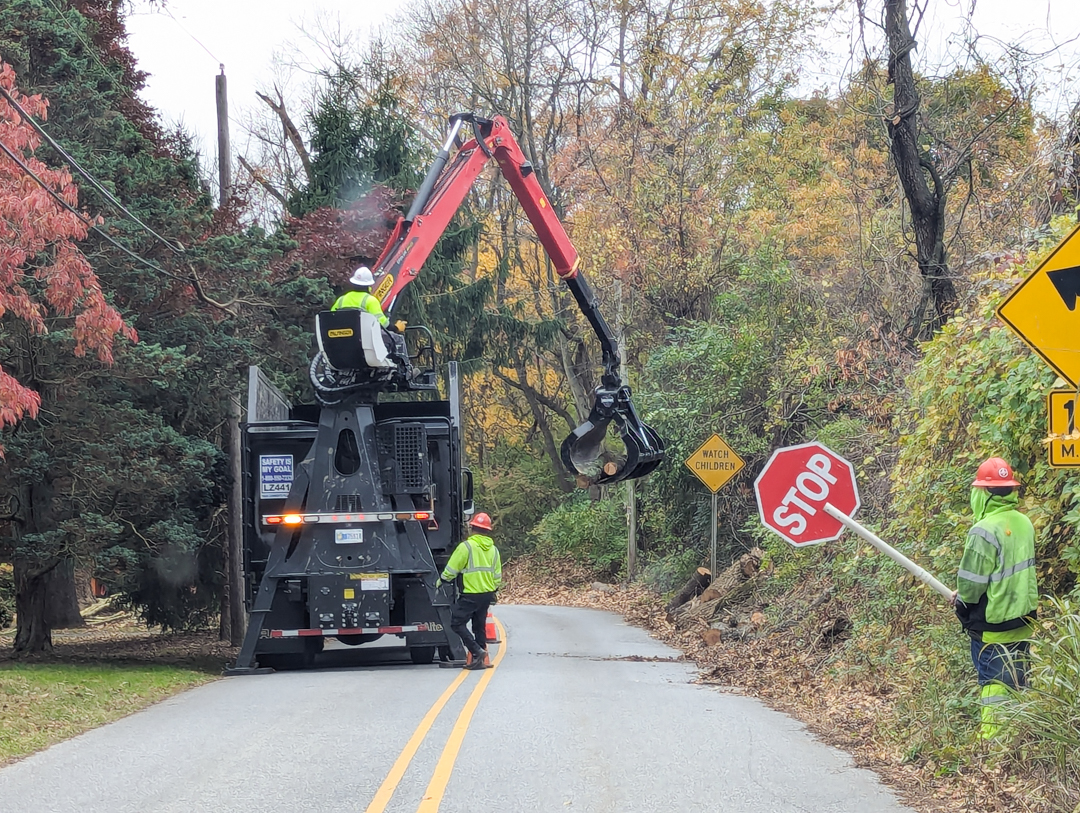
We all know that Asplundh uses the old State Farm building as a parking lot for its tree-work trucks. Does anyone else feel like they put every one of those trucks to work on Heyburn Road over the last few weeks? 😳 Holy tree trunks. Or shall we say “holey” tree trunks thanks to our friends, the Emerald Ash Borers, literally eating their way through the trunks of the ash trees.
If you’ve been driving on Heyburn, Ridge, Ring, or Atwater Roads lately during the day, you’ve almost certainly run into a log jam (pun intended 😉) of vegetation management around the power lines. This doesn’t feel like run-of-the-mill tree work. And is it ever going to end?
Chadds Ford township administration kindly put me in touch with the project manager at PECO to get a bit more information about what’s going on, why such aggressive “trimming” is taking place, and when it will end. Let’s discuss.
Why so many trees?
If you feel like this bout of tree trimming is a bit much, you’re correct. It’s above and beyond PECO’s standard vegetation management practices, thanks to the Pennsylvania Public Utility Commission (PUC), a public agency that oversees 9,000 utilities in Pennsylvania. Among other things, the commission’s mission includes ensuring reliable power for energy consumers in Pennsylvania.
The PUC identified that we have frequent power outages in Chadds Ford, often caused by fallen trees. Have you noticed too? 🧐 Chatter in community Facebook groups suggests you probably have.
Due to the high frequency of power outages in our area, the PUC mandated that PECO conduct a more aggressive vegetation management program around our local power lines to reduce future outages.
The PECO project manager confirmed that the vegetation management planner (the person who decides which trees to trim and remove) relies on a matrix to determine which trees and branches need attention. It includes guidelines to remove all ash trees around the lines (they’re dying anyway), clear branches growing around the lines, and remove any other trees in close proximity to the lines that are likely to fall and impact reliability.
As we have keenly observed, with the mountains of logs lying along the road, many ash trees and other trees are posing a threat to the power lines along our roadways. The ash trees rot from the inside out, making them especially precarious to manage once the ash borer disease really takes hold. Taking them out sooner rather than later keeps our roads safe and our lights on.
Will they clear out all the logs?
Yep! Many large logs are lying along the road. Asplund will eventually return to clear out all the tree trunks. They clean up most of the debris as they trim, but log removal requires a different set of vehicles. These come in later.
When will the project be complete?
There is no specific date, but the PECO project manager estimated completion of the tree trimming and chopping in Chadds Ford around mid-November, so buckle up for more delays. 😩 They’ll return within the next handful of weeks to pick up the logs. All related tree debris should be cleaned up by the end of December.
Did owners know their trees were being removed?
The project manager confirmed that all property owners where trees were being removed were notified in advance of the work. PECO maintains rights-of-way around its lines, giving it the authority to remove trees that impede the safe and reliable delivery of electricity, even on private property. But they coordinate with property owners to limit surprises.
What about the big tree at Heyburn Rd and Hilloch Lane?
This tree was supposed to be removed as part of the program. The township planned to make minor engineering adjustments to the intersection after the tree was removed to improve navigation. Following residents’ concerns, the tree remains in the middle of the intersection. PECO and the township will monitor the tree for now. It’s a gorgeous tree despite being in a rather problematic location.
Can we plant replacement trees?
Yes, but stick to smaller trees around the power lines. Generally, PECO suggests “that any trees planted within 20 feet on either side of pole-to-pole power lines have a mature height of less than 25 feet.” Additionally, PECO maintains a list of recommended best practices and species to help residents select trees that will thrive under power lines, limit outages, and require minimal vegetation management.
It’s a bummer to see so many trees cut down. But many of them are ash trees that don’t have much life left in them anyway. They need to be replaced with trees that will thrive in our area.
We also have to make trade-offs between bucolic beauty and modern energy demands. Removing trees that are threatening to fall onto the roads might pay dividends for our safety, too. Remember this on Highway 52? 🫣
Heck, with all the tree clean up, maybe the treacherous S-curve on Heyburn Rd south of Ridge Rd won’t look like a warzone anymore. One can hope. 🤞🏻
Would you consider supporting this work?
The community supports this newsletter. I mostly do the work for free. If you value this newsletter and have the means to support it financially, I’d love for you to become a paid subscriber. If not, that’s ok too. Thanks for considering it! 💛


Important question here, did the PECO rep tell you the ash trees rot from the inside out?
That’s totally the opposite of how they decay. The borer only chews through the cambium and sapwood, the heartwood is too tough. I can even show you dozens of examples of this.
If they’re the ones that told you that, I wouldn’t trust a word they said.
Thanks for the note. We didn’t talk about the science specifics of how the tree degrades over time. My scope of inquiry focused on the project’s timeline and extent, as that’s what I anticipated neighbors were most interested in understanding.
That “rotting from the inside” is my shortcut for noting that the tree degrades without apparent deterioration on the outside right away (at least to a layman’s eye). I know the arborist can see much more than those of us just driving by, wondering why trees that look pretty normal are being taken down. Hope that clarifies.