Electric vehicles are coming for your gas guzzlers

Energy is the hot topic du jour, so how about we dabble in electrons through the lens of life in Chadds Ford. Enjoy this pop-up series, Energy in Chadds Ford, exploring conversations about energy in our neck of the woods.
Electric vehicles are coming for your gas guzzlers. And I think you’re gonna love ’em!
What gives me reason to think this? More than you might expect.
We have two EV SUVs in our family that we charge (in part) with the solar panels on our roof, so we’re clearly drinking the battery-powered Kool-Aid. It’s especially sweet when the benefits of free energy from the sun compound in our bank account via small PECO bills and zero visits to the gas station.
But my eco-nerd tendencies and those of other early EV adopters won’t drive widespread change. Instead, the massive shift in energy paradigms shows up in small conversations with “normie” friends. Let me give you some examples.
Why electric vehicles are driving forward
⚡ Teenage boys know EVs are ‘tuff’
Tuff isn’t a typo. It’s middle-school jargon for “cool,” and they think electric is tuff. Many aren’t even old enough to drive, but teenage boys are upgrading their gas-powered dirt bikes for electric versions. I asked them why. They’re more fun to ride, and don’t require a stop at the gas station (which costs them more money than plugging into their parents’ garage outlets).
They’re quiet, the boys tell me. Better for sneaking out? Not pissing off your neighbors? I didn’t ask; not sure I want to know. But they’re just more pleasant to ride. Teenage boys understand that their bikes don’t have to be loud to be masculine and cool.
Apparently, it’s also easier to do tricks. Not sure I love that reason as a parent either. But as for trend-setting… electric options just perform better!
These are incredibly compelling reasons for the next generation of men to fall in love with electric transportation and ditch any misconceptions that vehicles have to growl and spew polluting fumes to feel manly.
⚡ Even car guys love EVs.
Want to know who else is starting to believe that EVs perform better? Wait for this. Sports car guys.
A friend who owns a sports car resale business – like this guy’s a serious “car” guy – recently replaced his monstrous pick-up truck (!!) with a Tesla Model Y. Have you seen gas prices lately?! He said his Tesla (not even the fanciest model) has more juice than a Porsche 911. Read that again. 👀
Friends… If you’ve never driven an electric car, you might not appreciate this, but they’re fast as hell and fun to drive. Even if you think climate change is a hoax (sorry… it’s not), that’s neither here nor there when it comes to EVs because they’ll leave most ICE cars in their electron dust.
We have two super heavy electric EVs, and even those can gun it when we need to merge onto I-95 at the 322 interchange. P.S. Who designed that merge anyway??? 🤯
But back to EVs, we’ve been driving EVs since 2021. We started with a Tesla and eventually transitioned to two electric SUVs. Hockey bags are bulky and demand a lot of friggin’ space. Hockey road trips require a long-range battery. We’ve been smooth sailing up and down the Northeast and Mid-Atlantic region to various hockey tournaments without hitting up a gas station for years. Yes. You can take road trips in EVs.
⚡ America’s largest car company is investing big in electrification and batteries
General Motors is all in on batteries and distributed energy. Distributed energy basically means energy that’s generated and stored all over the place (think rooftop solar, EV batteries, home batteries, community solar arrays, etc…) instead of just at large power plants and transported on the power grid. It’s the energy of the future (and increasingly the present, if we’re being honest and willing to look outside our national borders).
Electric vehicles, particularly those with bi-directional charging (meaning they can draw energy to charge and drive, or act as a backup power source for your home), are a huge potential resource for large-scale energy management. GM sees the economic opportunity and hopes to be an industry leader in the space as our energy paradigm shifts in the coming years.
GM Energy is a relatively new GM division seeking to serve as a bridge between transportation and power grid management. They hired a guy from the utility industry to help lead the group. Then they wrote an open letter to America’s utility executives and energy policymakers that basically says (and I’m paraphrasing), “The future is electric. Batteries will transform our energy management paradigm. EVs are a huge part of that transformation and can be a meaningful solution to the AI power conundrum. We plan to be on the cutting edge of that transition. Let’s do this together.”
GM Energy also serves as a new revenue source for the company. Along with EVs, GM plans to offer large batteries (home- and utility-scale) and home smart panels. These will eventually allow customers to use their cars as backup power sources for their homes and even sell excess energy back to the grid.
“Would you like to purchase an extra home battery or smart panel with that new car to make it even more useful?” What dealer is going to complain about having compelling reasons to upsell their customers?
⚡ Even the Wawas of the South are on the EV bandwagon
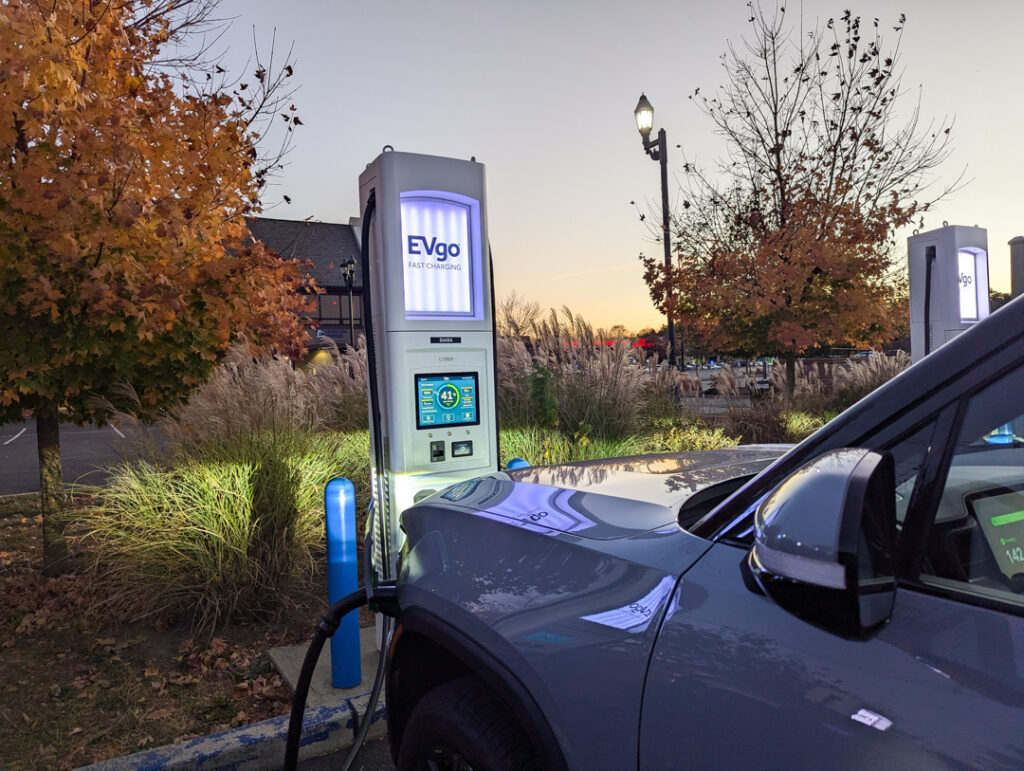
You’ve probably noticed that Wawas are installing lots of EV charging stations. These types of gas- and food-centric convenience stores see a very compelling case for investing in EV charging infrastructure. First, it’s a complementary revenue hedge against gas. If gas consumption declines as EV sales rise, it’s not existential.
Beyond that, as long-time EV drivers, we know that the food options near charging stations drive our pit stop decisions. We’re far more likely to stop at a charging spot with good food choices.
Large convenience stores and fast food joints in the South are jumping on this strategy. Despite political headwinds, these companies see that lots of their customers drive EVs. Not shockingly, people care more about getting cars that meet their needs than about what their politician of choice pretends to hate in exchange for campaign donations (though Trump’s Tesla ad on the White House lawn probably didn’t hurt the EV love fest growing outside of liberal enclaves).
EV charging installation is growing across the country. The money follows market demand, and market demand follows affordability. These days… that’s electric. Electric everything.
⚡ On Chinese EVs in Canada
This is more of a projection than an observation, but Canada will soon be welcoming Chinese EVs to their country. If I were a betting woman, I’d wager on Polymarket that Americans will look across that border and wonder why we can’t have the really nice $15k-$20k EVs that our northern neighbors drive.
China took world-class American electro-tech innovation from Apple, Tesla, and others and transformed it into the most advanced, high-performing suite of affordable EVs (among other things). Meanwhile, we all but stopped investing in advanced electronics manufacturing, handing our innovative successes to China on a silver platter. You’re welcome…. I guess… 🙄 So much for America First. 🤦🏻♀️
We can’t have Chinese EVs right now because they’re so good and so cheap that they would destroy our domestic auto industry and pummel Big Oil profits at the gas pump. But when those Chinese EVs are sitting pretty just a few miles over the border, I suspect it’s only a matter of time before curious Americans become hungry for the quiet, fast, fun, cheap alternative to our loud, gas-guzzling, pollution-spewing alternatives.
For whatever it’s worth… the US is an outlier
Around the world, many countries are far ahead of the United States in their transition to electrified transportation. Car sales in just about every region outside the US have seen sharp spikes in EV sales over ICE vehicles.
E-bike sales are on the rise too. I wouldn’t be surprised if this is part of a larger, long-term cultural shift away from car-centric urban design toward more human-centric urban design, in conjunction with the cleaner, cheaper features of electrified transportation.
While global trends were already trending, the war in Iran starkly highlighted the unreliability of fossil fuels. Countries around the world lost access to oil and gasoline because the leader of one country unilaterally decided to bomb another country to sway the unflattering news cycle away from embarrassing him.
The United States and Iran can close the Straight of Hormuz at a moment’s notice (and this suggests other trade routes could face similar fates if local leaders so choose). This uncertainty continues to proliferate as a ceasefire starts and stops again and again. It increasingly calls into question the sustainability of international trade routes protected by the US Navy, a circumstance that has been integral to widespread, reliable free trade and global prosperity.
No one, however, can close the “Straight of Sunlight” to one’s solar panels, which ultimately charge homes, businesses, and batteries cheaply (and eventually for free1).
Good stories travel best from neighbor to neighbor.
If this story matters to you, pass it along. It’s the best way to keep community journalism growing in Chadds Ford. Email or text it to a friend. Share on socials. Spread the word.
Renewables as a business opportunity, not an altruistic expense
The market and business leaders also see clean energy as an opportunity, not a sacrifice.
From the Semafor Energy newsletter on December 4, 2025:
“Whereas in the past many CEOs of large companies argued that sustainability-related investments were mainly a PR exercise, there’s a rapidly growing sense that “this is not about sacrificing the business, it’s about taking advantage of a growing part of the world economy,” Rich Lesser, BCG’s global chairman, told Semafor. The sustainability economy can be compared to AI, Lesser said: People might quibble about the pace at which it will progress, but “there’s no sense this trend will reverse. This is a long-term trend that is reasonable to bet on and probably risky to bet against.”
Under the misguided belief of United States exceptionalism, our political winds continue to blow towards fossil fuels. Somehow, the global commodity markets and trends don’t apply to us?
Political headwinds be damned, we’re finally coming to our collective senses (and no, I’m not suggesting we shut off the oil rigs and gasoline spigots tomorrow). Mainstream markets are starting to embrace electrification en masse.
Right now, the US federal administration is betting against sustainability and electro-tech. Most states and businesses are investing anyway (though likely not as aggressively without the federal support available during the last administration). If we aren’t careful, we will be left behind the future of energy (and because everything requires energy, especially AI, that’s ultimately the future of innovation, too).
US market signals point to the electrification of transportation
The preferences of teenage boys, the “big toys” purchased by car enthusiasts, the investments made by major automotive manufacturers, and the EV charging station investments in the South and beyond are market signals, not virtue signaling. These types of preferences and investments drive large-scale, systematic paradigm shifts.
Moreover, they’re happening despite headwinds from our federal government. Our current administration is doing its darndest to curtail clean energy advancements in pursuit of fossil fuel campaign contributions (with some success). For goodness sake, they’re paying billions of our tax dollars to cancel new energy generation projects that produce some of the cheapest energy precisely when we need as much energy generation as possible.
They’re slowing down the transition, but I don’t believe it can last. Our government might be able to misinform the masses on climate matters for now, but they won’t be fooling people forever about what they or their friends experience as cooler, faster, more convenient, less expensive, or just better.
💭 Do you think DJT realizes yet that, in the long run, he and his for-funzies war in Iran are the best champions of clean energy in history in spite of themselves? I bet the Big Oil and LNG execs do. 🤸🏼♀️ I guess that’s the art of the trust-fund-funded deal. Remind me to take no notes, and look to real business success stories. 😘
What’s the vibe in your neighborhood?
Teenagers are trendsetters. American car manufacturers define the car market to boost their bottom line. When the sports car guys are converted, the rest will follow. Market signals indicate a shift in preferences, while electric vehicles become more affordable. I think the shift is inevitable, though I wish it were happening faster.
Electric vehicles are coming for your gas guzzlers, and I think you’re going to love them.
But I’d love to know. What are you seeing in your neighborhood? How do you view the future of electric vehicles in our community?
- You read that right. One day, electricity will be so abundant thanks to solar that it will be free. It’s already free for a few hours a day in countries like Australia and Germany, where they produce so much electricity from solar panels that they give it away during the day. ↩︎