Who’s backing our local state candidates this election?

Isn’t that an interesting question? In days like these, when we’re drowning in dark money, we don’t always know. But sometimes we can follow the cash.
The Internet tells me you have a short attention span, and I’m supposed to reel you in with an emotional hook. I feel like it’s better to set the stage before we get into juicy details (of which there are plenty).
Can we lay the groundwork before we dish the deets? Kapeesh? Kapeesh. 👍🏼 I promise 10 minutes of investment in staying informed today is worth it, so you can be confident about your choice for the next two years they represent you in Harrisburg.
Friends, we need to know stuff to make good decisions. Lock in with me. 🤝
If you take away one thing from this piece, let it be that all politics is local. Forget the national stage if you’re short on capacity to care. So much of our lives are dictated by what happens in the state legislature that it’s super important to pay a few ounces of attention to these races!
The basics: Who are we talking about?
- Race: PA House District 160
- Incumbent: Craig Williams
- Challenger: Elizabeth Moro
- Pennsylvania State House candidates are up for re-election every 2 years.
Who’s funding our local state candidates this election?
By and large, political candidates work hardest for the people who pay their campaign bills (even though our tax dollars pay their salaries). Let’s deduce what we can from the campaign finance reports filed by our local state House representatives competing in the election this November 3rd to see who is filling their cookie jars.
Dark money disclaimer
Dark money flows through U.S. elections like water tumbling over Niagara Falls. Fast and furious. “Dark money” means it’s funneled through organizations not required to disclose their donors. We don’t really know how much money is coming from whom, and who ultimately supports political candidates.
Dark money sucks. Thank Citizens United v. Federal Election Commission for this hot mess. We desperately need to fix this, but that’s beyond this conversation.
Today, we’re not going to discuss dark money, even though it’s a major problem. Instead, we’ll focus on the funds our local candidates disclose in mandatory state campaign finance reports.
Focused on funding for the current race
The last race for this seat happened at the end of 2024 between these same two candidates. So I pulled only published campaign finance reports from the Pennsylvania Department of State site from January 1, 2025, through the current date. I attributed funding in 2024 and earlier to the prior race.
The most recent reporting period ended on June 6, 2026, and the next reporting period doesn’t close until mid-October 2026. A LOT of money will likely come in for both candidates during the current period. We won’t know for sure what campaign contributions were received through the summer and into the fall until just a couple of weeks before the election.
But the contributions received so far start to tell a story about who’s supporting our candidates and whom they’re actually serving.
Let’s compare.
Big Picture: Who’s funding whom and for how much?
I reviewed every campaign finance report for Moro and Williams from January 2025 through June 6, 2026 (so you didn’t have to). 🫶🏻 I sorted by donor, industry, groups vs. individuals, dollar amounts, and more. What can we glean from these disclosures?
Let’s ignore generic, partisan political action committees (PACs) for this discussion, because they’ll both have their own partisan groups backing them. They kind of cancel each other out and don’t tell us much about a candidate’s real motivations beyond national or state party platforms.
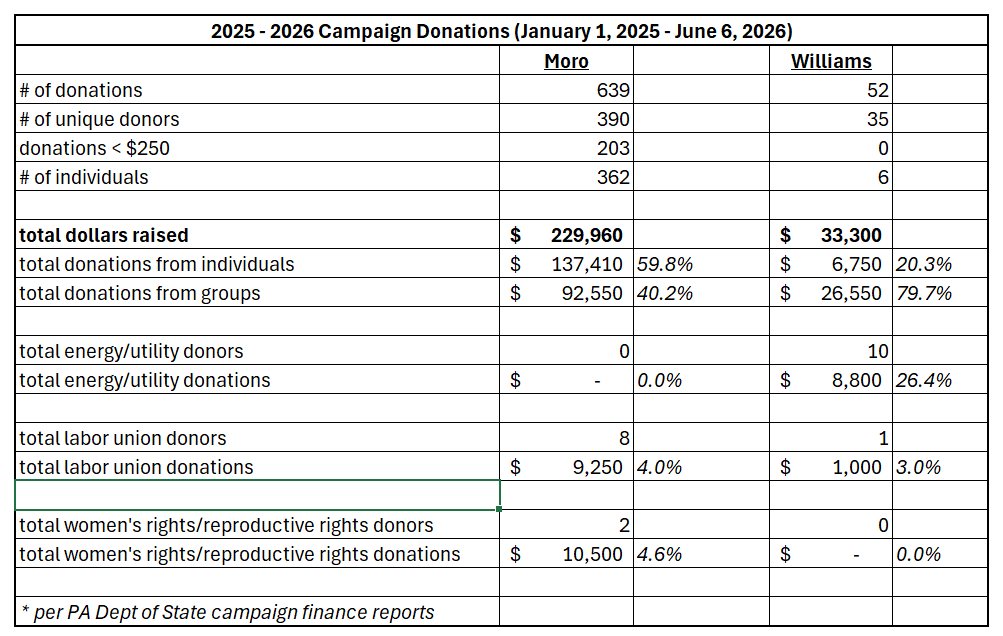
The rest of the donations offer better clues about prospective representation and real priorities. I’ve summarized some relevant details from the report analysis below. The stark comparisons between these two bodies of contributions pose a lot of questions.
Individual donations
The most glaring difference, in my opinion, between the two campaigns is the number of individual donors supporting each candidate. Elizabeth has 362 individual donors compared to only 6 for Craig; she has 20 times as many individual donors as he does. Individuals represent $137,410 (60%) of Moro’s total donations, compared to $6,750 (20%) for Williams.
Individual donations to Craig Williams
Williams’ lack of individual donations begs some obvious questions.
- Why does Craig have so few individual donations?
- Why not a single donation under $250?
- Has he not been hosting fundraising events with his constituents?
- Do local individuals not support his campaign?
- Is he not out in the community connecting with everyday voters enough?
As you may have guessed, I don’t keep track of his calendar, so I have little idea where he is and when. Only Big Tech and Flock cameras surveil those intimate details. 👀
His public messaging in newsletters and on social media offers a few insights into attendance at periodic public events, but little detail about a more robust grassroots campaign. If his campaign contribution reports are any indication, he doesn’t seem to prioritize individual support or grassroots efforts.
Individual donations to Elizabeth Moro
Not much surprised me about Moro’s list. I expect candidates to have a healthy number of individual donations, even if they’re smaller than PAC and political group donations.
I don’t book Elizabeth’s calendar or have access to her Google Maps history either, so I don’t know exactly what she’s up to on the campaign trail. Her email newsletters and social media messaging show a wider variety of events where she mixes and mingles with constituents, sometimes fundraising and other times serving as a community representative.
Her Mondays with Moro events, where you can stop by Hank’s to have a cup of coffee with her from 8 – 9 am, are the clearest example of her willingness to welcome anyone to the table to share feedback, critique, support, or frustration. The number of unique, individual donors suggests she’s drawn a much larger grassroots wave of support.
Corporate and special interest donations
For Craig, energy-adjacent companies represent 10 of the 35 unique donors during the reviewed period and are the primary special interests paying the bills. They account for 26% of his funding. If he’s working 9:00 to 5:00 for the money, he’s working for them, not for us. When more than a quarter of funding comes from one industry, it’s pretty clear who’s in charge.
For Elizabeth, special interest groups include organizations that advocate for topics like women’s and reproductive rights (4.6%), as well as labor unions (4.0%). Neither group has a stronghold on influence relative to other donors, and they pale in comparison to grassroots individual donations.
I’m not particularly surprised by either summary. Worth noting, Elizabeth’s campaign materials are transparent about the priorities mentioned above. She explicitly calls out these priorities in her messaging so voters know where she stands.
Craig’s campaign materials aren’t forthcoming about his connection to fossil fuels (though his voting record and latest data center bill proposal make it clear he’s a very good friend of the industry).
Bankrolled by data center money?
Now that we’ve covered the big picture, we need to debunk some bunk our buddy Craig Williams is spewing about Moro. In a recent ad (I’ve seen it on TV and in mailers), Williams claims that Moro is “bankrolled by data center money.” He cites the “PA Dept of State” as the information source, which I presume refers to the campaign finance reports. Great! We can fact-check for ourselves. Power to the people. 💪🏻
Guess how many specific “data center” advocates are on the reports I reviewed for both candidates. Zero. None. Nada.
Let’s zoom out a bit. Who benefits from data centers?
Moro has 6 donations from 5 trade unions totaling $7,000, out of just under $230,000 raised during that period. This represents 3% of total campaign contributions from organizations that 1) may or may not benefit from data center construction (depending on who gets the work) and 2) typically support Democratic candidates. No other donations tangentially align with data center development.
For Williams, more than 26% of total campaign contributions come from fossil fuel/energy organizations. These entities will absolutely benefit from energy-hungry data center development, since the market drives up prices for everyone in the industry, and they are all connected to the same grid that powers the beasts.
👉🏻 Who’s bankrolled by data center money? If it’s anyone, it’s Craig. The man apparently needs a mirror. 🪞
I’m happy to play fair. I haven’t seen any untrue campaign finance claims by Moro about Williams. In fact, her materials focus primarily on actual votes he has taken on the House floor. Actions speak louder than words, and these are black-and-white facts to check. We can decide for ourselves whether those votes served our community.
But if you’ve seen some campaign materials you think deserve a debunking review, leave a comment. We can look into it together.
More than money
Of course, money isn’t the only indication of how an elected official will serve us. It might tell us a lot, but it won’t tell us everything.
Voting matters a lot
How an elected official votes offers clear indications of how they represent us, and how those votes align with their messaging tells us a lot about integrity. There’s much to be gleaned from Williams’ voting record, which we’ll dive into another time. Unfortunately, challengers who haven’t served before don’t have voting records to review.
How candidates spend their time & interact with constituents
Both candidates have calendars full of commitments that show us how they show up in the community. This offers real insight into how they will likely show up for constituents as an elected official.
🤡 I don’t suspect either Moro or Williams will pull a “John Fetterman.” His not-so-sneaky switcheroo, or whatever we’re calling it, is an anomaly. 😬 Whether you support him or not, his costume change from the candidate he ran as to how he presents now is really something. I digress…
Williams in the wild
Williams is mostly a pop-in/pop-out kind of guy. He typically brings his professional photographer to events so they can snap a quick pic to prove he was present. He hosts a few topic-specific events where he comes with a presentation agenda and occasionally stands behind a table at larger community events. I’ve seen a couple of tele-town halls (which are a cop-out in my opinion, because it’s too easy to ignore the critics and make it a big ol’ fest of friendly “fire”).
He’s also very proud of all of his accomplishments. Like. Really proud. Like… “polish all the trophies” and “maybe borrow a couple trophies from others” proud.
A quick peek at his newsletters and his social media content reminds us of all of his House floor speeches that led to policies passing. I’m sure it was his speech that got everything across the finish line and not work from staffers, collaboration amongst Congress folks, and passionate constituents showing up to do the work. No collective effort to see here, friends. 😉 I long for the day when the humble word “we” scores some cameos in his communications.
Ask your neighbors trying to talk to him about policy or political issues, and they’ll tell you he’s hard to pin down. Even constituents from his own party struggle to steal a few minutes from his super-deduper busy schedule.
Back in 2025, I drove all the way to Harrisburg as a representative for Conservation Voters of Pennsylvania. We tried to get a quick 15-minute meeting with him or one of his legislative aides (with plenty of advance notice). No dice.
More recently, his social media team blocked me from tagging his official Instagram account because I criticized his rooftop solar policy positions. (I saved everything in my Instagram Highlights, so check the receipts if you want to confirm that I wasn’t being personally disparaging or offensive. That would just make me look bad.)
If he can’t take the heat from his own constituents around critique of his policies and stand up for his work, maybe he shouldn’t be in the kitchen.
❄️ Is it the kitchen where all the snowflakes melt? ❄️
Moro out and about
Meanwhile, Elizabeth is out and about in heels. She and her team have knocked on tens of thousands of doors so far this campaign season to hear from voters. She’s often at social events to meet with neighbors.
Most notably, Moro buys coffee almost every Monday for anyone who wants to join her at Hank’s. She invites neighbors to share their thoughts with her and drink coffee on her dime. You could light her up in public while she pays a competing cafe for your coffee.
Elizabeth enriches a competing cafe’s coffers with recurring coffee purchases while Craig empties his campaign coffers, accusing Elizabeth of enriching herself with campaign donations.
What’s that all about? Self-enrichment? I’m so glad you asked.
🥖 Sandwichgate Storytime!
On March 24, 2024, Moro used $383 in campaign funds to buy sandwiches from her Centreville Place: Cafe + Market for her campaign kickoff event. She included the single receipt for the purchase in her campaign finance reports.
I asked Elizabeth about this. Remember… she shows up out in the wild, so you can ask her tough questions, and she doesn’t melt. ❄️
Elizabeth said she was proud of the food she made at her cafe and wanted to share it with others. She could have purchased the sandwiches from another vendor. She also could have donated the sandwiches to the event, but she’s also running a small business on tight margins. At $383 for event food and drinks used for legitimate purposes, Sandwichgate doesn’t seem like the corruption scandal Craig wants you to believe it is.
Notice the timing of the ham-and-brie-on-baguettes transaction. 🥖 This sandwich purchase happened at the beginning of the campaign in the previous 2024 election cycle. He has so little genuine critique of her character or her policy positions that he has to dig back to a previous election cycle to find fodder for a supposed mustard-and-mayo mess.
💰 If we’re going back to previous campaign cycles…
I wonder what Craig did with the $15,000 hush-money campaign contribution he took from the brother of The Shoppes at Concord developer back in 2022. He sat on that check for three years before he spoke up about the project and became “totally opposed” to it in 2025, only when the community pulled out their pitchforks.
I wonder if any of that five-figure check went toward buying sandwiches for a lunch event? White, wheat, or rye? Maybe a wrap? 🤔 Just curious…
Back to that data center bankrolling accusation?
We debunked the nonsense around the dollars and cents of data center bankrolling campaigns.
But friends, that phony baloney about Moro being in bed with Big Tech doesn’t even make common sense either. Moro spent months of her personal life and plenty of her own money fighting to protect Crebilly Farms from development, including co-founding Neighbors for Crebilly.
Side note: Craig was not on the front lines with her fighting for Crebilly, even if he claims he helped save it and can dig up a picture where he photobombed a snap of an advocacy group. I’ve asked several people involved in the conservation effort whether Craig was involved, and I still haven’t found anyone who knows what he did. I’ll get back to you on that, but it’s safe to say he wasn’t doing any heavy lifting.
Moro cared about conservation before it was a campaign issue. She’s a real estate broker, for crying out loud; she could have taken some cushy commissions on the sale of houses in the development that would have replaced Crebilly Farms. Instead, she fought the commercial development.
Moreover, Conservation Voters of PA and the Sierra Club have endorsed her, and Climate Cabinet has supported her. These groups are not loosy-goosey handing out endorsements to people pushing for unfettered data center development.
If anyone is secretly rooting for data centers, it’s Go Go Gas Craig. He says he’s holding them accountable, and there’s a teeny weeny kernel of truth to that. His PA Ratepayer Protection Act includes clauses that require data centers to pay their own way for energy and infrastructure.
But it also requires that all PA data center energy come from new “baseload” power built in Pennsylvania. That’s effectively code for natural gas, and it’s a BFD. He’s putting fossil fuel interests before energy affordability. Full stop.
Ya know what’s funny-not-funny? Every time he yaps about his bill being “the only one” (it’s not) and “the only path” (it’s definitely not) to holding data centers accountable, he forgets to mention this dirty-fuel “baseload” caveat. Weird. 🤔
His proposed bill shuts out a litany of faster and more affordable solutions to power data centers (way more on that here). Why are we limiting our options to produce more power in THIS energy market?
💰 Oh yeah. 26% of his campaign donations come from fossil fuel companies. Duh! Silly me. 🤦🏼♀️ His bill should really be called the PA Fossil Fuels 🔥 Protection Act, but it’s not my job to name these things.
I can’t stress enough how big a deal the energy-source clause is. His bill doesn’t even align with US Department of Energy best practices. THIS federal administration (the one paying over $4 billion in our tax dollars to cancel new clean energy generation projects) is more open to non-fossil-fuel data center energy sources than Go Go Gas Craig. Did you even think that was possible?!
While “holding data centers accountable,” he voted against a data center accountability bill, House Bill 1834, on March 24, 2026. The “make them pay their own way” requirements were similar to Williams’ proposed bill. But, and this is a big “but,” HB 1834 favored clean energy instead of cutting it out. The bill left all energy options on the table AND included enforcement mechanisms to make sure data centers actually followed the rules. That was a no-go for Go Go Gas.
👉🏻 tl; dr: Williams is accusing Moro of being bankrolled by data centers while he’s heavily bankrolled by the energy companies that will profit handsomely from data center buildout. Meanwhile, he votes against a bill that would hold data centers accountable because the bill didn’t protect his favorite fossil fuel donors from the wrath of cheaper, faster, less polluting alternatives. Cool cool. Got it.
Did I mention that Williams’ bill actually calls for utilities to expedite energy development for data centers? I think in all his promotion of his bill, he forgot to tell you that part too. He seems very forgetful. But now you know! 😉
What about endorsements?
Various groups endorse political candidates. Sometimes those endorsements come with money, and sometimes they don’t. But they offer another real clue about the priorities our representatives will carry to Harrisburg.
Elizabeth shares her endorsements
As I mentioned above, Moro has been endorsed by a variety of organizations, including environmental, women’s and reproductive rights, trade unions, gun safety, and more. You can find the full list on her website.
Craig hides his endorsements?
Williams does not disclose who has endorsed him on his website. Surely someone has endorsed him (and if not, that would be embarrassing). Ooof. 😬 Does he not want us to know who has endorsed him? Why would he not share that information with voters? Does he just not care enough to tell us? I’ll let you decide.
Want to know more about their positions?
Moro shares summaries of her positions on her website. You can also learn more about where she stands from this non-partisan candidate comparison from WHYY.
Craig doesn’t disclose his stance on prominent issues on his website. He also did not respond to multiple requests for comment from WHYY, much like he doesn’t reliably respond to constituents. Does he even want to win?
This is incredibly lazy and complacent, and those certainly are not qualities I’m looking for in a representative. Can he not be bothered? Does he not want us to know? Is it too much to ask for voters to want to know where he stands? In my opinion, it’s disrespectful to voters that he’s not even trying to pretend that it matters to us.
What do you think?
Campaign messaging can be messy. It needs to be succinct yet powerful. Rage bait baits voters. But with a little help from friends, we can root out the truth from the trash. Reviewing the cash and endorsements behind politicians provides real insight into their anticipated advocacy and work in Harrisburg.
It’s clear where I stand on this race. I’m not going to pretend I’m some unbiased onlooker. I strongly prefer Elizabeth Moro’s policy platform, especially on women’s issues, conservation, and clean energy. I believe she’s shown more integrity in her campaign messaging thus far. She’s working way harder to earn our vote!! And bonus: she has the b*lls not to block me on social media when she doesn’t like my policy pushback.
What do you think? Did I miss something? Let me know in the comments. We all have blind spots, and I’m committed to engaging in dialogue with good-faith critique. We should all have access to the truth so we can cast our ballots with confidence and integrity.
🗳️ Be sure to check your voter registration and register here (if not done already) by October 19, 2026. Election Day is November 3!